
Silver or Gold? Their Investment Profiles Compared


Silver and gold have served as stores of value for thousands of years, but as modern investments they behave quite differently from each other.
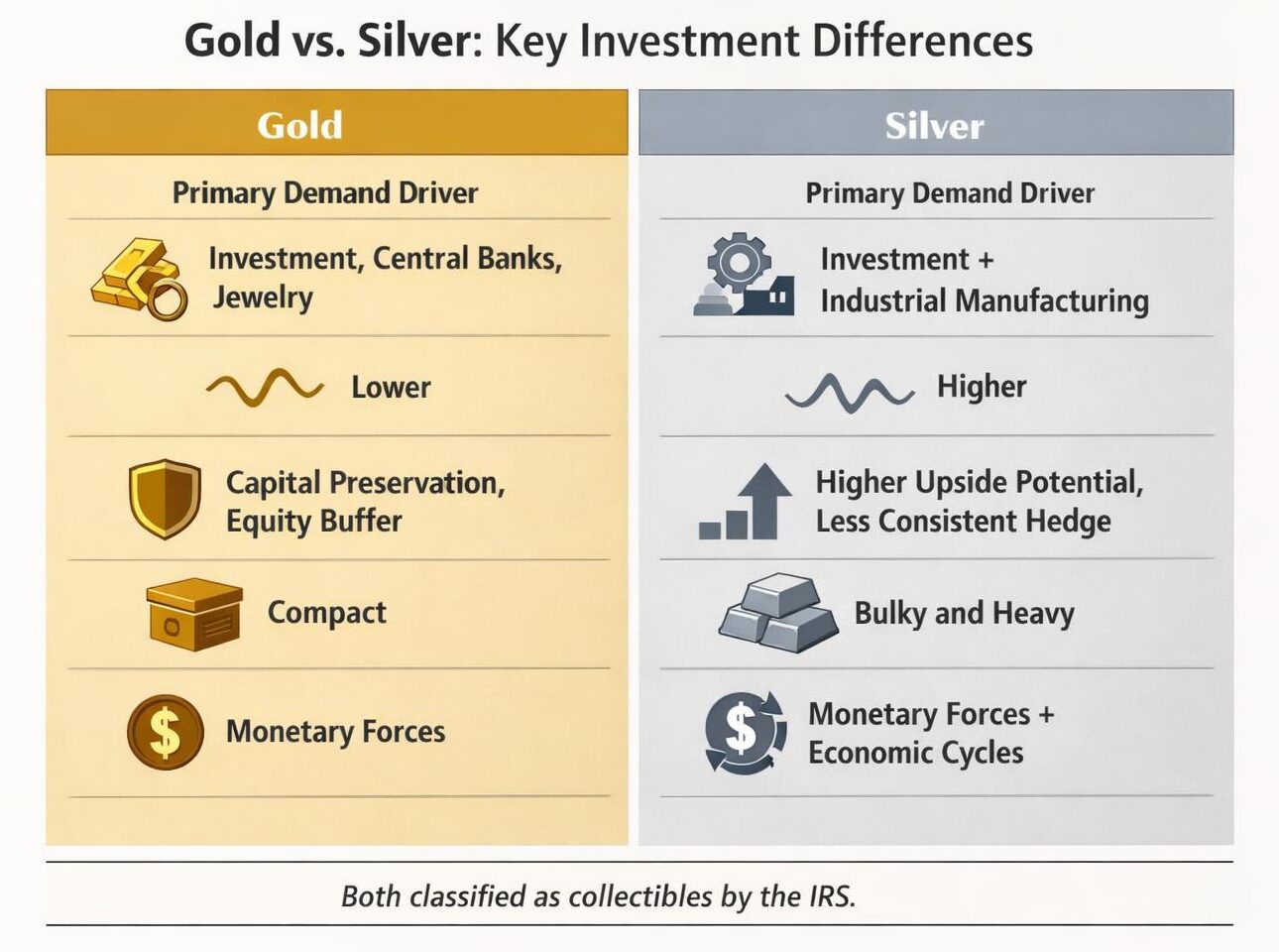
Gold and silver can both diversify a portfolio, but they serve different purposes. Gold generally offers lower volatility and a more established role as a store of value during market stress, while silver tends to experience larger price swings because its value is influenced by both investment demand and broad industrial uses such as solar panels, electronics, and electric vehicles.
What Makes Gold and Silver Different as Assets
Investors drawn to precious metals often treat gold and silver as interchangeable, assuming one is simply a cheaper version of the other. In practice, their price drivers, volatility profiles, industrial demand patterns, and roles in a portfolio are distinct enough that choosing between them involves real trade-offs worth understanding before committing capital.
Gold is primarily a monetary metal. The majority of demand for gold comes from investment, central bank reserves, and jewelry. Its industrial uses are relatively limited, which means its price is driven largely by sentiment, inflation expectations, currency movements, and investor behavior. When markets turn uncertain, gold often attracts buyers seeking a safe haven, which gives it a reputation for relative stability compared to stocks and other risk assets.
Silver is both a monetary metal and an industrial one. A significant portion of annual silver demand comes from manufacturing and various industrial processes where it is widely used. This dual role means silver responds to two separate sets of market forces simultaneously. It can rise during periods of economic growth when industrial activity is strong, and it can also rise during inflationary periods when investors seek hard assets. The flip side is that it can fall sharply during economic slowdowns when industrial demand weakens, even if broader uncertainty might otherwise support precious metals.
Price and Volatility
Silver is considerably more volatile than gold. Its price swings tend to be wider and faster in both directions. During bull markets for precious metals, silver has historically outperformed gold on a percentage basis. During downturns, it has also fallen harder and faster. Investors sometimes describe silver as a leveraged play on gold, meaning it tends to amplify whatever direction gold is moving.
One way analysts track the relationship between the two is through the gold-to-silver ratio, which measures how many ounces of silver it takes to buy one ounce of gold. When this ratio is high, silver is relatively cheap compared to gold on a historical basis. When it is low, silver is relatively expensive. Some investors use this ratio as a guide when deciding which metal to favor, though like any ratio it is descriptive rather than predictive, and the range has varied considerably over time.
Gold’s price movements tend to be more measured. It is not immune to sharp corrections, but its price metrics are less affected by economic cycles and shifts in industrial supply and demand. For investors whose primary goal is capital preservation during turbulent periods, gold’s lower volatility can be meaningful.
Storage, Liquidity, and Practical Costs
Source: Mooloo graphics
Physical ownership of silver introduces practical differences that affect real costs. Because silver is much cheaper per ounce than gold, holding a meaningful dollar amount requires significantly more physical space. An investor holding a given sum in gold might have a small stack of coins, while the same amount in silver would be considerably heavier and bulkier, requiring more serious storage planning. Secure storage facilities typically charge fees based on the value of holdings, though the physical volume difference still matters for home storage or smaller vault arrangements.
Both metals are highly liquid in the sense that buyers exist around the world, but gold tends to trade with tighter bid-ask spreads, particularly for large transactions. Silver can have slightly wider spreads, especially for physical coins and bars purchased from dealers. These spreads represent a real cost that affects returns, particularly for investors who buy and sell frequently.
Both metals are available in several forms beyond physical ownership, including exchange-traded funds that track spot prices, futures contracts, and shares in mining companies. Each of these approaches has its own cost structure, tax treatment, and risk profile. Physical ownership carries storage and insurance costs. ETFs charge annual management fees and do not give investors direct ownership of the underlying metal. Mining stocks introduce company-specific risk but offer the potential for dividends and operating leverage to metal prices.
Tax Treatment
Physical precious metals, including gold and silver, are classified as collectibles by the IRS. This classification matters because long-term capital gains on collectibles are subject to a higher maximum rate than long-term gains on most stocks and bonds. This collectibles rate can also apply when metal is held through certain ETFs that hold physical metal directly. Tax rules in this area can be complex, and the treatment may differ depending on whether gains are short-term or long-term, the type of investment vehicle used, and the investor’s overall tax situation. Consulting a tax professional before making significant decisions based on tax assumptions is worthwhile, as rules can change.
Portfolio Role and Correlation
Gold has a well-documented history of low or negative correlation with equities during periods of market stress. This behavior is part of why institutional and individual investors include it in diversified portfolios. It does not always rise when stocks fall, and it is not a perfect hedge, but its track record as a buffer during equity downturns is more established than silver’s.
Silver’s correlation with equities is less consistent. Because of its industrial demand component, it sometimes moves in the same direction as economically sensitive assets rather than serving as a counterbalance. Investors seeking to reduce portfolio volatility through a precious metals allocation may find that gold serves this purpose more reliably than silver.
That said, some investors include both metals, treating gold as the stability component and silver as the higher-risk, higher-potential-reward component. This approach accepts silver’s volatility in exchange for greater upside exposure during precious metals rallies.
Factors That Drive Each Metal’s Price
Understanding what moves these prices helps investors think about when each metal might perform well or poorly.
- Gold tends to rise when real interest rates are low or negative, when inflation expectations increase, when the US dollar weakens, when geopolitical uncertainty spikes, or when central banks increase their gold reserves.
- Silver responds to the same monetary forces as gold, but also to industrial trends such as growth in solar energy installation, semiconductor manufacturing demand, and electric vehicle adoption.
- Supply disruptions in major mining regions can affect both metals, though the geographic concentration of silver mining means supply can be sensitive to conditions in a relatively small number of countries.
- Investor sentiment and speculative positioning in futures markets can drive short-term price swings in silver more than in gold, due to silver’s smaller overall market size.
Which Situations Each Metal May Suit
Neither metal is universally better. The more useful question is which characteristics align with a particular investor’s goals and tolerance for price swings.
- Investors prioritizing capital preservation and lower volatility tend to find gold a more straightforward fit.
- Investors comfortable with wider price swings who want exposure to both monetary and industrial demand trends may find silver appealing.
- Budget-conscious investors sometimes prefer silver because the lower price per ounce allows for smaller initial purchases, though storage and handling considerations grow as positions increase.
- Investors interested in clean energy sector growth may view silver’s expanding role in solar manufacturing as a relevant long-term consideration, keeping in mind that industrial demand can be disrupted by technology changes or material substitution over time.
Common Misconceptions Worth Addressing
One persistent idea is that silver is undervalued simply because the gold-to-silver ratio is historically elevated. While the ratio can be an interesting data point, it does not carry predictive power on its own. The ratio has remained at elevated levels for extended periods without reverting, and structural changes in supply and demand can shift what a typical ratio looks like over time.
Another misconception is that physical metals are risk-free. Both gold and silver can lose significant value over extended periods in real terms, particularly when interest rates are high and other assets are producing strong returns. Precious metals pay no income, so their total return consists entirely of price appreciation, which is not guaranteed.
A related point worth understanding is that holding a precious metal through an ETF is a different experience from holding physical metal. ETFs offer convenience and generally lower transaction costs, but they do not provide the same direct ownership as holding coins or bars. Investors drawn to precious metals for reasons related to financial system risk should consider whether ETF ownership aligns with their actual goals.