
When Should You Claim Social Security Benefits?


The age at which you claim Social Security benefits is one of the most consequential retirement decisions you will make, and there is no single right answer that applies to everyone.
Social Security gives eligible workers a range of ages to begin collecting retirement benefits, and the monthly amount you receive depends heavily on when you start. Claiming earlier means smaller monthly checks for a longer period. Claiming later means larger monthly checks for a shorter period. Understanding how this trade-off works, and what factors influence the decision, helps you think through the choice more clearly before the time comes.
How Social Security Retirement Benefits Work
Social Security retirement benefits are based on your earnings history. The Social Security Administration calculates your benefit using your highest 35 years of earnings, adjusted for wage inflation. This produces a figure called your Primary Insurance Amount, which is the monthly benefit you would receive if you claimed at exactly your full retirement age.
Your full retirement age depends on when you were born. For people born in 1960 or later, full retirement age is 67. For those born between 1943 and 1954, it is 66. There are gradual steps in between for birth years that fall between those ranges. These figures are set by law and have changed before, so it is worth confirming your specific full retirement age through the Social Security Administration’s website or your personal Social Security statement.
The Claiming Window: Ages 62 to 70
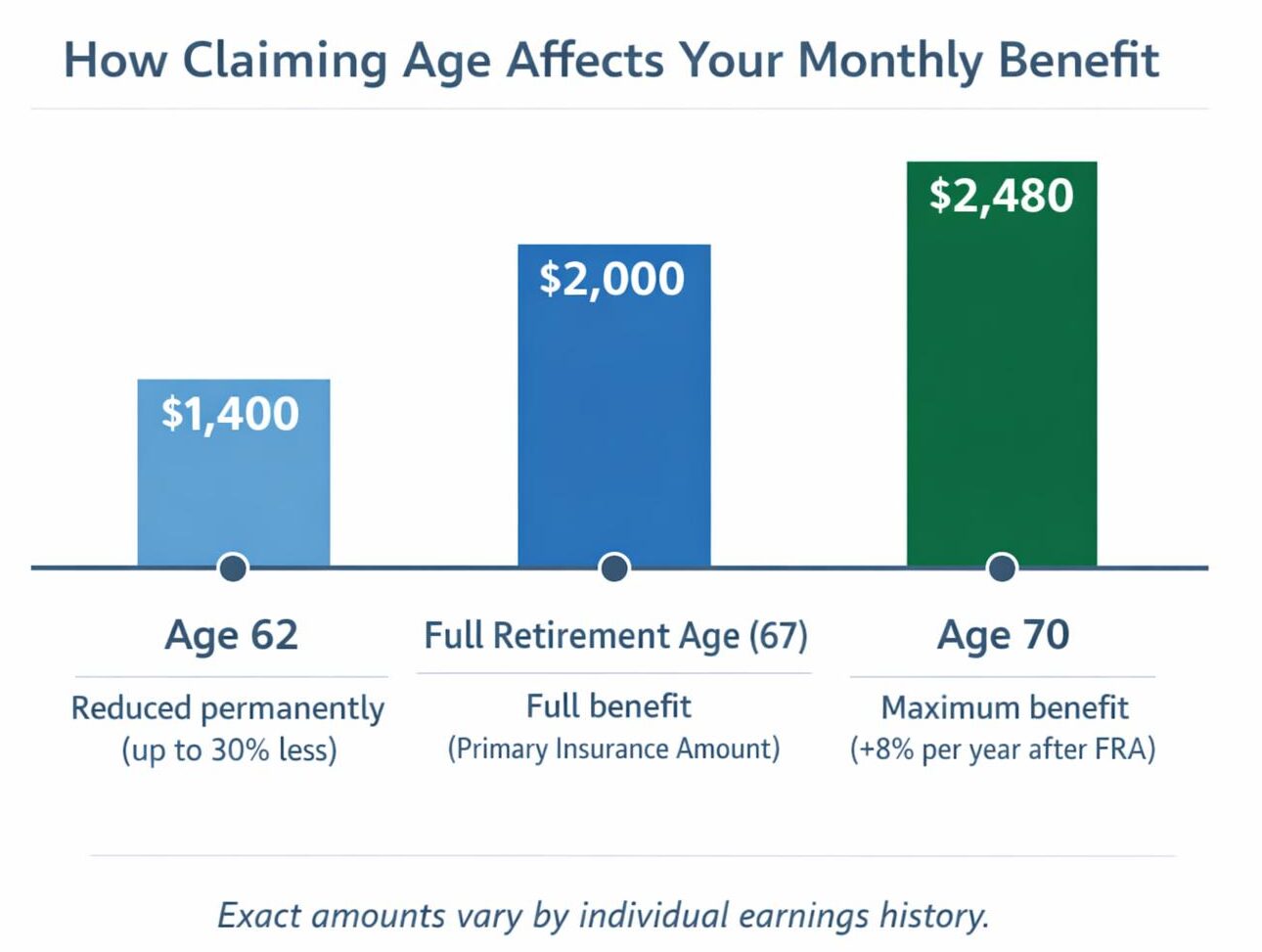
You can begin claiming Social Security retirement benefits as early as age 62, but your monthly benefit will be permanently reduced compared to what you would receive at full retirement age. The reduction varies depending on how many months early you claim and your full retirement age. Claiming at 62 when your full retirement age is 67 can reduce your monthly benefit by as much as 30 percent.
On the other side, if you delay claiming past your full retirement age, your benefit grows by 8 percent for each additional year you wait, up to age 70. After age 70, there is no further increase, so there is generally no financial benefit to waiting beyond that point.
To put this in practical terms: if your full retirement age benefit would be $2,000 per month, claiming at 62 could reduce it to around $1,400 per month, while waiting until 70 could increase it to roughly $2,480 per month. These figures are illustrative and your actual benefit will depend on your birth year, earnings record, and specific circumstances, but the directional relationship holds broadly across most cases.
The Break-Even Concept
Source: Mooloo graphics
A common way to think about claiming age is through the concept of a break-even point. If you claim early, you receive smaller payments but start collecting sooner. If you claim late, you receive larger payments but forgo income during the years you waited. At some point, the total amount received under both strategies equalizes. That point is the break-even age.
For most people, the break-even point between claiming at 62 versus 67 falls somewhere in the late 70s. Between claiming at 67 versus 70, the break-even typically occurs in the early 80s. If you live past that break-even age, delaying was financially advantageous in terms of total lifetime benefits. If you do not live that long, claiming earlier produced more total income.
The challenge is that no one knows their exact lifespan. This is why the break-even framework is useful for framing the decision but cannot by itself produce a definitive answer.
Factors That Influence the Decision
Several considerations shape how people think about their claiming age. None of them automatically determines the right choice, but each one is worth examining carefully.
- Health and life expectancy: People in good health with a family history of longevity often benefit more from delaying, since they are more likely to collect larger payments for many years. Someone with significant health concerns may find earlier claiming more practical.
- Need for income: If you need income at 62 because you have stopped working and have limited savings, claiming early may be a financial necessity rather than a strategic choice.
- Other retirement income sources: If you have substantial savings, a pension, or other reliable income, you may be able to delay Social Security without financial strain, allowing your benefit to grow.
- Spousal benefits: Married couples have additional complexity to consider. A surviving spouse can claim based on the deceased spouse’s record, so the higher earner delaying can increase the survivor’s benefit for potentially many years.
- Working while collecting: If you claim before full retirement age and continue to work, your benefit may be temporarily reduced if your earnings exceed the annual earnings limit set by the SSA. After full retirement age, there is no earnings test and no reduction applies regardless of how much you earn.
- Tax considerations: Depending on your total income in retirement, a portion of your Social Security benefits may be subject to federal income tax. This is not avoided by claiming at a different age, but it is a factor worth considering in overall retirement income planning.
Spousal and Survivor Benefits
For married couples, the decision about when to claim is not made in isolation. Each spouse has their own claiming decision, and the two interact in important ways.
A spouse who did not work, or who had much lower earnings, may be able to claim a benefit based on the other spouse’s record. This spousal benefit can be worth up to 50 percent of the higher earner’s Primary Insurance Amount, depending on when the claiming spouse files.
Survivor benefits are separate and potentially larger. If one spouse dies, the surviving spouse may be eligible to receive up to 100 percent of what the deceased spouse was receiving, provided certain conditions are met, including waiting until their own full retirement age to claim the survivor benefit. This means the higher earner’s decision to delay has a direct long-term impact on the surviving spouse’s financial security.
These interactions make it worthwhile for couples to model different scenarios together rather than treating each person’s claiming decision as independent.
Claiming Early Is Not Always a Mistake
There is sometimes an assumption that delaying Social Security is always the smarter financial move. That view is too simple. Claiming early makes sense for a range of people, including those with serious health conditions, those who have no other income source, those whose work situation ends involuntarily in their early 60s, and those who simply prefer guaranteed income sooner rather than a larger amount later.
The 8 percent annual increase for delaying past full retirement age is often cited as a strong guaranteed return. It is predictable and backed by the federal government, but it only materializes fully if you live long enough to collect the larger payments for enough years to outweigh what you gave up by waiting.
Using the SSA’s Own Tools
The Social Security Administration provides several resources to help people understand their projected benefits. Creating a free account at ssa.gov gives you access to your personal Social Security statement, which shows your estimated benefit at different claiming ages based on your actual earnings record. This is more reliable than any general rule of thumb, because it reflects your specific work history.
The SSA also provides a retirement estimator and educational materials that explain how different claiming ages affect your monthly benefit. Using these tools with your actual numbers produces a clearer picture than working from general examples alone. Because benefit calculations depend on your earnings record and can be affected by future policy changes, reviewing your statement periodically is a useful habit.
What the Decision Ultimately Comes Down To
Deciding when to claim Social Security involves weighing a guaranteed monthly increase against the cost of waiting, in the context of your health, income needs, other assets, and family situation. It is partly a financial calculation and partly a judgment call about factors that cannot be known with certainty.
Working through the break-even math, understanding how spousal and survivor benefits interact, and reviewing your personal Social Security statement are all practical starting points. For people with more complex situations, including those with pensions, significant assets, or other retirement income sources, working through the numbers with a qualified financial planner who specializes in retirement income can add meaningful clarity before a decision that, once made, is largely permanent.