ETF Fees Explained for Beginners


When you invest in an ETF, you are not just buying a basket of stocks or bonds — you are also agreeing to pay ongoing fees that quietly reduce your returns over time.
For most investors, these fees are small enough that they barely register as a concern day to day. But because they compound over years and decades, even a seemingly minor difference in fee levels can have a noticeable effect on your final balance. Understanding how ETF fees work, what they cover, and how to compare them is a practical skill that can improve long-term investment outcomes.
What Is an Expense Ratio?
The primary fee associated with ETFs is called the expense ratio. This is an annual fee expressed as a percentage of your investment, and it covers the costs of running the fund. Those costs typically include portfolio management, fund administration, legal and compliance expenses, and marketing.
The expense ratio is not billed to you separately. Instead, it is deducted from the fund’s assets on an ongoing basis, which means the returns reported for any ETF already reflect this cost. For example, an ETF with a 0.10% expense ratio would deduct $1.00 per year for every $1,000 invested. That may sound trivial, but at higher investment amounts and over longer time horizons, the cumulative drag becomes more meaningful.
Expense ratios vary significantly depending on what kind of ETF you are buying. Broad market index ETFs, which track indexes like the S&P 500 or the total US stock market, tend to have very low expense ratios. Actively managed ETFs, where a portfolio manager makes ongoing decisions about which securities to hold, typically charge more because of the additional labor and research involved. Specialty ETFs focusing on narrow sectors, commodities, or alternative strategies often carry higher fees as well.
How Expense Ratios Affect Your Returns Over Time
The compounding effect of fees works in the opposite direction from the compounding effect of returns. When your investment grows, you earn returns on previous returns. When you pay fees, you lose not just the fee amount itself but all the future growth that money would have generated.
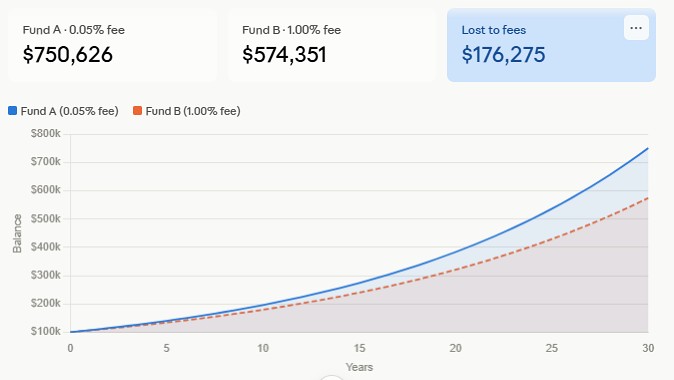
Consider two hypothetical investors, each starting with $100,000. They inject no additional funds during their investment and earn an average gross return before fees of 7% per year over 30 years. One invests in a fund with a 0.05% expense ratio, the other in a fund with a 1.00% expense ratio. Over three decades, the difference in ending balances is nothing short of remarkable.
Results
Fund A (0.05% fee, 6.95% net return):
$100,000 × (1.0695)^30 ≈ $100,000 × 7.5063 = $750,626
Fund B (1.00% fee, 6.00% net return):
$100,000 × (1.06)^30 ≈ $100,000 × 5.7435 = $574,349
Difference: $750,626 − $574,349 ≈ $176,277
The underlying investments might offer nearly identical market exposure, but the fee difference compounds quietly in the background.
This is why expense ratios receive so much attention in personal finance discussions. They are one of the few investment variables a person can control with certainty — future market returns are unpredictable, but fees are disclosed upfront.
Trading Costs and Bid-Ask Spreads
The expense ratio is not the only cost associated with owning an ETF. Because ETFs trade on stock exchanges throughout the day, buying or selling shares involves a transaction cost called the bid-ask spread.
The bid price is what buyers are willing to pay for shares, and the ask price is what sellers want to receive. The difference between these two numbers is the spread. For heavily traded ETFs that track major indexes, the spread is usually very small. For less liquid ETFs with lower trading volumes, the spread can be wider, which effectively adds a cost every time you buy or sell.
Many major US online brokerages have eliminated commissions on ETF trades, though policies vary and can change. You should verify the current fee structure of any brokerage you use before investing.
Premium and Discount to NAV
Source: Mooloo graphics
ETFs have two different measures of value that are worth understanding. The net asset value, or NAV, represents the per-share value of the fund’s underlying holdings. The market price is what the ETF shares are actually trading for on the exchange at any given moment.
These two numbers are usually very close together for popular ETFs. However, during periods of market stress or for less liquid funds, ETF shares can trade at a premium above NAV or even at a discount below it. Buying at a significant premium means you are paying more than the underlying assets are worth. Selling at a discount means you are receiving less.
For long-term investors using broadly traded ETFs, this difference is typically minimal. It is worth being aware of, however, particularly if you are considering less common funds or placing orders during volatile market conditions.
Actively Managed ETFs Versus Index ETFs
The fee difference between actively managed and index ETFs reflects a genuine difference in how they operate. Index ETFs are designed to replicate the performance of a specific index by holding the same securities in roughly the same proportions. Because the portfolio is rule-based and does not require continuous human judgment, operating costs are low.
Actively managed ETFs employ portfolio managers who research, select, and adjust holdings based on their analysis. This requires more resources, and those costs are passed along to investors through higher expense ratios.
The practical question for investors is whether the higher fee is justified by better performance. Research on actively managed funds has generally found that, over long time periods, a majority of actively managed funds actually underperform comparable index funds once fees are accounted for. This does not mean active management never adds value, but the fee hurdle is real and worth factoring into any comparison. In recent times, similar findings have emerged relating to the effectiveness of AI investment advisors compared to humans.
Where to Find ETF Fee Information
Every ETF is required to disclose its expense ratio in a standardized document called the prospectus, as well as in a shorter summary document sometimes referred to as the summary prospectus or fund fact sheet. These documents are publicly available on the fund company’s website and through the SEC’s EDGAR database.
Most brokerage platforms also display the expense ratio on the ETF’s information page, making it straightforward to compare fees before you invest. When evaluating similar ETFs that track the same or comparable indexes, the expense ratio is often one of the clearest points of differentiation.
Other Fees to Be Aware Of
Beyond the expense ratio and trading costs, a few other fees occasionally apply in specific situations.
- Some ETFs that invest in physical commodities, currencies, or certain alternative assets may have additional structural costs built into their design that go beyond a standard expense ratio.
- Leveraged and inverse ETFs, which are designed to deliver multiples of daily index returns or opposite returns, often carry higher fees and have complex cost structures that can work against long-term holders due to daily rebalancing effects.
- If you use a financial advisor or managed account service that holds ETFs on your behalf, you may also pay an advisory fee on top of the ETF’s own expense ratio.
- Certain brokerage platforms offer proprietary ETFs with no transaction fees but may charge fees for ETFs from other fund families. Reviewing the terms of your specific brokerage helps avoid unexpected costs.
Putting Fees in Context
Low fees are worth pursuing, but they are not the only factor in evaluating an ETF. The quality of the index being tracked, the fund’s size and liquidity, how closely it tracks its benchmark, and whether it aligns with your investment goals are all relevant considerations.
A fund with a slightly higher expense ratio that closely tracks its target index may be preferable to one with a marginally lower ratio that consistently lags its benchmark due to poor execution. Fee comparisons are most meaningful when you are evaluating genuinely similar funds that serve the same purpose.
For most everyday investors building a diversified long-term portfolio, choosing broadly traded ETFs from established fund companies with low expense ratios is a straightforward way to reduce the cost drag on returns without sacrificing quality or diversification.