
Do Gold ETFs Hold Physical Gold?


Gold ETFs are one of the most popular ways to invest in gold without storing physical metal yourself, but whether a specific fund actually holds gold bars in a vault depends entirely on how that fund is structured.
Are gold ETFs really backed by physical gold? The short answer is it depends. Not all gold ETFs work the same way and only some are backed by physical gold held in secure vaults. Others use financial instruments like futures contracts to track the price of gold without owning any metal at all. This is a very important distinction – especially if you’re thinking of gold investing for the piece of mind of owning a physical asset.
Understanding the difference matters because it affects how closely the fund tracks gold prices, what risks you take on, and how gains are taxed. This guide explains how physically backed and futures-based gold ETFs work, what to look for when evaluating them, and the practical trade-offs involved.
What a Physically Backed Gold ETF Actually Does
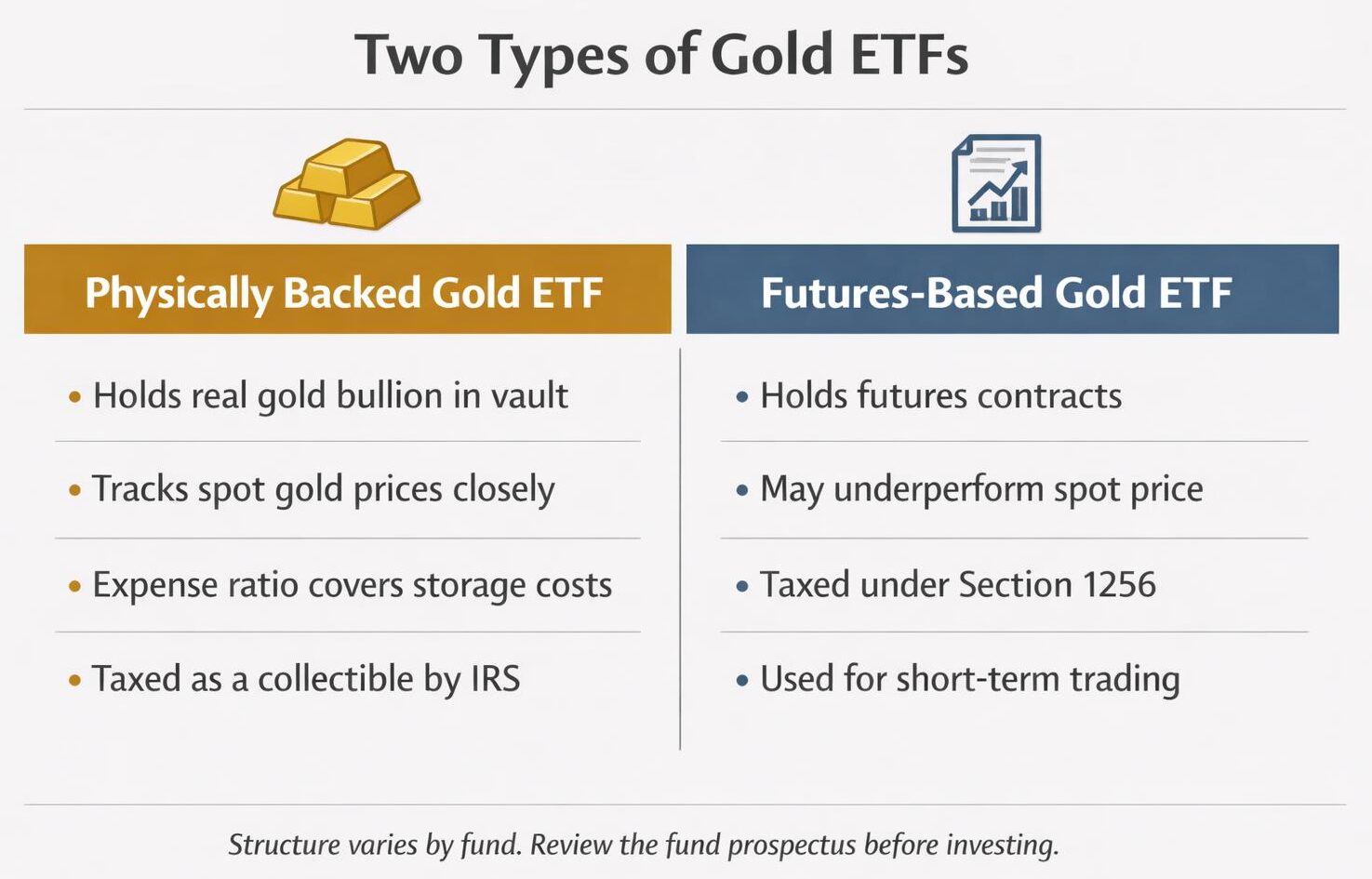
A physically backed gold ETF holds real gold as its underlying asset. When investors buy shares in the fund, the fund manager uses that money to purchase gold bullion, which is then stored in a custodian vault, typically operated by a major bank or specialized precious metals custodian. Each share represents a fractional ownership interest in a specific quantity of gold held by the trust.
For example, if a fund is structured so that each share represents one-tenth of a troy ounce of gold, and you own 100 shares, you have an economic interest equivalent to 10 troy ounces of gold. In most cases you do not have the right to personally claim those bars from the vault, but the gold exists and is held on behalf of shareholders as a group.
Some of the most widely traded gold ETFs in the United States, such as SPDR Gold Shares (GLD) and iShares Gold Trust (IAU), are structured as physically backed trusts. These funds publish regular reports disclosing the amount of gold held, and the gold is audited periodically. Because the fund’s value is tied directly to real metal, physically backed ETFs tend to follow spot gold prices closely.
Verified Physical Gold ETFs
Sorted by tonnes held, descending
| Name | Ticker | Holdings (Tonnes) | Fee |
|---|---|---|---|
| SPDR Gold Shares | GLD | 1,006.7 | 0.40% |
| iShares Gold Trust | IAU | 461.5 | 0.25% |
| SPDR Gold MiniShares Trust | GLDM | 211.4 | 0.10% |
| Sprott Physical Gold Trust | PHYS | 114.2 | 0.35% |
| abrdn Physical Gold Shares ETF | SGOL | 52.0 | 0.17% |
| iShares Gold Trust Micro | IAUM | 49.0 | 0.15% |
| VanEck Merk Gold ETF | OUNZ | 19.5 | 0.40% |
| Goldman Sachs Physical Gold ETF | AAAU | 18.7 | 0.18% |
| GraniteShares Gold Trust | BAR | 10.1 | 0.18% |
Gold ETFs That Use Futures Contracts Instead
Not every gold ETF holds physical gold. Some funds gain exposure to gold prices through futures contracts, which are agreements to buy or sell gold at a set price on a future date. These funds never hold gold in a vault. Instead, they roll futures positions forward on a regular schedule to maintain ongoing exposure to gold prices.
Futures-based gold ETFs introduce a cost known as roll cost, which is closely related to a market condition called contango. When the futures market is in contango, meaning longer-dated contracts are priced higher than near-term ones, rolling from an expiring contract into the next one costs money. Over time, this can cause a futures-based fund to underperform the actual spot price of gold, even when gold prices are rising. The opposite condition, called backwardation, can work in the fund’s favor, but it is less common in gold markets.
For long-term investors focused on gold as a store of value, futures-based ETFs may not track gold prices as reliably as physically backed alternatives. They tend to be used more by traders seeking short-term exposure or by certain institutional strategies.
How to Tell Which Type You Are Buying
Source: Mooloo graphics
The most reliable way to confirm whether a gold ETF holds physical gold is to read the fund’s prospectus or product page. Physically backed funds will explicitly state that they hold gold bullion and will describe their custodian arrangements. Holdings reports will show the quantity of gold held, typically expressed in troy ounces or metric tons.
Key things to look for include:
- A description of the fund as a grantor trust or physically backed product
- Disclosure of the custodian bank or vault operator
- Regular holdings reports showing the actual quantity of metal held
- An expense ratio reflecting the annual cost of storing and managing the physical gold
If the fund description refers to futures contracts, derivatives, or swap agreements rather than vault storage, you are looking at a non-physically backed product. Fund summary pages on financial data sites will often categorize ETFs by structure, which can help narrow things down quickly.
The Role of the Custodian
In a physically backed gold ETF, the custodian is the institution responsible for holding and safeguarding the gold. This is typically a large bank with secure vault facilities. The fund manager and the custodian are separate entities, which provides a layer of protection for investors. From an asset security perspective, even if the fund manager encountered financial difficulties, the gold held in custody would remain an asset of the trust rather than an asset of the manager’s business.
Custody arrangements are disclosed in the fund’s legal documents. Some funds use a primary custodian and permit sub-custodians, meaning the gold may be held across multiple locations or moved between vaults under certain conditions. This is standard industry practice, but understanding how the custodial chain works is worthwhile before investing.
Tax Treatment of Gold ETFs
The tax treatment of gold ETFs in the United States depends on the fund’s structure and how long you hold it. Physically backed gold ETFs structured as grantor trusts are generally treated by the IRS as interests in a collectible. This means long-term capital gains from these funds may be subject to the collectibles tax rate rather than the standard long-term capital gains rate applicable to most equities. The collectibles rate is generally higher, though the exact amount owed depends on your income level and current tax law.
Futures-based gold ETFs structured as partnerships or regulated investment companies may have different tax treatment. Some futures contracts held within these funds may be subject to mark-to-market rules under Section 1256 of the Internal Revenue Code, which applies a blended rate regardless of how long you held the position. Tax rules can change, and the specifics of your situation will vary, so confirming the current treatment with a qualified tax professional before investing is a reasonable step.
Storage Costs and Expense Ratios
Storing physical gold securely is not free, and physically backed gold ETFs pass that cost on to investors through the expense ratio. This is the annual percentage fee deducted from the fund’s assets, which gradually reduces the amount of gold each share represents over time. Expense ratios vary between funds, and even small differences can compound meaningfully over a long investment horizon.
Comparing expense ratios between similar funds is straightforward, but the lowest fee is not automatically the best choice. Liquidity, fund size, custodian quality, and how closely the fund tracks spot gold prices all deserve consideration alongside cost.
Alternatives to Gold ETFs
Investors who want gold exposure have several options beyond ETFs. Each comes with its own trade-offs:
- Physical gold: Buying coins or bars gives you direct ownership but requires secure storage and insurance, which carry their own costs and logistical considerations.
- Gold mining stocks: These provide indirect exposure through companies that produce gold. Mining stocks can amplify gold price movements but also introduce company-specific risks that are unrelated to the price of gold itself.
- Gold mutual funds: These may hold physical gold, mining stocks, or a combination of both. Unlike ETFs, mutual fund shares are typically bought and sold at end-of-day prices rather than trading continuously on an exchange.
- Gold futures: Direct futures trading offers precise exposure but involves leverage, margin requirements, and contract mechanics that make it more suitable for experienced investors.
What Long-Term Investors Tend to Consider
For someone using gold as a long-term portfolio diversifier or a hedge against inflation, the choice between a physically backed ETF and a futures-based product often comes down to tracking accuracy and cost efficiency. Physically backed funds tend to deliver a more straightforward relationship between the fund price and the spot price of gold, without the performance drag that can accumulate from rolling futures contracts in a contango market.
That said, gold is a volatile asset. Its price can fall significantly and remain depressed for extended periods, and unlike stocks or bonds, gold does not generate income. Including gold in a portfolio is a strategic decision that depends on an individual’s overall investment approach, time horizon, and tolerance for price swings. Understanding the structure of the vehicle used to gain that exposure is a useful starting point for making a more informed choice.