
How Does FDIC Insurance Work for Multiple Bank Accounts?


FDIC insurance protects depositors when a bank fails, but understanding exactly how that protection applies across multiple accounts, banks, and ownership types can make a significant difference in how much of your money is actually covered.
The Federal Deposit Insurance Corporation, commonly known as the FDIC, was created in 1933 following a wave of bank failures during the Great Depression. Its core purpose is straightforward: if an FDIC-insured bank closes and cannot repay depositors, the FDIC steps in to cover losses up to specified limits. What surprises many people is that the coverage rules are more nuanced than a simple per-person limit. The way accounts are structured, titled, and spread across institutions all plays a role in determining how much protection a depositor actually has.
The Basic Coverage Limit Explained
The standard FDIC insurance limit is $250,000 per depositor, per insured bank, per ownership category. That phrase is worth reading carefully, because each part of it matters. The coverage is not simply $250,000 per person across all banks. It applies separately at each individual bank, and it also applies separately within different ownership categories at the same bank.
This means a depositor could potentially hold well over $250,000 in FDIC-insured deposits without exceeding coverage limits, depending on how those deposits are arranged. However, the rules that govern this are specific, and it is worth understanding them clearly rather than assuming that spreading money around automatically solves the problem.
FDIC coverage applies to deposit accounts such as checking accounts, savings accounts, money market deposit accounts, and certificates of deposit. It does not cover investment products such as mutual funds, stocks, bonds, or annuities, even if those products are purchased through a bank.
How Ownership Categories Work
The concept of ownership categories is central to understanding FDIC insurance for multiple accounts. The FDIC recognizes several distinct ownership categories, and coverage limits apply separately within each category at the same bank. The most commonly used categories include:
- Single accounts, which are owned by one person with no beneficiaries designated
- Joint accounts, which are owned by two or more people
- Retirement accounts, such as traditional IRAs and Roth IRAs
- Revocable trust accounts, including payable-on-death accounts with named beneficiaries
- Irrevocable trust accounts
- Certain business and government accounts
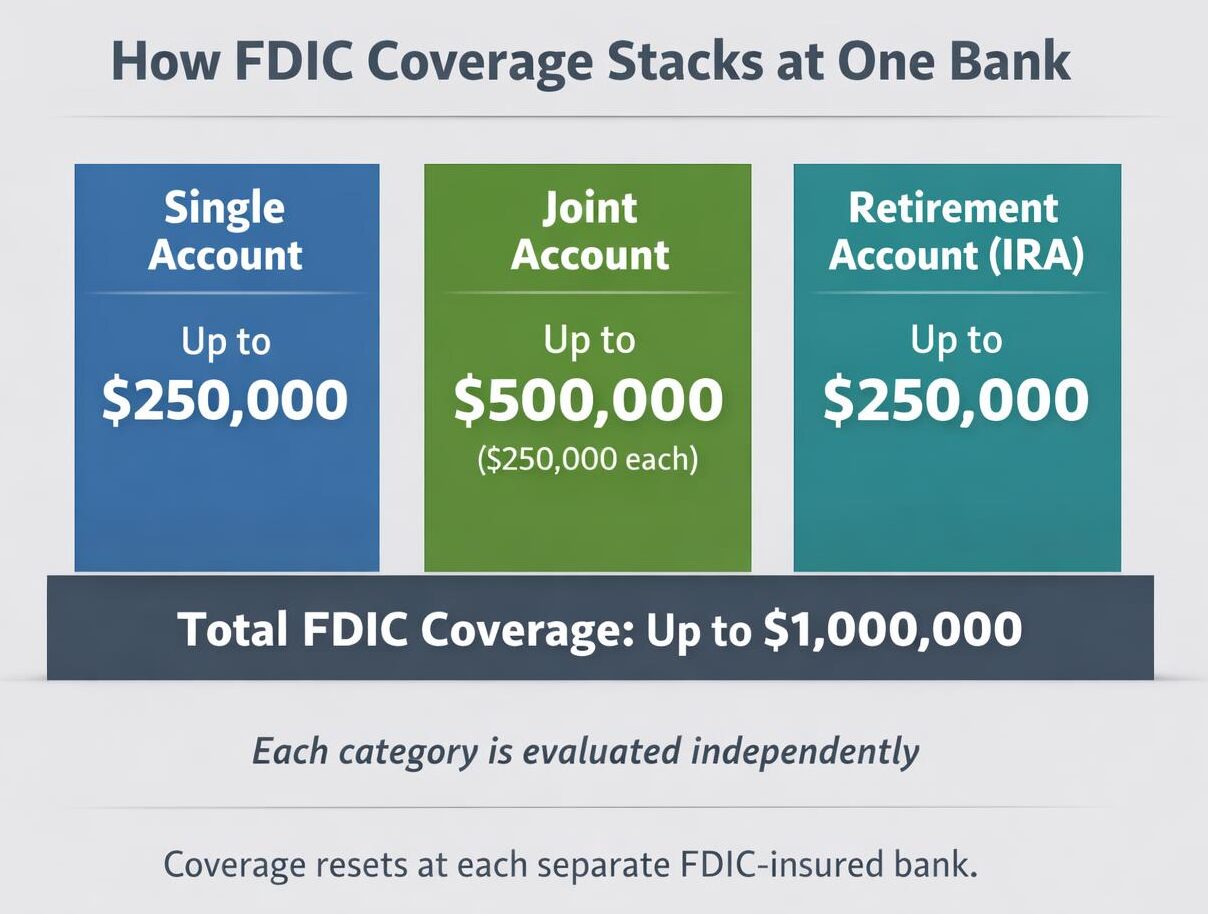
Because these categories are treated separately, a depositor can hold insured deposits in multiple categories at the same bank and receive coverage within each. For example, someone might have a single savings account covered up to $250,000, a joint account with a spouse that carries its own separate coverage, and an IRA covered under the retirement account category. Each of these is evaluated independently.
Single Accounts at the Same Bank
Source: Mooloo graphics
If you hold several individual accounts at the same bank, all under your own name with no co-owners or beneficiaries, the FDIC combines all of those balances and applies a single $250,000 limit to the total. Opening additional accounts at the same bank does not multiply your coverage. Because the accounts are in the same ownership category at the same institution, they share one coverage limit.
This is a common point of confusion. People sometimes assume that opening additional accounts creates additional protection, when in fact the structure and ownership of those accounts determines whether coverage is extended.
How Joint Accounts Are Covered
Joint accounts receive their own coverage separate from each owner’s single accounts. A joint account held by two people is insured up to $250,000 per co-owner, meaning the joint account itself can be covered for up to $500,000 in total. Each co-owner’s share is evaluated separately within that ownership category.
The co-owners’ individual accounts are not affected by the joint account coverage. So if a married couple each holds individual accounts at the same bank and also maintains a joint account there, the joint account’s coverage is calculated separately from each person’s single-account coverage. This is one of the ways families can hold more than $250,000 at a single institution while remaining within FDIC limits.
Revocable Trusts and Beneficiary Accounts
Revocable trust accounts, including informal arrangements such as payable-on-death accounts, can provide expanded FDIC coverage based on the number of eligible beneficiaries named on the account. Under current FDIC rules, coverage for revocable trust accounts is generally calculated per owner, per eligible beneficiary, up to the standard limit per beneficiary. This means an account with multiple named beneficiaries can carry substantially higher total coverage than a basic single account.
For example, if one person holds a payable-on-death account and names several eligible beneficiaries, the total coverage for that account could be considerably higher than $250,000. However, the rules in this category have specific requirements, and it is worth reviewing FDIC guidelines directly or speaking with a banking professional if your situation involves complex trust arrangements. The FDIC provides a free online tool called the Electronic Deposit Insurance Estimator, or EDIE, which can help depositors calculate their coverage based on account details.
Spreading Deposits Across Multiple Banks
One of the most straightforward ways to extend FDIC coverage is to hold deposits at multiple insured banks. Because the $250,000 limit applies per depositor, per insured bank, deposits at different institutions are covered independently. A depositor who holds $250,000 at Bank A and $250,000 at Bank B has full coverage at each, provided both banks are FDIC-insured and the accounts fall within the same ownership category at each institution.
This approach is widely used, particularly by people holding larger cash reserves. The main practical considerations are the administrative effort of managing accounts at multiple institutions and confirming that each bank is actually FDIC-insured. Not every financial institution carries FDIC coverage. Credit unions, for instance, are typically insured by a separate agency called the National Credit Union Administration, or NCUA, which operates under similar principles but is a distinct program.
Verifying Whether a Bank Is FDIC-Insured
Before depositing money at any institution, it is reasonable to confirm that it carries FDIC insurance. Most banks display FDIC signage at their branches and on their websites, but coverage can also be verified through the FDIC’s BankFind tool, available on the FDIC’s official website. This is particularly relevant for online banks and fintech platforms, where the insurance structure may be less immediately visible. Some fintech companies hold customer deposits at partner banks and pass FDIC insurance through to customers, but the specific arrangements can vary and are worth reviewing carefully before depositing funds.
What Happens When a Bank Fails
When an FDIC-insured bank fails, the FDIC acts to protect insured depositors. In most cases, deposits are transferred to another insured institution or the FDIC issues payments to depositors for their insured balances. Historically, insured depositors have had access to their funds either on the same business day as a bank closure or within a few business days.
Deposits that exceed the insured limits become unsecured claims against the failed bank’s assets. These depositors may recover some portion of their uninsured funds through the receivership process, but recovery is not guaranteed and can take considerable time. This is why understanding coverage limits matters in practice, not just in theory.
Practical Considerations for Larger Depositors
For depositors holding significant cash balances, a few practical approaches are worth understanding:
- Using multiple FDIC-insured banks to keep balances within coverage limits at each institution
- Taking advantage of different ownership categories at the same bank where genuinely applicable to your situation
- Naming beneficiaries on applicable accounts to potentially extend coverage under revocable trust account rules
- Using deposit placement networks, such as those offered through services like IntraFi, which spread deposits across many banks automatically while keeping them accessible through a single institution
FDIC rules and coverage limits are set by regulation and can change over time. The current $250,000 limit was permanently established following the 2008 financial crisis, having previously been set at a lower amount. Depositors with significant balances or complex account structures should verify current rules through the FDIC’s official website or consult with a qualified banking professional to ensure their funds are appropriately covered.