
How Much FDIC Insurance Do Joint Accounts Get?


Joint bank accounts come with an FDIC insurance advantage that many account holders are not aware of when they open one together.
The Federal Deposit Insurance Corporation protects depositors if a bank fails, but coverage limits work differently depending on how an account is structured. In fact, a joint account held by two or more people is treated as a separate ownership category from individual accounts, which means the total coverage available can be substantially higher than what either person would receive on their own.
How FDIC Insurance Works at a Basic Level
The FDIC is a federal agency that insures deposits at member banks. If an insured bank were to fail, the FDIC steps in to protect depositors up to applicable limits. This coverage applies automatically, without any action required on the part of the account holder, as long as the bank is FDIC-insured.
Coverage is calculated per depositor, per insured bank, per ownership category. That last part is what makes joint accounts worth understanding. The FDIC recognizes different account ownership categories, including single accounts, joint accounts, retirement accounts, and trust accounts. Each category is evaluated separately, which can allow a person to hold more than the standard coverage limit at a single bank while remaining fully protected.
It is worth verifying that your bank is FDIC-insured, since not all financial institutions carry this protection. Credit unions, for example, are typically covered by the National Credit Union Administration rather than the FDIC. The coverage rules are similar but administered separately.
The Standard Coverage Limit for Joint Accounts
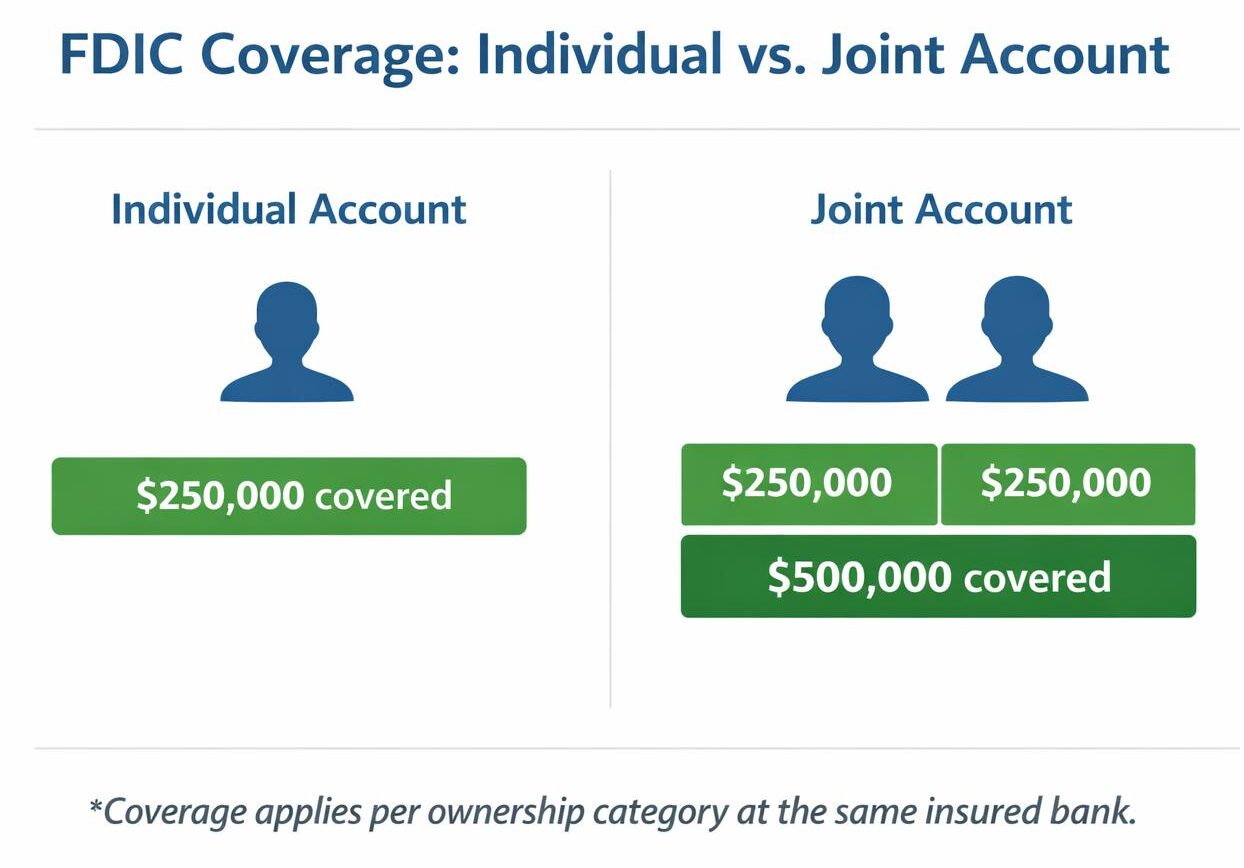
For joint accounts, the FDIC insures each co-owner’s share up to the standard deposit insurance limit per insured bank. The current standard limit is $250,000 per depositor, per ownership category, per insured institution. Because both account holders receive this protection on their respective shares, a joint account held by two people actually has a combined coverage ceiling of $500,000 at a single institution.
This assumes that each co-owner has equal rights to the funds in the account, which is the standard assumption for joint accounts unless otherwise documented. If an account has three co-owners, the coverage can extend further, with each person’s interest protected up to the per-owner limit.
Coverage limits can be adjusted by Congress or the FDIC over time, so it is worth confirming current amounts through the FDIC’s official website at fdic.gov before making significant decisions based on them.
How This Compares to Individual Account Coverage
Source: Mooloo graphics
To understand why joint account coverage is meaningful, consider a straightforward example. A person who holds an individual savings account is covered up to $250,000 at a given bank. If that same person also holds a joint account at the same bank with their spouse, their interests in the joint account is covered separately, up to another $250,000. This means the individual could have up to $500,000 of FDIC coverage at the same bank across those two ownership categories.
Their spouse, as a co-owner of the joint account, also has their $250,000 share of the joint account protected. If the spouse holds their own individual accounts at the same bank, those are covered separately as well.
This layering effect means that two people banking together at the same institution can have significantly more than $250,000 of combined FDIC protection without needing to spread their money across multiple banks.
What Counts as a Joint Account for FDIC Purposes
The FDIC has specific requirements for an account to qualify as a joint account under its coverage rules. The account must meet three conditions:
- All co-owners must be living people, not businesses or legal entities.
- All co-owners must have equal withdrawal rights, meaning any one person can access the full balance without the permission of the other co-owners.
- The account must be jointly owned, meaning each co-owner has a legal interest in the funds.
If one of these conditions is not met, the FDIC may not treat the account as a joint account for insurance purposes. An account held in multiple names on behalf of a business, for example, would likely fall into a different ownership category rather than the joint account category.
Common Situations Where Joint Account Coverage Matters
Married couples who share bank accounts are one of the most common examples. If a couple holds $400,000 in a joint checking account at a single insured bank, the entire balance would fall within the $500,000 joint coverage limit, assuming both partners have equal rights to the funds. Neither person would face a coverage gap in that scenario.
Parents who add an adult child to a bank account should understand how this affects coverage calculations. The child becomes a co-owner for FDIC purposes, which can increase the total coverage available on that account. However, it also means the child has full legal access to those funds, which is a separate consideration worth thinking through carefully.
Keeping Track of Coverage Across Multiple Accounts
If you and a co-owner hold several accounts at the same bank, your total joint coverage applies across all of those accounts combined, not per account. Put simply, you can’t just open more and more accounts at the same bank to increase your FDIC coverage. A couple with three joint accounts at the same bank has a total joint account coverage limit of $500,000 across all three accounts, not $500,000 per account.
To extend coverage beyond the limit, you would need to use different ownership categories, open accounts at different FDIC-insured institutions, or explore options such as FDIC-insured deposit sweep programs that some banks and brokerage platforms offer.
The FDIC provides a free online tool called the Electronic Deposit Insurance Estimator, or EDIE, which can help you model how coverage applies to your specific account arrangements at a given bank. It is a practical resource for understanding how your current deposits are protected.
What Happens to Coverage When a Co-Owner Dies
The FDIC provides a grace period after a co-owner passes away during which coverage on the joint account is calculated as if all co-owners were still living. This gives the surviving account holder time to restructure accounts without facing an immediate gap in coverage.This prevents families from facing an unexpected coverage gap while they are still settling the estate or deciding how to handle the account.
The length and terms of this grace period are defined by FDIC rules, which can be updated. If this situation applies to you, checking with the FDIC or your bank directly will give you the most accurate and current guidance.
Practical Considerations for Larger Balances
For households with bank deposits that approach or exceed standard coverage thresholds, there are a few approaches worth understanding. Spreading funds across multiple FDIC-insured banks is one option, since coverage limits apply per institution. Some banks and brokerage platforms offer programs that distribute deposits across a network of partner banks automatically, which can increase effective FDIC coverage considerably.
Treasury bills and certain other government securities are backed by the full faith and credit of the U.S. government rather than FDIC insurance, which is another avenue some depositors with large balances consider. These carry their own characteristics and risk profiles that are worth researching separately.
Joint account ownership is not a strategy in isolation but rather one element of how deposit insurance works across different account types. Understanding how each ownership category interacts at the same institution gives you a clearer picture of how well your deposits are protected and whether any adjustments would be worth considering.