
How to Compare Savings Accounts Before Opening One


Choosing where to keep your savings sounds simple until you realize how much variation exists between accounts at different banks and credit unions.
Interest rates, fees, minimum balance requirements, and account features can differ significantly from one institution to the next. A savings account that looks attractive at first glance may come with conditions that reduce its practical value for your situation. Knowing what to look for before you open an account helps you make a more informed choice rather than defaulting to whatever your current bank happens to offer.
Why the Interest Rate Is Only Part of the Picture
The annual percentage yield, commonly written as APY, is the number most people focus on when comparing savings accounts. APY reflects how much you earn over a year, including the effect of compounding, expressed as a percentage of your balance. A higher APY means more interest earned on the same deposited amount, so it is a reasonable starting point for comparison.
However, focusing only on the rate without reading the fine print can lead to surprises. Some accounts advertise a high APY that applies only to a specific balance tier, meaning the rate drops once your balance exceeds a certain threshold. Others offer a promotional rate for new customers that reverts to a lower standard rate after a set period. When you see an advertised rate, it is worth checking whether it applies to your expected balance for the full account term, or whether conditions are attached.
Rates on savings accounts are variable in most cases, which means the bank can adjust them at any time in response to broader interest rate movements. A rate that looks competitive today may not stay that way. This is a normal feature of savings accounts rather than a red flag, but it is worth understanding that savings account rates are not locked in the way a certificate of deposit rate typically is.
Fees and How They Affect Your Actual Return
A savings account with a strong APY can still deliver a poor result if fees eat into your earnings. Monthly maintenance fees are one of the most common charges to watch for. At some banks, these fees are automatically waived if you maintain a minimum daily balance or link the account to a checking account. At others, they apply regardless.
As a simple illustration: if an account earns interest on a modest balance but also charges a monthly maintenance fee that you do not qualify to waive, the fees could easily exceed the interest earned over the course of a year. Running that kind of calculation before opening an account can save a real headache later.
Other fees worth checking include:
- Excessive transaction fees, which some accounts charge if you exceed a set number of withdrawals per month
- Fees for falling below a minimum balance
- Wire transfer or outgoing transfer fees
- Paper statement fees if you prefer receiving physical statements
- Account closure fees, which some institutions charge if you close the account within a short time of opening it
Fee structures are typically outlined in the account’s terms and conditions or a separate fee schedule document. Reviewing this before applying takes only a few minutes and can prevent unexpected charges.
Minimum Balance Requirements and Access Conditions
Some savings accounts require a minimum opening deposit, a minimum ongoing balance, or both. A minimum opening deposit is the amount you need to fund the account initially. A minimum daily or monthly balance is what you must maintain to avoid fees or to qualify for a particular interest rate tier.
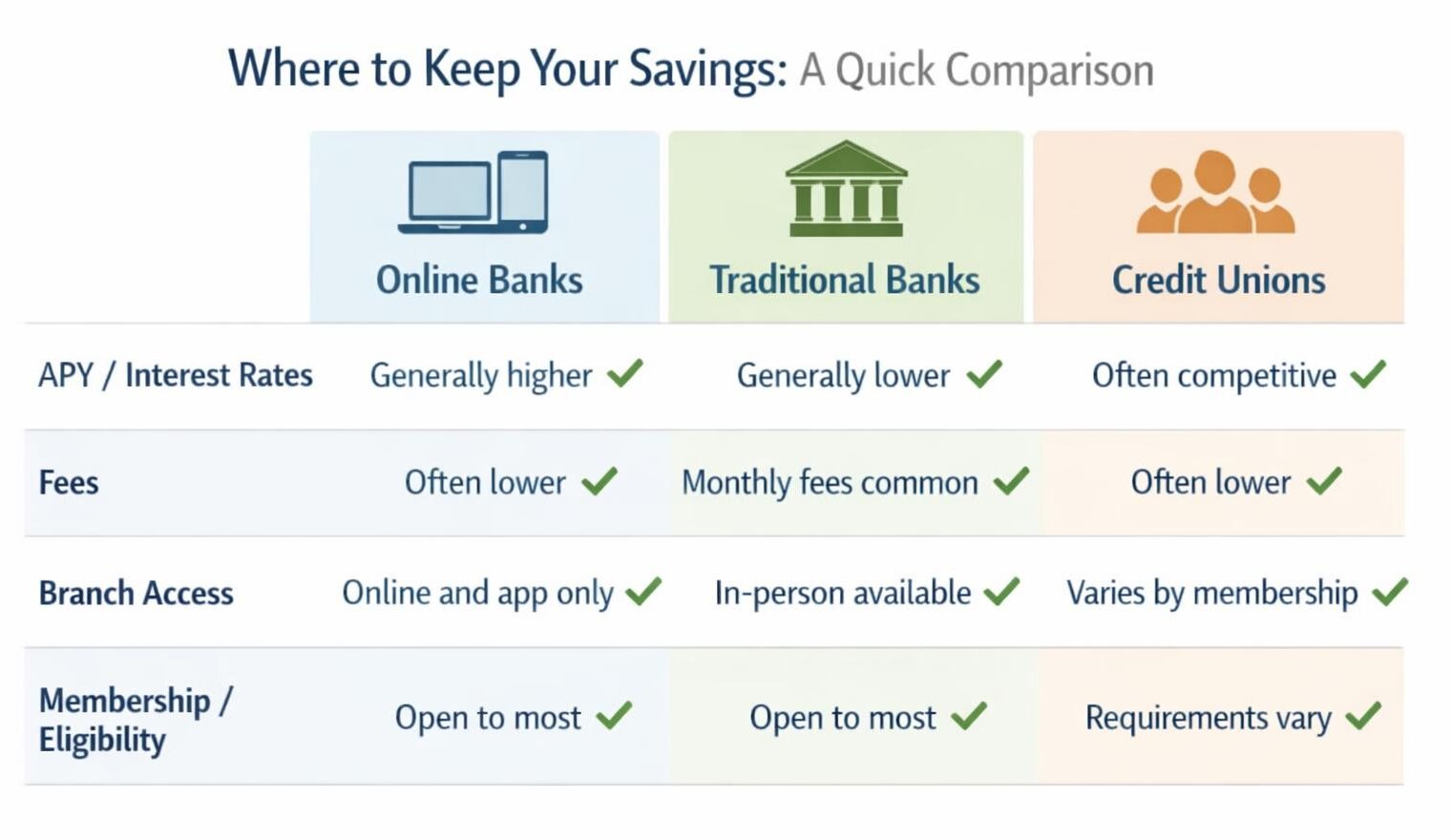
High-yield savings accounts at online banks often have no minimum balance requirement, while certain accounts at traditional banks or credit unions may require a more substantial opening or ongoing balance. If your balance fluctuates or you are just starting to save, an account with strict minimums could result in recurring fees during months when your balance dips below the threshold.
Access conditions are also worth examining. Consider how easy it is to move money in and out of the account. Most savings accounts allow transfers to a linked checking account, but processing times vary. Some banks complete transfers within the same day, while others take two to three business days. If you need to access funds quickly in an emergency, transfer speed matters.
Online Banks Versus Traditional Banks
Online banks generally offer higher APYs on savings accounts compared to large traditional banks. The reason is straightforward: online banks operate with lower overhead costs because they do not maintain physical branch networks. Those savings are often passed on to customers in the form of better interest rates.
The trade-off is that you interact with an online bank entirely through a website or mobile app, with no in-person branch to visit. For most routine savings activity, this works fine. Customer service is typically available by phone, chat, or email. However, if you value face-to-face banking or regularly need to deposit cash, an online-only bank may be less convenient.
Credit unions offer another alternative. As member-owned nonprofit institutions, credit unions sometimes offer competitive rates and lower fees compared to large commercial banks. Membership requirements vary by credit union, with some open to the general public and others restricted to specific employers, geographic regions, or professional groups.
FDIC and NCUA Insurance
Before opening a savings account anywhere, confirming that the institution is federally insured is an important step. Banks that are members of the Federal Deposit Insurance Corporation, or FDIC, provide insurance on deposits up to the applicable limit per depositor, per ownership category, per institution. Credit unions operate under similar protection through the National Credit Union Administration, or NCUA.
This insurance means that if the institution fails, your deposits up to the insured limit are protected. Coverage limits and ownership categories can be more detailed than a single figure suggests, so if you plan to hold a large balance, it is worth reviewing how coverage is calculated for your specific situation. The FDIC and NCUA both provide resources on their official websites to help depositors understand how coverage applies to their accounts.
Features That May Matter Depending on How You Use the Account
Beyond rates, fees, and insurance, a few practical features can make a meaningful difference in day-to-day usefulness.
- Mobile deposit availability, which lets you deposit checks using a smartphone camera rather than visiting a branch or ATM
- Savings buckets or sub-accounts, offered by some banks, which let you label and organize savings toward different goals within a single account
- Automatic savings tools that round up purchases or schedule recurring transfers from checking to savings
- ATM access, particularly relevant if you may occasionally need to withdraw cash directly from the savings account
- Integration with budgeting apps or other financial tools you already use
Not every feature matters to every person. If you simply want a place to hold an emergency fund with minimal interaction, a straightforward high-yield account with no fees and a solid APY may be all you need. If you prefer to organize savings into categories or automate contributions, features that support those habits can add genuine value.
How to Run a Practical Comparison
When you are ready to compare accounts, a side-by-side approach tends to work well. Pick three to five accounts that appear competitive and note the APY, minimum balance requirements, monthly fees and waiver conditions, transfer speeds, and whether the institution is federally insured. Rate comparison websites can help surface current offerings, though it is worth verifying each rate directly on the bank’s own website since rates change frequently.
Pay attention to the account opening process as well. Some banks allow you to open an account online in a few minutes with a basic identity verification. Others require more documentation or may have a waiting period before the account is fully active. If you are hoping to move funds quickly, the onboarding timeline is a practical detail worth confirming upfront.
Taking the time to compare accounts properly before committing is generally worthwhile. The difference between a low-rate account at a traditional bank and a higher-rate account at an online bank can add up over time, particularly as your balance grows. Understanding what you are agreeing to, including the fees, conditions, and limitations, puts you in a stronger position to choose an account that genuinely fits your needs.