What Is the Difference Between Checking and Savings Accounts?


Checking and savings accounts are both offered by banks and credit unions, but they serve different purposes and importantly, come with different rules about how you can use them.
Most people end up holding both types at some point, but it is not always obvious what makes them distinct or how to decide which one to use for a given purpose. Understanding how each account works, what the trade-offs are, and how they fit together can help you make more informed decisions about managing your day-to-day cash.
The Core Purpose of Each Account
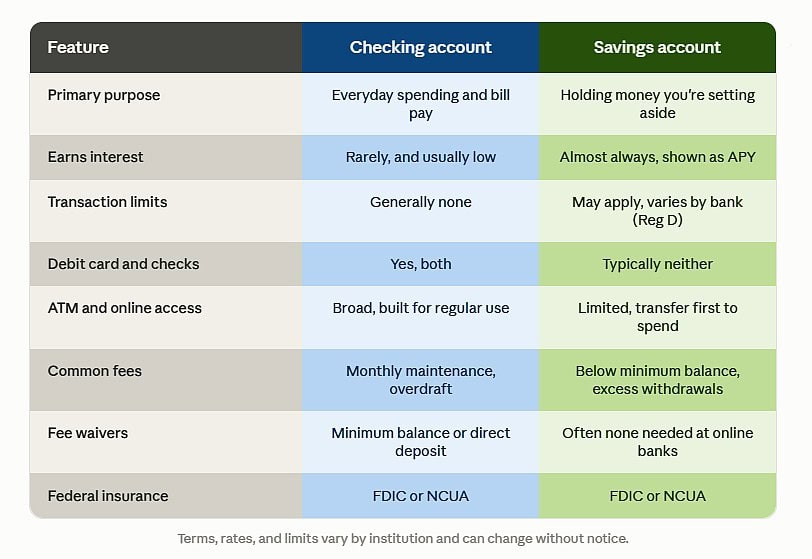
A checking account is built for frequent transactions. You use it to pay bills, receive your paycheck through direct deposit, make purchases with a debit card, withdraw cash at ATMs, and write checks. The defining feature is flexibility. There is generally no limit on how many times you can move money in or out of a checking account in a given month, which makes it the natural home for everyday spending and payments.
A savings account, by contrast, is designed to hold money you are setting aside rather than spending immediately. It is not meant to be used for daily purchases. Instead, it works as a place where your money can sit and earn interest over time. The trade-off for that interest is reduced flexibility. Banks have historically applied limits to certain types of withdrawals from savings accounts, and the account is generally structured to discourage frequent access.
How Interest Works in Each Account
Checking accounts sometimes pay interest, but most standard checking accounts do not. When they do, the rates tend to be very low. High-yield checking accounts exist at some institutions, but they often come with conditions such as minimum balance requirements or a required number of debit card transactions each month.
Savings accounts almost always pay interest, which is the main financial incentive for keeping money in one. The interest rate on a savings account is expressed as an annual percentage yield, commonly written as APY. This figure reflects how much your balance would grow over a year, including the effect of compounding.
The actual APY on savings accounts varies considerably between institutions and changes over time in response to broader interest rate conditions. Online banks and credit unions have often offered higher rates than traditional brick-and-mortar banks, though this is not always the case. If you are comparing savings accounts, checking the current APY at several institutions is worthwhile, as rates can differ significantly. Always verify current rates directly with the institution, since they can change without notice.
Transaction Limits and Federal Regulation D
Source: Mooloo Graphics
For many years, federal regulations restricted certain withdrawals and transfers from savings accounts to six per month. This rule, known as Regulation D, was a key distinction between checking and savings accounts. In 2020, the Federal Reserve amended the rule to give banks the option to remove that limit, and many institutions have since relaxed or eliminated the restriction.
However, not all banks have changed their policies, and some still enforce their own internal limits on savings account transactions. Exceeding those limits can result in fees or, in some cases, the bank converting your savings account to a checking account. It is worth checking the specific terms at your institution so you know what applies to your account.
Fees and Minimum Balances
Both account types can carry monthly maintenance fees, though fee structures vary widely. Some banks waive fees if you maintain a minimum daily balance, receive direct deposits above a certain threshold, or meet other conditions. Other institutions, particularly online banks and credit unions, offer accounts with no monthly fees at all.
For checking accounts, fees can also arise from overdrafts. An overdraft occurs when you spend more than your available balance. Some banks charge a flat fee per overdraft transaction, while others offer overdraft protection that links your checking account to a savings account or a line of credit. The terms and costs of overdraft programs differ between institutions, so it is worth reading the details before relying on them.
Savings accounts may charge fees if your balance falls below a minimum threshold or if you exceed transaction limits. Minimum balance requirements for savings accounts vary by institution, with some requiring only a small amount to open and maintain the account.
Access to Your Money
Checking accounts offer broad access through debit cards, checks, online bill pay, wire transfers, and ATMs. This is by design. The account is built for regular use, and you can generally move money in and out freely.
Savings accounts are more limited in how you access funds. Most savings accounts do not come with a debit card, and you cannot write checks from one. To use money from a savings account, you typically transfer it to a checking account first, then spend from there. This added step is not accidental. The structure encourages you to treat your savings account as a separate pool of money that you do not draw from casually.
FDIC and NCUA Insurance
Both checking and savings accounts at insured institutions are protected by federal deposit insurance. At banks, this coverage is provided by the Federal Deposit Insurance Corporation, known as the FDIC. At credit unions, the equivalent protection comes from the National Credit Union Administration, known as the NCUA.
This insurance protects depositors if an institution fails. Coverage limits apply per depositor, per institution, and per ownership category. The standard coverage limit is subject to change and may depend on how accounts are titled, so it is worth confirming the current limit directly with the FDIC or NCUA. If you hold significant balances, understanding how coverage applies to your specific situation is useful.
How the Two Accounts Work Together
In practice, many people use checking and savings accounts as a pair rather than choosing between them. A common approach is to have income deposited into a checking account and then transfer a portion to savings on a regular basis. This creates a clear separation between spending money and money you are intentionally setting aside.
That separation has practical benefits. It reduces the chance of accidentally spending money you meant to save, and it makes it easier to track your financial position because your checking account balance more closely reflects what you actually have available to spend in the near term.
Some people go further and open multiple savings accounts for different purposes, such as one for an emergency fund, one for a planned purchase, and one for travel. Many online banks allow you to label or nickname individual savings accounts, which makes it easier to track progress toward separate goals without mixing funds together.
Choosing the Right Account for Your Situation
When evaluating a checking account, the main factors to consider are fees, overdraft policies, ATM access, and how well the account integrates with the payment methods you use most. A checking account with high fees or inconvenient access can reduce the practical value of keeping your money there.
For a savings account, the APY is an obvious consideration, but so are the minimum balance requirements, any limits on withdrawals, and whether the account is at an institution you already use or somewhere new. Some people prefer to keep their savings at a different bank than their checking account, partly because the slight inconvenience of transferring money between institutions creates a small barrier to impulse spending.
There is no single correct way to structure your accounts. What matters most is having a clear understanding of what each account is for, what it costs, and how it behaves when you need to move money in or out.