
What is the Additional Child Tax Credit?


The Additional Child Tax Credit is a refundable tax benefit that can put money back in your pocket even when you owe little or nothing in federal income tax.
For families with children, tax season often raises a practical question: what happens if the Child Tax Credit reduces your tax bill to zero but you still have credit left over? That is exactly the situation the Additional Child Tax Credit is designed to address. In plain terms, the ACTC allows families with lower tax bills to still benefit from the child credit system rather than simply losing the unused portion. Understanding how it works, who qualifies, and how it interacts with the regular Child Tax Credit can help you make the most of what the tax code offers.
The Difference Between the Child Tax Credit and the Additional Child Tax Credit
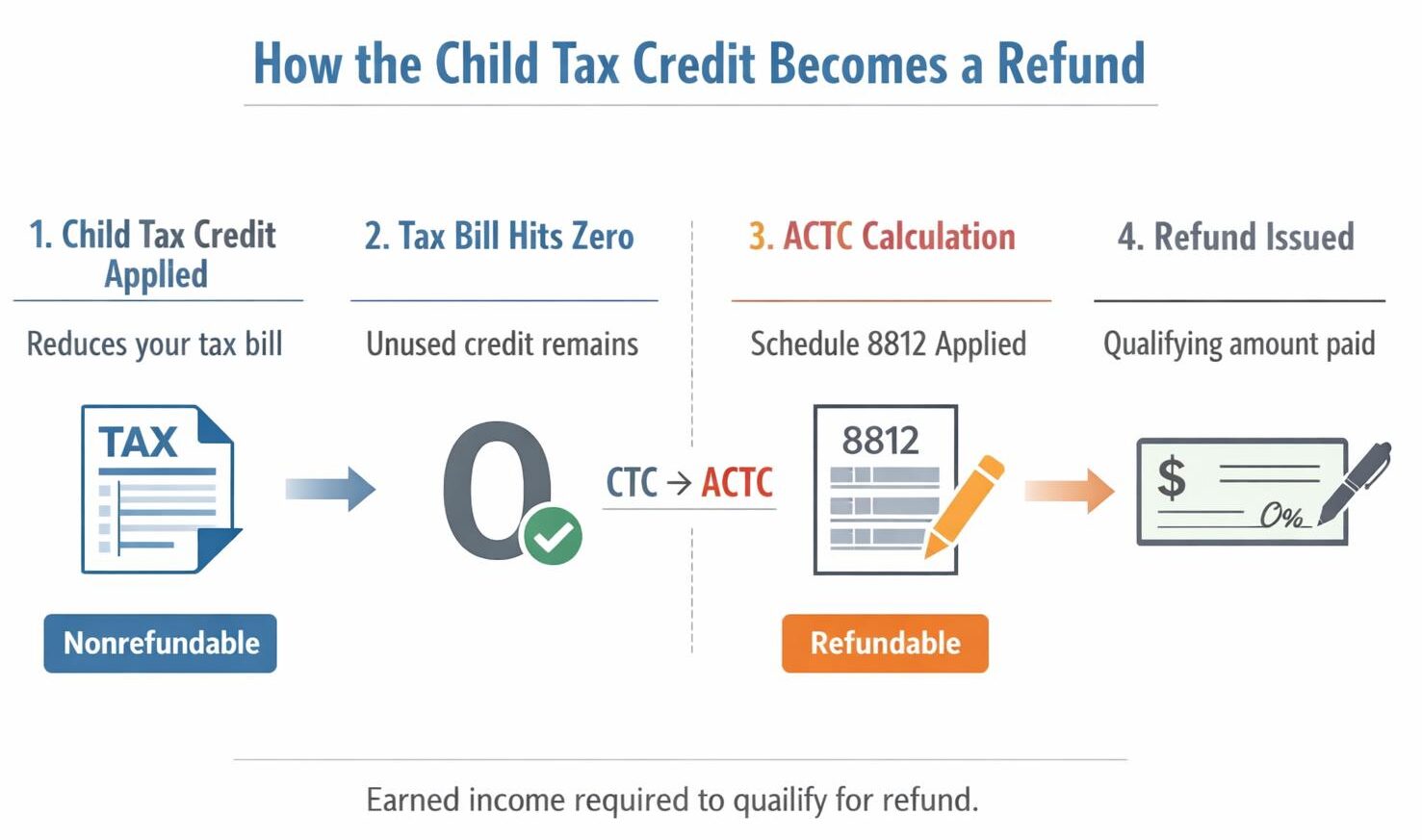
These two credits sound similar and are closely connected, but they serve different functions. The Child Tax Credit (CTC) is a nonrefundable credit, meaning it can reduce your federal income tax liability to zero, but it cannot generate a refund on its own if your tax bill is already at zero.
The Additional Child Tax Credit (ACTC) is the refundable portion of the Child Tax Credit system. If the Child Tax Credit reduces your tax to zero and there is still unused credit remaining, you may be able to claim the ACTC and receive some of that remaining amount as a refund. This distinction matters most for lower and moderate income families who may not owe enough in federal taxes for the full nonrefundable credit to apply.
How the Refundable Portion Works
When you file your federal tax return, the Child Tax Credit first offsets any taxes you owe. If that process brings your tax liability to zero and there is still credit available, you may then claim the Additional Child Tax Credit to receive a refund for some or all of the remaining amount.
The amount you can claim as the ACTC is not simply the leftover credit. A separate calculation is required, generally based on a percentage of your earned income above a certain threshold. This formula exists because the credit is intended to benefit working families. The IRS uses Schedule 8812 to calculate both the Child Tax Credit and the Additional Child Tax Credit, and this is the form where the refundable portion is determined.
The rules around these credits have changed multiple times through legislation, and the specific thresholds, percentages, and maximum amounts can shift from year to year. Checking the IRS website or consulting a tax professional for the current tax year figures is advisable before assuming prior year rules still apply.
Who Can Qualify for the Additional Child Tax Credit
To claim the ACTC, you generally need to meet the same requirements as the Child Tax Credit. The key eligibility factors typically include:
- Having a qualifying child who meets the IRS age, relationship, residency, and support tests
- The qualifying child must have a valid Social Security number
- Having earned income, since the refundable portion is tied to wages, salaries, or self-employment income
- Meeting applicable income limits, as the credits phase out at higher income levels
- Filing a federal tax return, even if you would not otherwise be required to do so
The earned income requirement is particularly relevant. Families with little or no earned income may not qualify for the refundable portion even if they have qualifying children. The credit is structured to support working parents.
Income limits also apply. The Child Tax Credit begins to phase out for taxpayers above certain income thresholds, which in turn affects how much ACTC may be available. These thresholds differ based on filing status, so a married couple filing jointly has a different phase-out point than a single filer.
A Practical Example of How This Plays Out
Suppose a parent filing as head of household has two qualifying children and earns a moderate income. Their federal tax liability, after other deductions and credits, is a relatively small amount. The Child Tax Credit first reduces that liability to zero. Because unused credit remains, the parent then works through the ACTC calculation on Schedule 8812. Depending on their earned income and the applicable percentage, they may receive a portion of the remaining credit as a direct refund.
The actual refund amount depends on the specific figures involved and the rules in effect for that tax year. This example is meant to illustrate the general flow rather than predict a specific outcome.
The Role of Schedule 8812
Schedule 8812 is the IRS form used to calculate credits for qualifying children and other dependents. It handles both the nonrefundable Child Tax Credit and the Additional Child Tax Credit in one place. The schedule walks through the calculation step by step, applying your income, the number of qualifying children, and your tax liability to arrive at the credit amounts you can claim.
Most tax software handles this automatically, but understanding what Schedule 8812 is doing can help you catch errors or make sense of why your refund is a particular amount.
Timing and Refund Delays
One practical consideration for families claiming the Additional Child Tax Credit is that federal law requires the IRS to hold refunds that include the ACTC until a certain point in the filing season. This rule was introduced to reduce fraudulent refund claims. If your refund includes the ACTC, you should expect it to arrive later than refunds that do not include this credit, even if you file early in the year.
The IRS typically provides guidance each year about when these refunds are expected to be released. The Where’s My Refund tool on the IRS website is the most reliable way to track your specific refund status.
Common Misconceptions Worth Clarifying
A common point of confusion is treating the Child Tax Credit and the Additional Child Tax Credit as two separate credits that must be applied for independently. They are actually two components of the same credit system. You do not apply for them separately; the calculation on your tax return automatically determines how much of each you are entitled to based on your situation.
Another misconception is that receiving the ACTC means collecting money you did not earn or pay in. The refundable portion is a legitimate part of the tax code designed to support working families with children, and claiming it is simply using a credit you are entitled to under the law.
Some taxpayers also assume that a higher income automatically disqualifies them from any child-related credits. In reality, the phase-outs are gradual rather than a hard cutoff. Credits reduce incrementally as income rises rather than disappearing entirely at a single dollar threshold.
How Legislative Changes Can Affect These Credits
The Child Tax Credit and Additional Child Tax Credit have been subject to significant changes over the years. Legislation has altered the maximum credit amounts, the refundable percentage, income thresholds, and other provisions. What applied in one tax year may differ considerably from another.
This means that relying on information from a prior year’s return or articles written in previous years can lead to inaccurate expectations. For any given tax year, the IRS website, the Schedule 8812 instructions, and IRS publications covering child-related credits are the authoritative sources for current figures and rules. A qualified tax professional can also help you understand how changes in the law apply to your specific filing situation.
Practical Steps When Claiming This Credit
- Confirm that each qualifying child has a valid Social Security number before filing
- Review the IRS instructions for Schedule 8812 for the current tax year to understand the calculation
- Use tax preparation software or a tax professional to ensure the credit is calculated correctly
- Account for the potential refund delay if your refund includes the ACTC when planning your finances
- Keep documentation supporting your claim, including proof of the child’s residency and relationship to you
- Check the IRS website for any legislative updates that may affect the credit amounts for the year you are filing
The Additional Child Tax Credit provides a meaningful benefit for working families who might otherwise receive little value from the Child Tax Credit due to a low tax liability.