Is Plaid Safe to Use With Your Bank Account?


If you’ve ever connected a budgeting app, investment platform, or payment service to your bank account, there’s a good chance Plaid was working behind the scenes to make that connection happen.
Plaid is one of the most widely used financial data networks in the United States, yet most consumers have never heard its name. Understanding what Plaid actually does, how it handles your banking information, and what risks are worth considering can help you make more informed decisions about which apps you authorize to access your financial data.
What Plaid Does and Why So Many Apps Use It
Plaid acts as a bridge between your bank account and third-party financial apps. When you use an app like Venmo, Robinhood, Acorns, or a budgeting tool and you’re asked to connect your bank account, that connection is often powered by Plaid. Rather than building their own bank connection infrastructure, app developers integrate with Plaid’s system, which has established relationships with thousands of financial institutions across the US.
From the user’s perspective, the process usually looks like this: you tap a button to link your bank, a Plaid-branded screen appears, you search for your bank, and you enter your banking username and password. Plaid then verifies your account and passes relevant data back to the app you’re using. This could include your account balance, recent transactions, account number for transfers, or income history, depending on what the app is requesting.
Plaid earns revenue from the app developers who use its service, not from consumers directly. This means you don’t pay Plaid anything, but you are providing something valuable in exchange: access to your financial data.
How Plaid Handles Your Banking Credentials
One of the most common concerns people have is what happens to their bank username and password when they type it into a Plaid screen. This is a reasonable question, and Plaid’s approach has evolved over time.
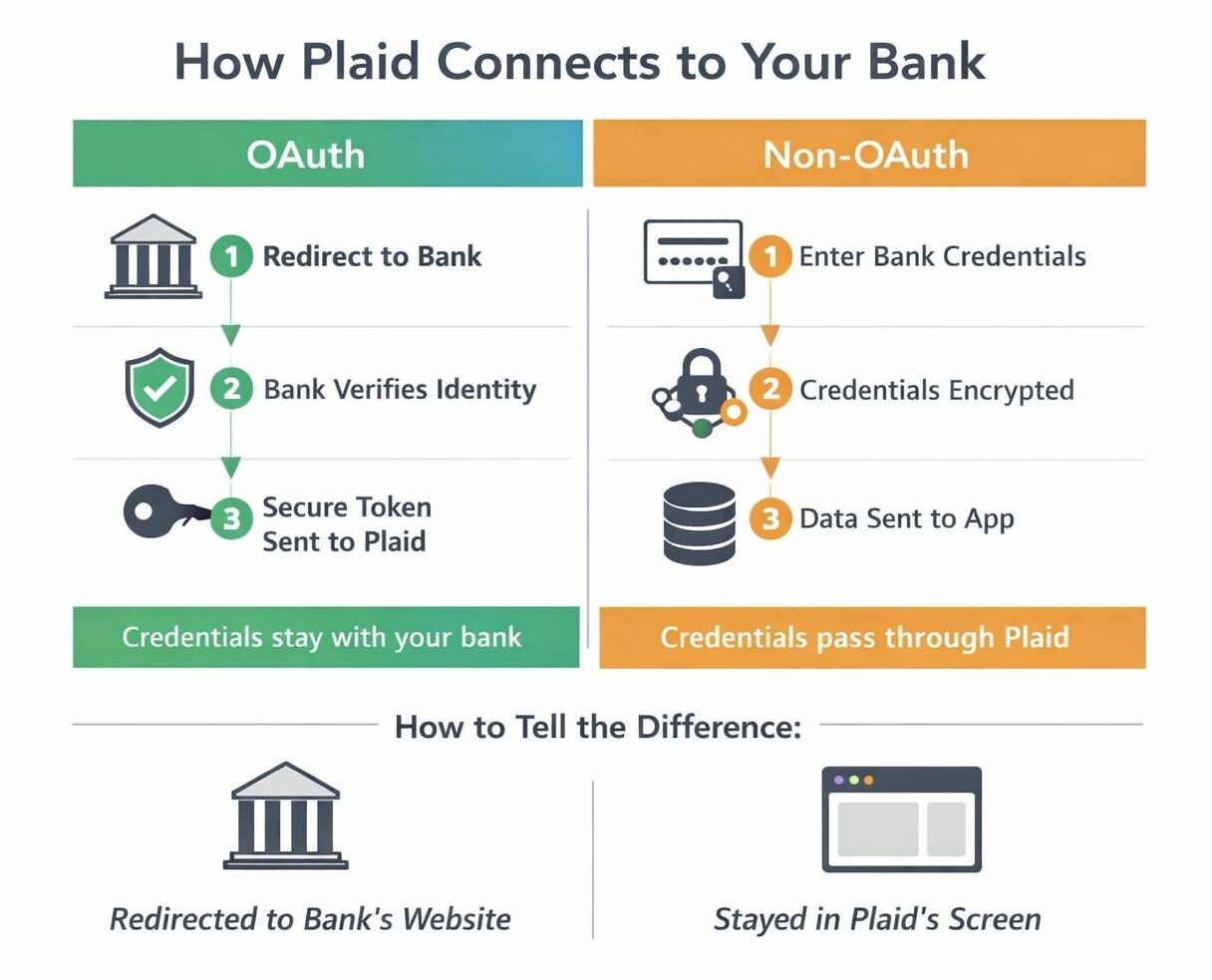
Plaid has moved toward a method called OAuth for many major financial institutions. With OAuth, you are redirected directly to your bank’s own login page to authenticate yourself, and your actual credentials are never actually shared with Plaid or the third-party app. Your bank verifies who you are and then issues a limited-access token to Plaid, which the app uses to retrieve only the data it has been authorized to access.
For banks that do not yet support OAuth, it’s possible Plaid may still use a process where your credentials are entered through their interface. Plaid states that it encrypts these credentials and does not store them in a way that allows employees or apps to read them. However, this older method does involve your credentials passing through a third-party system, which is worth understanding before proceeding.
Whether a specific bank supports OAuth with Plaid depends on the institution. Larger banks generally support it, while some smaller credit unions or community banks may not. You can often tell by observing whether the linking process redirects you to your bank’s official website or keeps you within the Plaid interface.
What Data Plaid Shares With Apps and Who Controls It
Source: Mooloo graphics
Plaid does not give every app access to every piece of your financial data. The data shared depends on what the app has requested and what you consent to during the linking process. A budgeting app might need ‘read access’ to your transactions and balances. A lending platform might request income verification. A payment app needs your account and routing number to initiate transfers.
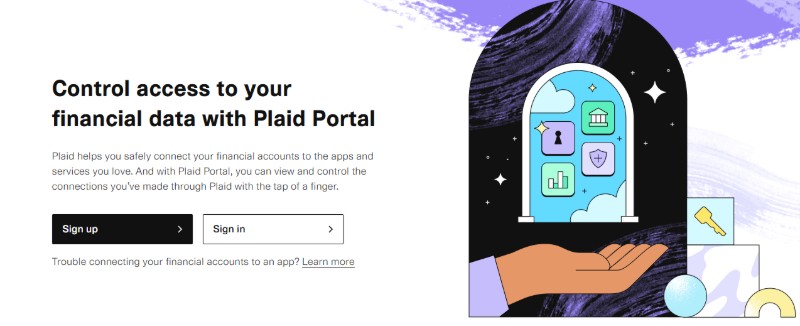
Plaid maintains a consumer portal at my.plaid.com where you can see which apps are connected to your financial accounts through their network, review what data has been shared, and disconnect apps you no longer use or trust. This is a useful tool that many people don’t realize exists. Disconnecting an app through the Plaid portal removes Plaid’s authorization to share your data with that app, though it’s also worth disconnecting from within the app itself and contacting your bank if you have specific concerns.
It’s worth noting that disconnecting an app does not automatically delete data that was already transmitted. Each app has its own data retention and privacy policy, so if you’re concerned about how a specific app stores your financial information, reviewing that app’s privacy policy is the appropriate next step.
Source: My Plaid.com
Security Measures Plaid Uses
Given the sensitivity of financial data, Plaid is subject to significant regulatory and industry security requirements. Some of the security practices they publicly describe include:
- Encryption of data in transit and at rest using industry-standard protocols
- Multi-factor authentication options for consumers accessing their portal
- SOC 2 compliance, an auditing standard that evaluates how companies manage data security and privacy
- Monitoring systems designed to detect unusual access patterns or suspicious activity
Plaid is also subject to US financial privacy laws including the Gramm-Leach-Bliley Act, which governs how financial institutions handle consumer data. While these protections are meaningful, no system is completely immune to data breaches or security incidents, and that applies to any company that handles sensitive information at scale.
Past Legal and Privacy Issues Worth Knowing About
In 2022, Plaid reached a settlement in a class action lawsuit in which consumers alleged that Plaid collected more financial data than was necessary and used it in ways that weren’t fully disclosed. Plaid agreed to pay a settlement and committed to changes in how it handles data collection and transparency, though it did not admit wrongdoing.
This history is relevant context. It suggests that at least at one point, Plaid’s data practices were broader than many consumers understood them to be. Since then, Plaid has made visible changes to its transparency tools, including the consumer portal mentioned earlier. Whether those changes fully address past concerns is something individual users can evaluate based on their own comfort level.
Practical Risks to Consider
Using Plaid is not inherently dangerous, but it does involve sharing sensitive access with a third party. There are several practical considerations worth thinking through:
- If a third-party app that uses Plaid experiences a data breach, your financial data held by that app could be exposed, even if Plaid’s own systems remain secure
- Granting account access to multiple apps over time means your data exists in more places, which increases your overall exposure
- Some apps may request broader access than they need for the service they provide; it’s reasonable to consider whether that level of access is necessary before connecting
- Fraudulent apps occasionally attempt to mimic legitimate services; always verify you’re using a reputable app before connecting your bank account through any service
For most people using well-known financial apps, Plaid functions without incident. The risk profile is generally considered acceptable given the convenience it provides, but that’s a trade-off each person should weigh based on their own comfort with sharing financial data.
Alternatives to Linking Through Plaid
If you’d prefer not to use Plaid, some options exist depending on what you’re trying to accomplish. Many banks allow you to manually enter your account and routing number to set up transfers, which bypasses Plaid entirely. Some apps also offer micro-deposit verification, where the app sends two small test deposits to your account that you then confirm to complete the connection.
A number of fintech apps and platforms have begun building direct bank integrations or working with alternative financial data networks, though Plaid remains dominant in the US market. If avoiding Plaid is important to you, it’s worth checking whether the app you want to use offers an alternative verification path before assuming Plaid is the only option.
How to Manage Your Plaid Connections Over Time
A practical habit many financially aware consumers adopt is periodically reviewing which apps have access to their financial accounts. Through the Plaid portal at my.plaid.com, you can get a consolidated view of active connections. Removing apps you no longer actively use is a straightforward way to reduce unnecessary data sharing without giving up the tools you do find valuable.
Your bank may also have its own section in online banking showing which third-party apps have been granted data access. Reviewing both the Plaid portal and your bank’s connected apps settings gives you the most complete picture of where your financial data is flowing.