Cash Advance Apps That Don’t Use Plaid


Plaid has become the default plumbing for most cash advance apps. It verifies your bank balance, confirms your paycheck deposits, and automates repayment once payday hits, which is exactly why apps from Dave, Brigit and others have built around it.
But a growing number of users want out. Some are wary of how much transaction data Plaid can see. Others have banks that simply don’t connect cleanly. And in 2021, Plaid settled a $58 million lawsuit over claims it collected more account data than users realized it would, which hasn’t helped its reputation even though the company denied wrongdoing.
If you fall into that camp, you do have options. Here’s how cash advance apps verify your identity and income without Plaid, and which apps actually offer it.
Why Some Users Skip Plaid
Three concerns come up most often:
- Data scope. Plaid pulls detailed transaction histories to confirm income, and critics argue it often collects more than an app strictly needs.
- Bank compatibility. Not every bank plays nicely with Plaid, which can lock some users out of apps entirely.
- Credential comfort. Some people simply don’t want to hand bank login credentials to a third party, even an encrypted one.
How Non-Plaid Apps Verify You Instead
Source: Mooloo graphics
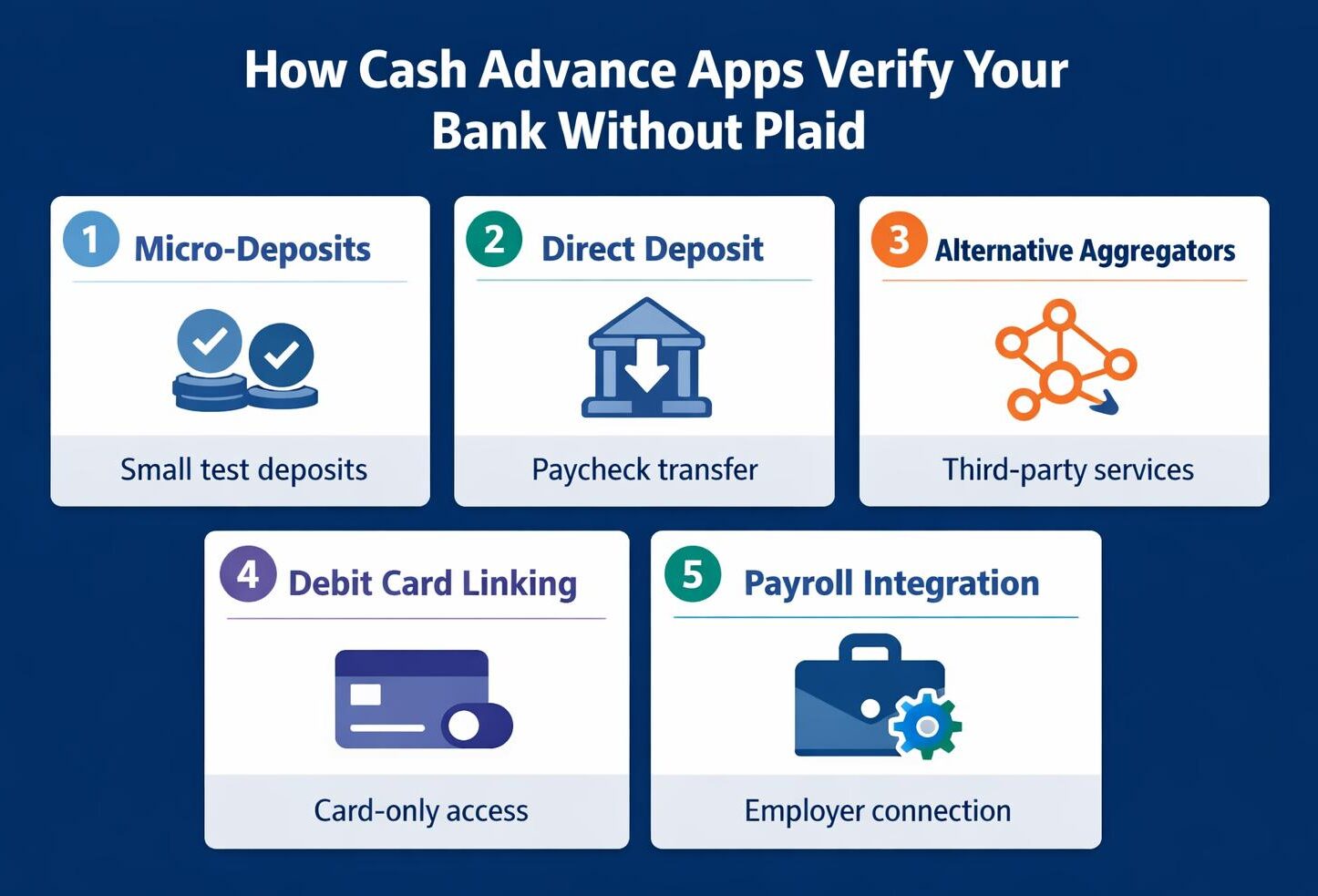
Apps that skip Plaid generally lean on one of these methods:
- Alternative aggregators. Plaid isn’t the only data aggregator in fintech. MX, Finicity, Akoya, and Trustly all do similar jobs, linking your bank account through their own APIs.
- Payroll integration (Argyle). Rather than reading your bank transactions, Argyle connects straight to payroll systems. This verifies income at the source, which makes it a better fit for gig workers or hourly employees with irregular paychecks.
- Yodlee. A longtime Plaid competitor that still uses credential-based bank logins, just through its own pipeline.
- Direct bank logins. Some apps connect straight to your bank with no aggregator in the middle at all.
- Direct deposit into the app. Instead of reading your outside bank account, the app has you route your paycheck into its own linked account or card, giving it direct visibility into your income.
- Micro-deposit verification. The app sends two small test deposits, you confirm the amounts, and that proves account ownership without any login sharing. It’s slower (often one to two business days) but skips aggregators entirely.
- Debit card linking. A handful of apps let you link just a debit card rather than a full bank account, which limits how much financial data they see.
Apps Worth Checking
Other platforms connect directly with supported banks, skipping aggregators altogether. Apps such as Klover and Possible Finance have historically allowed users to log in directly, though support may vary by bank. Several other apps are known to offer Plaid-free connection options or use alternative aggregators, including;
-
- Empower: Empower offers cash advances and does not exclusively rely on Plaid. Depending on your bank, it may use other methods to connect accounts or verify income.
- MoneyLion: MoneyLion offers Instacash advances and has supported multiple bank connection methods. Some users have connected accounts without going through Plaid, particularly by setting up direct deposit into their MoneyLion account.
- Cleo: Cleo supports bank linking through methods other than Plaid for some users, depending on the bank and account type. It is worth checking directly whether your specific bank connects through Plaid or another pathway within the app.
- Earnin: Earnin is an earned wage access app that verifies income through employment information, timesheets, or location data rather than relying solely on bank aggregator data. Its verification model differs from that of standard advance apps.
- Gerald: Gerald has offered no-fee cash advances and has used alternative bank connection options, though users should confirm the current connection method directly with the app.
This list isn’t exhaustive, and many apps actually support several aggregators, choosing one automatically based on your bank. The most reliable way to find out which method applies to you is to download the app and start linking your account – you will see which service name shows up on the verification screen.
Weighing the Trade-Off
Going Plaid-free has real upsides: more control over your data, access if your bank isn’t Plaid-supported, and no need to hand over bank credentials to Plaid specifically. But it comes with costs too. Your app choices shrink, the alternatives are often less polished, and direct bank logins can be less stable or carry their own security tradeoffs.
What to Compare Before Choosing
- Supported banks: confirm your account actually qualifies for the app’s Argyle, Yodlee, or direct-connection option.
- Fees: subscription models (some apps run $8.99 to $14.99 a month) versus tip-or-ad-based models (like Klover).
- Transfer speed: some advances land instantly, others take one to three business days.
- Repayment: most apps still auto-withdraw on payday regardless of which verification method you used.
Bottom Line
Plaid still powers most of the cash advance app market, but it’s not the only path in. If data privacy is your concern, or your bank just doesn’t play well with Plaid, apps built on Argyle, Yodlee, alternative aggregators, or direct bank connections are worth a look. Compare fees, speed, and security carefully before you commit.
This topic is part of the broader banking system. For a complete explanation of accounts, transfers, fees, and consumer protections, see our Banking & Cash Management guide.