ACH Transfer vs Wire Transfer: What Is the Difference?


When you need to send money electronically, two options come up repeatedly: ACH transfers and wire transfers. Both move funds between bank accounts, but they work in fundamentally different ways.
Understanding the difference matters because the right choice depends on how quickly you need the money to arrive, how much you are sending, and how much you are willing to pay in fees. Choosing the wrong method can mean unexpected costs, delays, or limitations that could have been avoided with a clearer picture of how each system operates.
How ACH Transfers Work
ACH stands for Automated Clearing House, which is the electronic network that processes the majority of everyday bank-to-bank transactions in the United States. When you set up direct deposit for your paycheck, pay a utility bill online, or transfer money between your own accounts at different banks, you are almost certainly using the ACH network.
Rather than moving money in real time, ACH transactions are collected in batches and processed at set intervals throughout the business day. The network is managed by Nacha, a nonprofit organization that sets the rules governing how ACH payments are handled. This batch processing approach is part of what makes ACH transfers cost-effective, but it also means they are not instant.
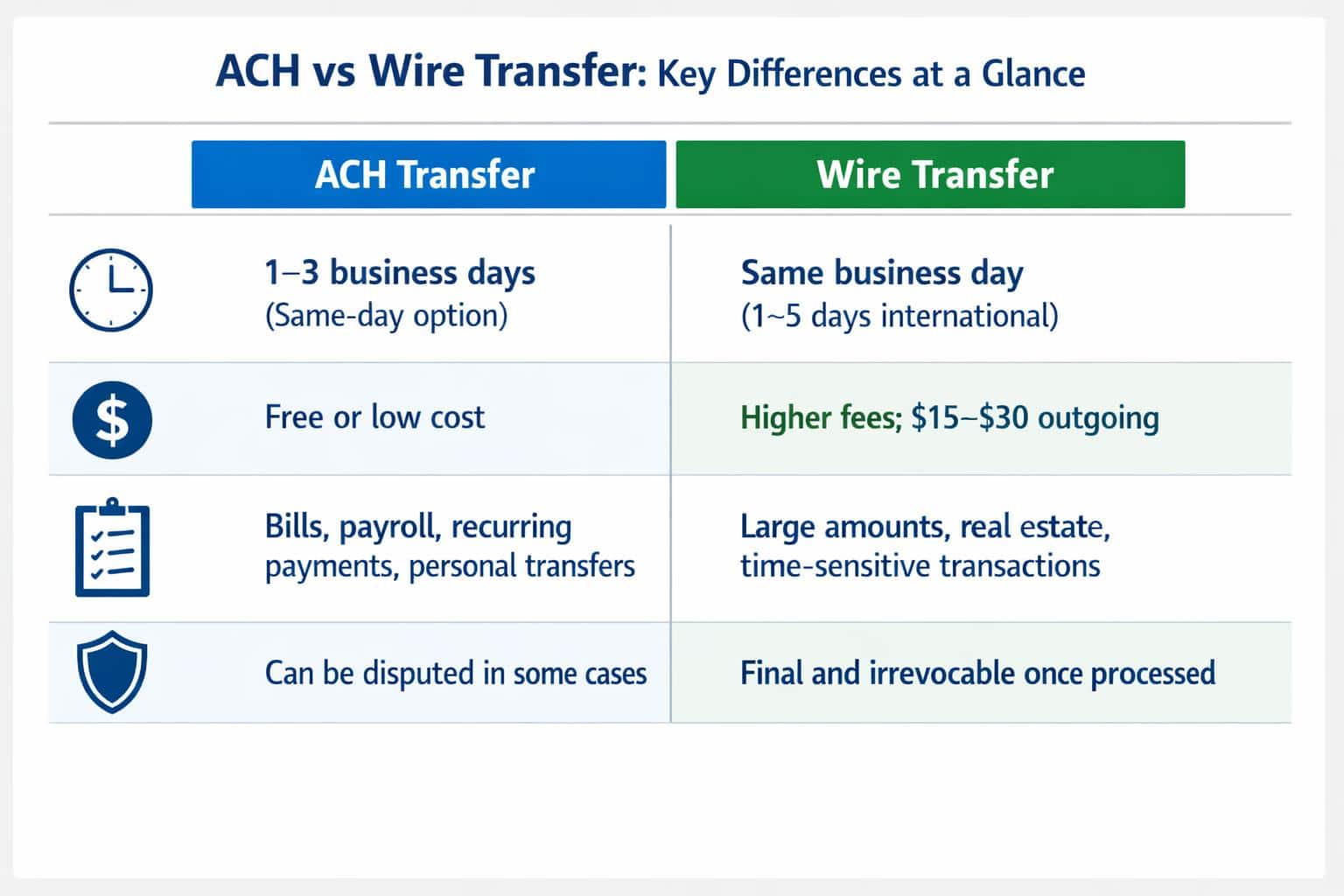
Standard ACH transfers typically take one to three business days to complete. Same-day ACH is available for many transactions and delivers funds within the same business day, though it may carry a slightly higher fee depending on your bank. Weekends and federal holidays do not count as business days, so timing matters if you are working against a deadline.
How Wire Transfers Work
Wire transfers move money differently. Instead of batching transactions, a wire transfer sends funds directly from one bank to another through a dedicated payment system. In the United States, domestic wire transfers are processed through Fedwire, which is operated by the Federal Reserve, or through the Clearing House Interbank Payments System, commonly known as CHIPS.
Because wires are processed individually rather than in batches, domestic wire transfers typically arrive on the same business day, often within a few hours of being sent. International wire transfers, which commonly route through the SWIFT network, can take one to five business days depending on the destination country and any intermediary banks involved along the way.
Wire transfers are generally considered final and irrevocable once processed. This is a key characteristic that sets them apart from ACH, where transactions can sometimes be reversed under specific circumstances.
Cost Differences Between ACH and Wire Transfers
Cost is one of the most noticeable practical differences between the two methods. ACH transfers are typically free or very low cost. Many banks offer standard ACH transfers at no charge, and same-day ACH may carry a small fee. Some online banks and fintech platforms have made ACH transfers entirely free for customers as a standard feature.
Wire transfers cost considerably more. Domestic wire fees at traditional banks commonly range from around fifteen to thirty dollars for outgoing transfers, though fees vary by institution and it is worth checking with your bank directly. Incoming wire fees are less common but do exist at some institutions. International wires typically cost more, and the recipient may face additional fees from their own bank or any intermediary banks that handle the transfer along the way.
For anyone sending small amounts regularly, these fees can add up quickly. A wire transfer fee on a two hundred dollar payment represents a meaningful cost that an ACH transfer would likely avoid entirely.
Transfer Limits and Use Cases
ACH transfers typically come with daily and monthly limits set by individual banks, and these limits can vary considerably. Some banks cap personal ACH transfers at a few thousand dollars per day, while others allow much higher amounts, particularly for business accounts. If you need to move a large sum, it is worth checking your bank’s specific limits before initiating the transfer.
Wire transfers are generally more suitable for large amounts because many banks impose fewer restrictions on wire transfer amounts, or set limits that are far higher than those applied to ACH. This is one reason wire transfers are commonly used in real estate transactions, business-to-business payments, legal settlements, and other situations where large sums need to move quickly and with finality.
ACH transfers, on the other hand, are well suited for recurring payments, payroll, bill payments, and everyday transfers between personal accounts. They are the backbone of routine financial activity for most American households.
Reversals, Fraud, and Security Considerations
The finality of wire transfers is both a strength and a risk. Because wires are generally irrevocable, the recipient’s bank has no obligation to return funds once the transfer has been completed. This makes wire transfers useful for situations where the recipient needs assurance that payment cannot be reversed after the fact. However, it also means that if you are the victim of fraud or you send money to the wrong account, recovering those funds can be extremely difficult.
Wire transfer scams are a significant concern. Fraudsters often impersonate real estate agents, attorneys, contractors, or bank employees to trick people into wiring money to fraudulent accounts. Because the transfer is typically final, losses from these scams are often unrecoverable. Before sending any wire transfer, especially for a large or unfamiliar transaction, verify the recipient’s banking details through a known and trusted contact method rather than relying on contact information provided in an unexpected email or message.
ACH transfers offer more consumer protections in certain scenarios. Under federal rules, consumers have the right to dispute certain unauthorized ACH transactions within a defined time window. The specific rules around disputes and reversals can be complex, and protections vary depending on whether you are an individual consumer or a business. Nacha’s operating rules govern these processes, and your bank can explain the protections that apply to your specific account type.
International Transfers and Alternatives
ACH transfers are primarily a domestic system. The network was designed for transfers within the United States, so if you need to send money internationally, a standard ACH transfer is not the appropriate tool. International wire transfers can handle cross-border payments, but as noted, they typically come with higher fees and longer processing times.
A number of third-party services have grown significantly in popularity for international money transfers. Platforms such as Wise and Remitly operate outside the traditional ACH and wire infrastructure and often offer competitive exchange rates and lower fees for international transfers. These options are worth comparing if you regularly send money abroad, though it is always sensible to review the fees, exchange rates, and transfer times for any service before committing to a transaction.
Choosing Between ACH and Wire Transfer
The decision often comes down to a few practical questions. How quickly does the money need to arrive? How large is the amount? Is cost a significant factor? And how important is payment finality to the recipient?
Wire transfers make sense when speed is critical, the amount is large, or the recipient requires guaranteed and final funds. Common examples include closing on a home purchase, settling a legal transaction, or funding an investment account under a time-sensitive deadline.
ACH transfers are the practical choice for routine, lower-cost transactions where a one to three business day window is acceptable. Paying bills, sending money to a friend or family member, transferring funds between your own accounts, and setting up recurring payments all fit comfortably within what ACH does well.
Both systems are widely used and well established, but they serve different purposes. Knowing which one fits your situation helps you avoid unnecessary fees, missed deadlines, or the frustration of a transfer that does not arrive when you expected.