
What is an Insured Cash Sweep Program In Banking?


If you have ever held a large cash balance at a bank and wondered whether all of it was protected by federal deposit insurance, an insured cash sweep program may be one of the more useful banking tools you have not fully explored.
Most people know that the Federal Deposit Insurance Corporation (FDIC) insures deposits up to a certain limit per depositor, per institution, per ownership category. But that coverage limit creates a practical problem for businesses, nonprofits, high-net-worth individuals, and anyone else holding more cash than a single bank can insure. Insured cash sweep programs were developed specifically to address this gap, and understanding how they work can help you think more clearly about how your cash is held and protected.
How an Insured Cash Sweep Program Works
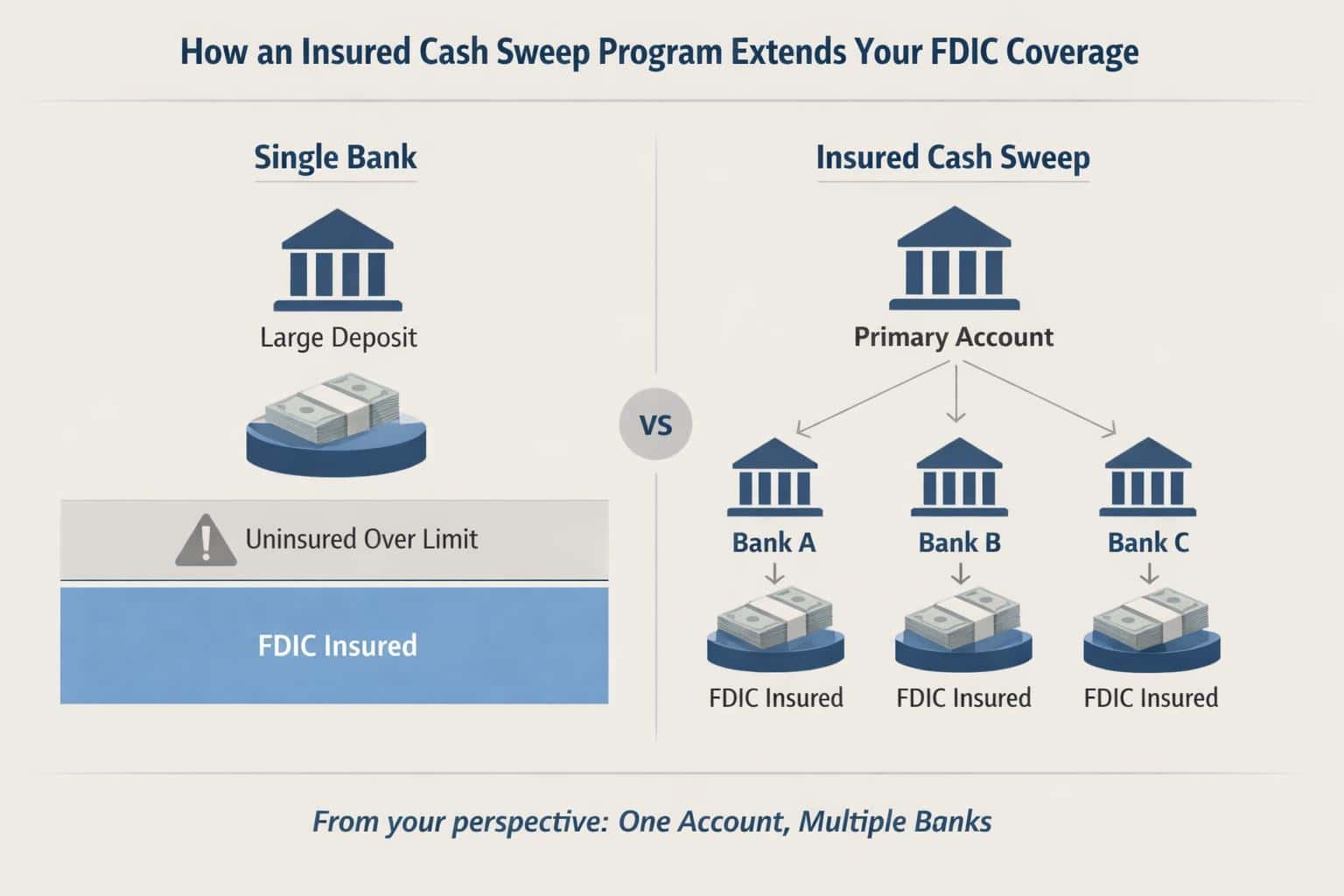
An insured cash sweep program is a service offered by banks and financial institutions that automatically distributes your cash deposits across a network of participating banks. Instead of your entire balance sitting at one institution where only a portion may qualify for FDIC coverage, the program splits your funds so that the balance at each individual bank stays within the insured limit.
From the depositor’s perspective, this happens mostly behind the scenes. You open a single account at your primary bank, deposit your funds, and that bank handles the logistics of distributing and tracking your money across its network. You still see a single account balance and deal with one institution for day-to-day transactions. The complexity of managing multiple bank relationships is handled by the program itself.
The term “sweep” refers to funds being moved out of your primary account and placed at other banks, typically overnight or on a scheduled basis. When you need to access your money, it is swept back. The coordination between participating institutions is what makes this work at scale.
Understanding FDIC Coverage Limits
To understand why insured cash sweeps matter, it helps to be clear about what standard FDIC insurance covers. The FDIC insures deposits at member banks up to a specific limit per depositor, per insured institution, per account ownership category. Coverage limits can change, so it is worth confirming the current amount directly with the FDIC at fdic.gov.
The ownership category distinction is significant. An individual’s personal accounts, joint accounts, retirement accounts, and certain trust accounts at the same bank may each qualify for separate coverage under different categories. Even so, someone holding several hundred thousand dollars or more in cash can reach the combined limits at a single institution relatively quickly.
An insured cash sweep program effectively multiplies your coverage by spreading funds across multiple FDIC-member banks. If the program has access to a sufficiently large network, the total insured amount available can be substantially higher than what any single bank account could provide.
Who Typically Uses These Programs
Source: Mooloo graphics
While individual consumers can benefit from insured cash sweep programs, they are particularly common among certain types of depositors.
- Small and medium-sized businesses that hold operating funds, payroll reserves, or seasonal cash balances that can exceed standard insurance limits.
- Nonprofits and foundations that need to hold grant funds or endowment cash safely between investment decisions.
- Real estate professionals, escrow agents, and attorneys who hold client funds in trust.
- High-net-worth individuals who want to keep significant cash holdings liquid while maintaining full insurance coverage.
- Municipalities and government entities seeking safe, insured options for public funds.
For a business holding several million dollars in a checking account while waiting to deploy those funds, the difference between partial and full insurance coverage is a meaningful concern. A sweep program can address that exposure without requiring the business to manually open and manage accounts at dozens of different banks.
The Difference Between Insured Cash Sweeps and Money Market Accounts
These two products are sometimes confused because both are commonly used to hold cash that earns some return. A money market account is a deposit account offered by a bank that typically pays a higher interest rate than a standard savings account. It is FDIC-insured, but only up to the standard coverage limit at that institution.
A money market mutual fund is different. It is an investment product, not a bank deposit, and is not FDIC-insured. It holds short-term securities and aims to maintain a stable value, but it carries a different risk profile than an insured deposit account.
An insured cash sweep program is a deposit-based arrangement. Funds placed through the program sit in actual bank deposit accounts at FDIC-member institutions and carry FDIC insurance at each bank. The key distinction is that the sweep program extends coverage across multiple banks, whereas a standard money market account is limited to the coverage capacity of a single institution.
Potential Benefits and Practical Advantages
The most direct benefit is the ability to hold more cash with full federal deposit insurance than would be possible at a single institution. For depositors who prioritize liquidity and safety over investment returns, this is often the central reason to use a sweep program.
There is also a convenience factor. Managing numerous individual bank accounts to achieve comparable coverage would be time-consuming and administratively burdensome. A sweep program consolidates the relationship to one primary account while the distribution happens automatically.
Some programs also pay interest on swept balances, though rates vary depending on the program, the bank, and current market conditions. Interest earned through these arrangements may be lower than what other cash management tools offer, so it is worth comparing options if earning a return on idle cash is a priority alongside insurance protection.
Limitations and Risks to Understand
Insured cash sweep programs are not without limitations, and it is worth understanding them before relying on one as a core part of your cash management approach.
- Network size matters. The total insured amount you can access depends on how many participating banks are in the network. Programs vary, and not all offer the same total coverage capacity.
- Your primary bank acts as the program administrator. If that institution experiences problems, your access to funds could be affected even if the underlying deposits at network banks are technically insured.
- Interest rates on sweep accounts are often modest. If earning a competitive return on cash is a priority, other options such as Treasury bills, high-yield savings accounts, or short-term certificates of deposit may be worth comparing.
- Not all sweep arrangements use FDIC-insured deposits. Some sweep programs move funds into money market mutual funds rather than bank deposit accounts. These do not carry FDIC insurance, so it is essential to confirm what type of arrangement is actually being used.
- Fees may apply. Some programs charge a fee or earn revenue through a spread between the interest paid to depositors and what the underlying banks earn. Reviewing the terms of any program carefully before enrolling is a reasonable step.
What to Ask Before Using One
If you are evaluating whether an insured cash sweep program is appropriate for your situation, there are several practical questions worth raising with the bank or financial institution offering the service.
Ask specifically whether swept funds are placed in FDIC-insured deposit accounts or in money market mutual funds, as these are meaningfully different from an insurance standpoint. Ask about the size of the network and the maximum insured amount available through the program. Ask whether fees apply, how interest is calculated and paid, and what happens if you need immediate access to a large portion of your balance.
It is also worth checking whether any of the network banks are institutions where you already hold accounts. If they are, your combined deposits at those banks could exceed the insured limit when both your existing accounts and swept funds are counted together, potentially leaving some portion uninsured despite the program.
How Insured Cash Sweeps Fit Into a Broader Cash Strategy
For most individuals with modest savings, standard FDIC coverage at a single bank is sufficient and no additional arrangements are necessary. Insured cash sweeps become genuinely relevant when cash holdings are large enough that standard coverage limits create real exposure.
A thoughtful cash management approach often involves separating funds by purpose and time horizon. Operating cash that needs to be immediately accessible has different requirements than reserves set aside for a future purchase or funds held temporarily between transactions. Sweep programs are well suited to the liquid, safety-focused portion of that picture, but they work alongside other tools rather than replacing them.
Rates, program terms, participating network banks, and regulatory rules can all change over time. Confirming current details directly with your bank and with the FDIC is the most reliable way to understand how any specific program operates and what coverage you can expect.