
SSI vs SSDI: What Is the Difference?


SSI and SSDI are both federal programs that provide financial support to people with disabilities, but they work in very different ways and serve different populations.
Confusing these two programs is understandable since both are administered by the Social Security Administration and both involve monthly payments to people who cannot work due to disability. However, the eligibility rules, payment amounts, funding sources, and linked health coverage are distinct. Understanding how each program works helps people determine which one they may qualify for, and in some cases, whether they might be eligible for both at the same time.
The Core Difference Between SSI and SSDI
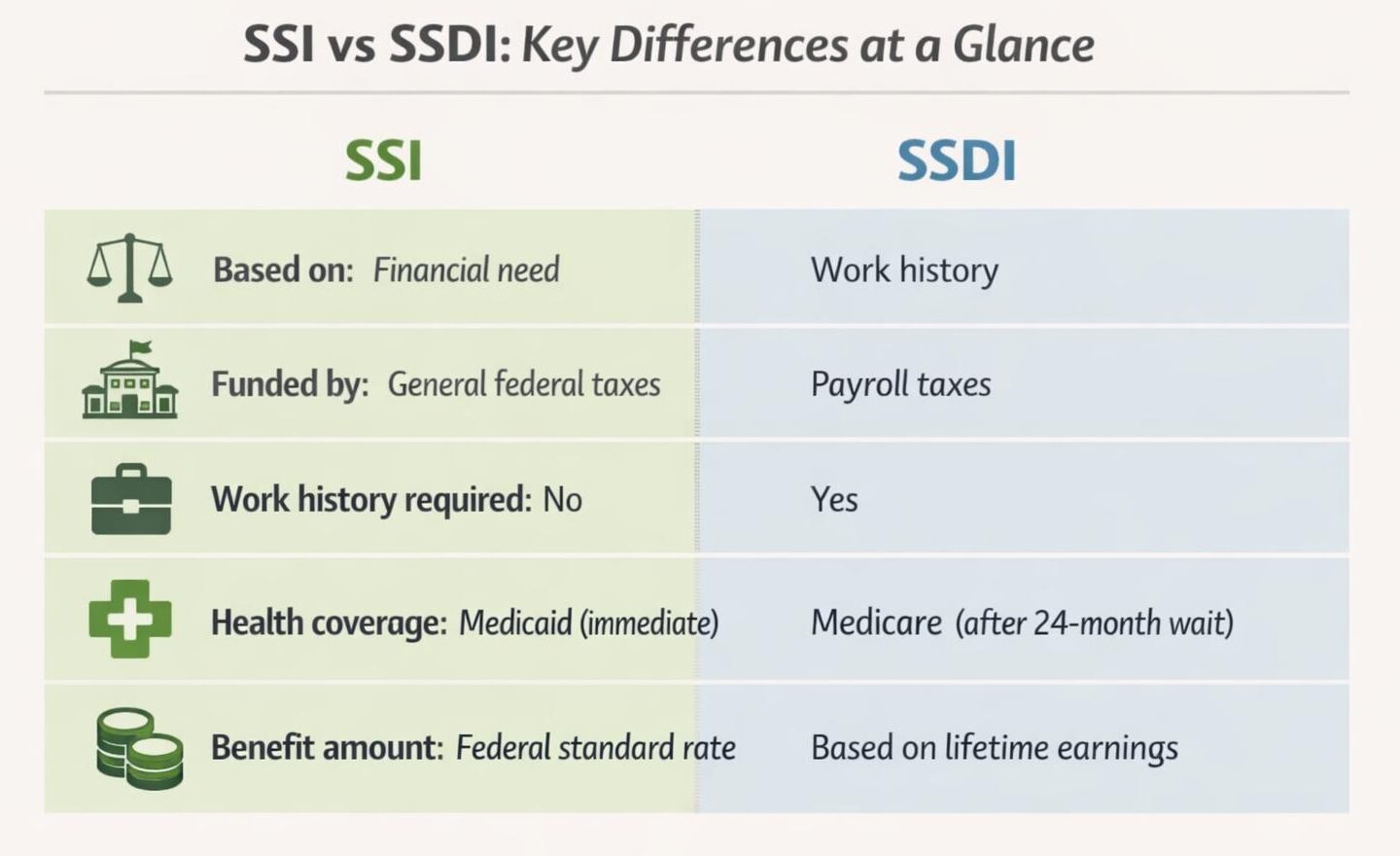
The fundamental difference comes down to work history versus financial need. SSDI, which stands for Social Security Disability Insurance, is an earned benefit. It is funded through payroll taxes, and eligibility is tied to how long and how recently a person worked and paid into the Social Security system. Think of it like an insurance policy that workers contribute to throughout their careers.
SSI, or Supplemental Security Income, is a needs-based program. It does not require any work history. Instead, it is designed for people with limited income and assets, regardless of whether they have ever held a job. SSI is funded through general federal tax revenue rather than the Social Security trust fund.
This distinction matters practically. A person who has worked for many years and paid Social Security taxes, then becomes disabled, would typically look at SSDI first. A person who has never worked, or who has not worked enough to qualify for SSDI, might qualify for SSI instead based on financial need alone.
How SSDI Eligibility Works
To qualify for SSDI, a person must meet two main requirements. First, they must have a medically documented disability that prevents them from engaging in what the Social Security Administration calls “substantial gainful activity,” and the disability must be expected to last at least one year or result in death. Second, they must have earned enough work credits through prior employment.
Work credits are calculated based on annual earnings, and the number of credits required depends on the applicant’s age at the time of disability. Generally, a person needs to have worked for a minimum number of years and must have worked relatively recently before becoming disabled. The SSA applies both a “recent work test” and a “duration of work test,” and both vary by age. Someone who becomes disabled in their 30s typically needs fewer total years of work history than someone who becomes disabled in their 50s.
Because SSDI is an insurance-based program, the monthly benefit amount is calculated based on a person’s average lifetime earnings, similar to how retirement benefits are calculated. People who earned higher wages over their working life will generally receive a higher SSDI benefit. Benefit amounts vary from person to person, and current figures should be confirmed directly with the Social Security Administration or through your personal mySocialSecurity account at ssa.gov.
How SSI Eligibility Works
Source: Mooloo graphics
SSI eligibility is based on disability plus financial need, and the financial thresholds are strict. Applicants must have limited income and limited resources. Countable resources generally include things like bank account balances, investments, and property other than a primary residence. The resource limits for SSI are relatively low, and the SSA may also count income or resources from a spouse or parent depending on the applicant’s living situation.
Income also affects SSI eligibility and benefit amounts. The SSA counts wages, pensions, Social Security benefits, and many other forms of income when determining whether someone qualifies and how much they receive. However, not all income is treated the same way. The SSA excludes a portion of earned income in order to encourage recipients to work where possible.
SSI is available to adults with disabilities, adults aged 65 or older who meet the financial criteria, and children with disabilities whose families have limited resources. This makes SSI a broader safety net than SSDI in terms of who it covers, but monthly payment amounts are generally lower and are set by a federal standard rather than individual work history. The federal benefit rate can change from year to year, so current figures should be verified directly with the SSA.
Health Coverage Connected to Each Program
One of the most significant practical differences between SSI and SSDI involves healthcare. SSDI recipients generally become eligible for Medicare after a waiting period that begins from the date the SSA determines their disability began. This waiting period is 24 months, which means there can be a meaningful gap in health coverage for someone who has recently stopped working due to disability.
SSI recipients, by contrast, are typically eligible for Medicaid immediately upon approval in most states. Because Medicaid eligibility rules vary by state, the experience can differ depending on where a person lives. For many SSI recipients, particularly those with significant ongoing medical needs, prompt access to Medicaid is an important feature of the program.
In some circumstances a person may receive both SSI and SSDI at the same time, which can result in access to both Medicare and Medicaid. People in this situation are sometimes referred to as “dual eligibles,” and they may face very low out-of-pocket healthcare costs as a result.
Can Someone Receive Both SSI and SSDI?
Yes, in some situations a person can receive payments from both programs simultaneously. This is called concurrent benefits. It typically occurs when someone qualifies for SSDI but their monthly SSDI payment is low enough that they still fall within SSI’s income and asset limits. In that case, an SSI payment may supplement the SSDI benefit to bring the total closer to SSI’s minimum threshold.
Receiving concurrent benefits adds complexity to a person’s situation. The SSDI payment is counted as income for SSI purposes, which reduces or eliminates the SSI payment depending on the amounts involved. Managing both programs requires careful attention to reporting requirements, since changes in income or living situation must be reported to the SSA promptly to avoid overpayments. If an SSDI application has been declined, check SSDI Reconsideration Help for effective reconsideration strategies.
The Application Process and Approval Timeline
Both programs require a formal application through the Social Security Administration. Applications can be submitted online, by phone, or in person at a local SSA office. For disability-based claims, the process involves a detailed review of medical records, work history, and functional limitations. The initial decision can take several months, and many applications are denied at first review.
Applicants who are denied have the right to appeal, and many people who are eventually approved go through at least one stage of the appeals process. Thorough medical documentation and, in some cases, representation from an attorney or qualified advocate can make a meaningful difference during appeals.
SSDI approvals come with a five-month waiting period before payments begin, meaning the first payment reflects the sixth full month of disability as determined by the SSA. SSI does not have this same waiting period, though the timing of payments depends on when an application is filed and approved.
Work Incentives and Returning to Work
Both programs have provisions designed to support recipients who want to try returning to work without immediately losing benefits. SSDI includes a Trial Work Period that allows recipients to test their ability to work for a defined period while still receiving full benefits. SSI uses a different set of rules, including earned income exclusions that allow recipients to keep a portion of their benefits when they have wages.
These rules are complex and can interact in ways that are difficult to navigate. The SSA supports a free program called Work Incentives Planning and Assistance, delivered through community organizations, that can help recipients understand how returning to work would affect their specific benefits before making any decisions.
Practical Considerations When Evaluating These Programs
Understanding the difference between SSI and SSDI is a starting point, but several practical realities are worth keeping in mind:
- Benefit amounts, income limits, and resource thresholds can change annually, so current figures should always be verified directly with the Social Security Administration at ssa.gov.
- State-level rules affect how Medicaid is administered for SSI recipients, meaning the experience is not identical across the country.
- The SSA’s definition of disability is strict and does not automatically align with definitions used by private insurance companies or other government programs.
- Applying promptly, maintaining thorough medical records, and responding to SSA requests in a timely manner can help move applications forward more smoothly.
- A denial at the initial stage is common, and pursuing the appeals process is often worthwhile if the denial appears incorrect.
Both SSI and SSDI serve essential roles in the US safety net. Understanding which program applies to a given situation, and what trade-offs each involves, makes it easier to approach the application process with realistic expectations and a clearer sense of what support may be available.