
What Are The ‘Magnificent Seven’ Stocks?


The term “Magnificent Seven” refers to a group of seven large US technology and technology-adjacent companies that have dominated stock market returns in recent years.
These companies – Apple, Microsoft, Nvidia, Alphabet (Google’s parent company), Amazon, Meta, and Tesla – became a widely discussed grouping among investors and financial media after analyst Gerald Cohen coined the term in 2023. Together, they currently represent around 34% of the overall US stock market, and understanding what they are, how they came to prominence, and what role they might play in a portfolio is useful background for any investor. Having a such a large proportion of the value of the S&P 500 tied up in so few companies is one of the eight metrics analysts check when deciding if the market is over cooked and a crash could be imminent.
Where the Name Comes From
The name references the classic 1960 western film, which was itself a remake of Akira Kurosawa’s Seven Samurai. Financial nicknames tend to stick when they capture something culturally recognizable. Earlier groupings like FAANG (Facebook, Apple, Amazon, Netflix, Google) served a similar purpose, though the composition shifted as the market evolved. The Magnificent Seven framing emerged partly because Nvidia’s dramatic rise in market value made it impossible to ignore, and Netflix had grown comparatively smaller relative to the others.
The grouping is informal. No official index or regulatory classification uses the “Magnificent Seven” label, though a number of ETFs and investment products have been built around the concept since the term gained traction.
Who the Seven Companies Are
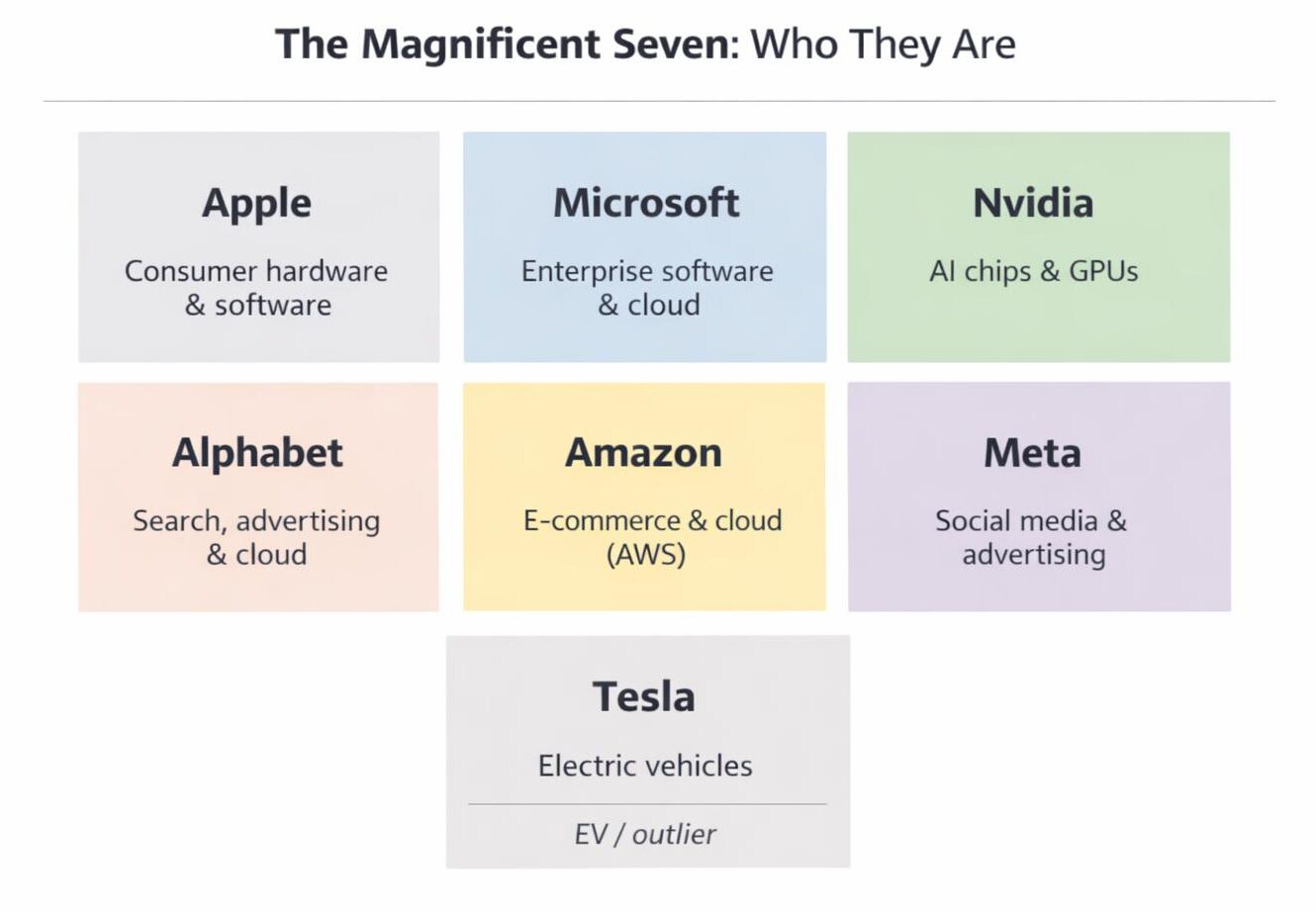
Each of the seven operates in a distinct segment of the technology economy, which is worth understanding rather than treating them as interchangeable.
- Apple is primarily a consumer hardware and software company, best known for the iPhone, Mac computers, and a growing services segment that includes the App Store and Apple Pay.
- Microsoft operates across enterprise software, cloud computing through Azure, and productivity tools including Microsoft 365. It has also made significant investments in artificial intelligence through its relationship with OpenAI.
- Nvidia manufactures graphics processing units (GPUs) that have become central to AI model training. Its growth accelerated sharply as demand for AI infrastructure increased.
- Alphabet is the parent company of Google, YouTube, and Google Cloud. Advertising revenue remains its largest business segment, though cloud computing and AI investments have grown substantially.
- Amazon combines a large e-commerce operation with Amazon Web Services (AWS), one of the world’s leading cloud computing platforms. It also operates advertising, streaming, and logistics businesses.
- Meta owns Facebook, Instagram, and WhatsApp. Its revenue is heavily advertising-driven, and the company has made substantial investments in virtual and augmented reality technologies.
- Tesla is the outlier in many ways. It is primarily an electric vehicle manufacturer rather than a software or internet company, though it also develops energy storage products and autonomous driving software.
Why These Companies Matter to Investors
Source: Mooloo graphics
The practical reason investors pay attention to this group is their combined weight in major US stock indexes. Because indexes like the S&P 500 are weighted by market capitalization, meaning larger companies occupy a bigger share of the index, these seven companies have at various points represented a significant percentage of the total index value. This means that someone holding a basic S&P 500 index fund already has meaningful exposure to all seven companies, whether they realize it or not.
This concentration has become a genuine topic of discussion in investment circles. When a small number of stocks represent a large portion of an index, that index’s overall performance becomes heavily tied to how those companies perform. In years when these stocks rose sharply, the S&P 500 posted strong returns. In periods when they fell or stalled, broad index returns were pulled down accordingly. So far in 2026 the combined value of the 7 is down 1% while the overall market is up 9%.
The Concentration Risk Question
One of the most discussed aspects of the Magnificent Seven is what their dominance means for investors who believe they hold a diversified portfolio. Diversification is the practice of spreading investments across different assets so that poor performance in one area does not disproportionately affect the whole. However, if a large index fund is significantly weighted toward seven companies, the actual diversification is less than it appears.
This is not a new phenomenon. US market history includes other periods where a small number of large companies held outsized index weight. Concentration risk works in both directions: when concentrated holdings rise, portfolio returns can be strong, but when they fall, the downside is also amplified compared to a more evenly distributed portfolio.
Some investors and advisors have responded to this by seeking out equal-weight index funds, which hold each company in an index at roughly the same proportion regardless of size. Others have increased allocations to international stocks or small-cap stocks to reduce dependence on any single cluster of companies. These are trade-offs rather than clear-cut solutions, and each approach carries its own considerations.
Valuations and Growth Expectations
Much of the Magnificent Seven’s market value is tied to expectations about future earnings growth, particularly around artificial intelligence. High-growth companies are often priced at higher valuation multiples, meaning investors are paying more for each dollar of current earnings in anticipation of larger future profits.
This creates a different kind of risk than that associated with most stable, dividend-paying businesses. If growth expectations are not met, or if the broader AI investment thesis takes longer to materialize than markets assume, valuations can compress significantly. These are large, established, and profitable businesses, but their stock prices currently reflect very optimistic assumptions about future development – especially with regards to AI, which is currently uniquely unprofitable across the entire spectrum of vendors.
Valuations change constantly, and any assessment of whether these stocks are expensive or fairly priced at a given moment depends on current market data that readers should check independently.
How These Stocks Appear in Common Investment Products
Most US investors who hold any of the following already have exposure to some or all of the Magnificent Seven without necessarily selecting them individually.
- S&P 500 index funds
- Total US stock market index funds
- Large-cap growth ETFs
- Technology sector ETFs
- Target-date retirement funds that include broad US equity allocations
The degree of exposure varies depending on the fund’s construction and when it is reviewed. Investors who want to understand their current exposure can typically look up the top holdings of any fund through the fund company’s website or through financial data platforms. This is worth doing before deciding whether to increase, reduce, or simply maintain existing exposure.
Active Versus Passive Approaches
Some investors choose to buy shares in individual Magnificent Seven companies directly, either because they have a specific view on a company’s prospects or because they want more control over their exposure. This involves stock selection, which carries its own risks. Even large, well-known companies can underperform the broader market over extended periods, and individual stock positions tend to be considerably more volatile than diversified funds.
Passive index investing accepts whatever the index holds, including these companies at their current market weight. The case for this approach is that attempting to identify which companies will outperform tends to produce worse outcomes for most individual investors over the long term. The case against is that, at current concentration levels, investors are accepting significant exposure to a small group of companies by default.
Neither approach is universally superior. The right structure depends on an individual investor’s knowledge, risk tolerance, time horizon, and goals – none of which a general article can determine for a specific reader.
What Changes Over Time
Market groupings like the Magnificent Seven are snapshots of a particular moment in financial history. The companies that dominate today are not guaranteed to dominate tomorrow. Previous market leaders such as General Electric, Eastman Kodak, and Nokia were once considered pillars of modern industry before experiencing significant long-term declines. Market leadership rotates, sometimes gradually and sometimes abruptly.