
How to Compare Savings Accounts Before Opening One


Not all savings accounts work the same way, and the differences between them can have a meaningful impact on how much your money grows over time.
Choosing a savings account might seem straightforward, but the range of options available today is wider than most people expect. Between traditional banks, online banks, credit unions, and financial apps, the features, fees, and interest rates vary considerably. Understanding what to look for before opening an account helps you avoid common pitfalls and find an option that fits how you actually manage your money.
Annual Percentage Yield: The Number That Matters Most
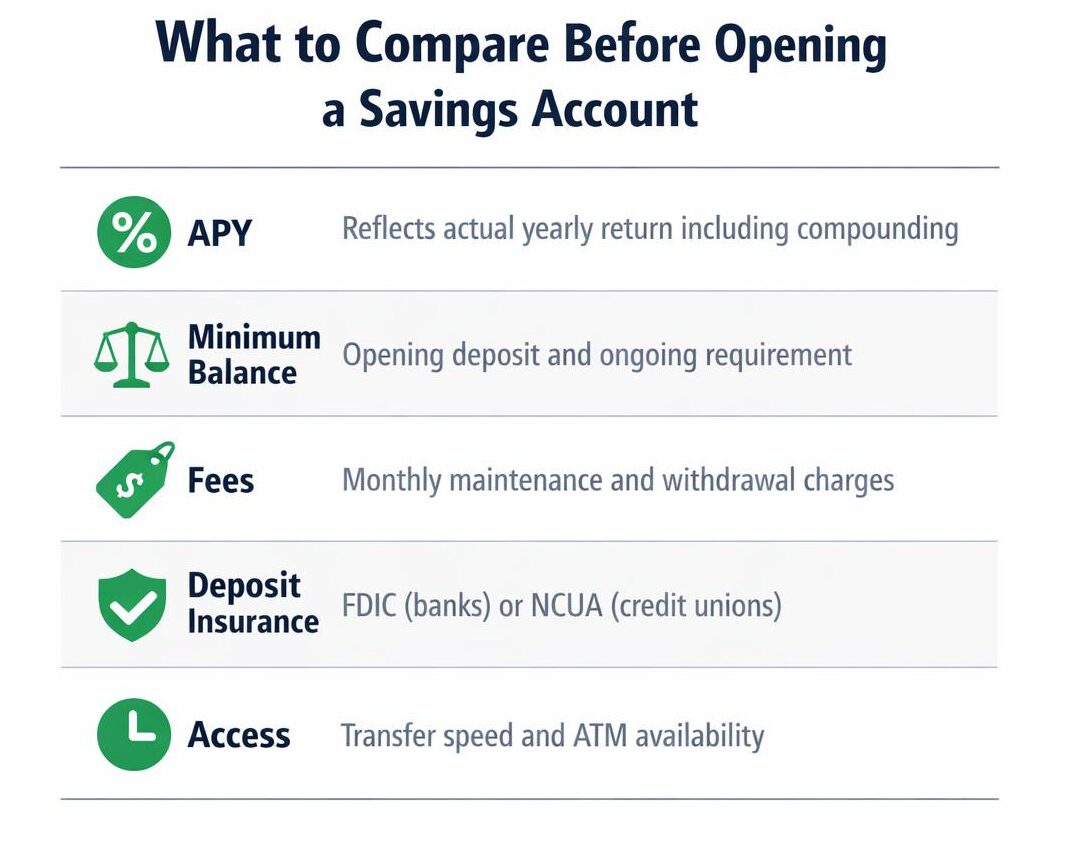
When comparing savings accounts, the annual percentage yield, or APY, is the most important rate to look at. APY reflects the actual return you earn on your balance over a full year, including the effect of compounding interest. This is different from the nominal interest rate, which does not account for compounding.
For example, if a bank compounds interest monthly rather than annually, the APY will be slightly higher than the stated nominal rate. When you see an advertised APY, that figure already factors in compounding, so it gives you a more accurate basis for comparing accounts with different compounding frequencies.
APY rates on savings accounts change over time in response to broader interest rate conditions, which are influenced by Federal Reserve policy. This means that a rate that looks attractive today may not stay the same. Most savings accounts carry variable rates, so it is worth checking periodically whether your current account remains competitive.
Minimum Balance Requirements and How They Affect You
Some savings accounts require you to maintain a minimum balance to earn the advertised APY, to avoid monthly fees, or simply to keep the account open. These requirements vary widely. Some accounts have no minimums at all, while others may require several hundred or even several thousand dollars to unlock the best rates.
There are two common types of minimums to understand. The first is a minimum opening deposit, which is the amount you need to deposit when you first open the account. The second is an ongoing minimum balance, which is the amount you need to maintain to avoid fees or qualify for a higher rate.
If an account requires a minimum balance to waive a monthly fee, but your savings fluctuate and sometimes fall below that threshold, those fees will reduce your actual earnings. Even a small monthly fee can offset a meaningful portion of the interest earned on a modest balance. Accounts with no minimum balance requirements are often a simpler choice for those who are just starting to save or whose balances vary month to month.
Fees That Can Quietly Reduce Your Balance
Source: Mooloo graphics
Beyond minimum balance fees, savings accounts can carry a range of other charges that are worth reviewing before you apply. Common fees include monthly maintenance fees, excessive withdrawal fees, paper statement fees, and fees for outgoing wire transfers.
One fee that catches some account holders off guard relates to transaction limits. Federal regulations historically capped certain types of withdrawals and transfers from savings accounts at six per month under Regulation D, though the Federal Reserve suspended this federal limit in 2020. However, many banks continue to enforce their own internal limits and may charge fees if you exceed them. Policies differ from one institution to another, so it is worth confirming the specific rules before opening an account.
Reading the fee schedule before opening an account is one of the most practical steps you can take. Banks are required to disclose their fees, and most publish a full schedule on their website. Prioritizing accounts with no monthly maintenance fees tends to simplify ongoing management considerably.
Online Banks Versus Traditional Banks
Online banks frequently offer higher APYs than traditional brick-and-mortar banks. The reason is straightforward: online banks operate with lower overhead costs because they do not maintain physical branch networks, and they often pass some of those savings along to customers through better rates.
The trade-off is the absence of in-person service. If you prefer to speak with someone face to face, resolve issues at a branch, or deposit cash regularly, a traditional bank may be a better fit. Some people also place value on a bank with a visible physical presence, which is a reasonable personal consideration.
Credit unions are another option worth considering. They are member-owned, not-for-profit institutions that often offer competitive rates and lower fees than commercial banks. To join a credit union, you typically need to meet eligibility criteria such as living in a certain geographic area, working for a specific employer, or belonging to a qualifying organization. Membership requirements vary, so it is worth checking what options are available to you.
FDIC and NCUA Insurance
When comparing savings accounts, verifying that your deposits are insured is a basic but important step. The Federal Deposit Insurance Corporation, or FDIC, insures deposits at member banks up to defined limits per depositor, per institution, per account ownership category. The National Credit Union Administration, or NCUA, provides equivalent protection for deposits at federally insured credit unions under the same general framework.
Coverage limits and the rules governing how they apply to different account types and ownership structures are detailed and can change over time. The FDIC and NCUA both maintain resources on their websites that explain current coverage limits and how to calculate your total coverage. If you hold large balances or accounts at multiple institutions, understanding how to maximize your FDIC coverage is important.
Accounts offered through non-bank financial apps or fintech platforms may or may not carry FDIC insurance depending on how they are structured. Some of these services hold customer funds at partner banks that are FDIC members, which may extend deposit insurance to those accounts. Others operate differently. Reviewing the specific terms before depositing money is a sensible precaution, particularly for larger amounts. It’s important to note that there is no FDIC insurance for savings with ‘crypto’ institutions like Nexo or Crypto.com.
Access to Your Money
How easily you can access your money is a practical factor that often gets overlooked when comparing savings accounts. Consider how you would transfer funds to your checking account, how long those transfers typically take, and whether the bank charges for expedited transfers.
Some online banks process external transfers within one business day, while others may take two to three business days. If your savings account is held at a different institution from your checking account, transfer timing becomes relevant in situations where you need funds quickly. Accounts at the same institution as your checking account typically allow near-instant internal transfers.
ATM access is another practical consideration. Some savings accounts come with an ATM card, though many do not. If you want the ability to withdraw cash directly from your savings account, checking whether an ATM card is available and what fees may apply across different ATM networks is worth doing before you apply.
Features That May or May Not Matter to You
Beyond the basics, some savings accounts include additional features that are worth understanding even if they do not apply to every saver. Automatic savings tools allow you to set up recurring transfers from checking to savings on a schedule you choose. Some banks also offer sub-accounts or savings buckets that let you organize money toward different goals within a single account.
Relationship benefits are another consideration at larger banks. Some institutions offer better savings rates or waived fees to customers who also hold a checking account, mortgage, or investment account with them. Whether the overall package is competitive compared to standalone options depends on the specific rates and fees involved. Running the numbers for your own situation is a more reliable approach than assuming a bundled relationship is automatically the better deal.
How to Structure Your Comparison
When you are ready to compare accounts side by side, a straightforward framework helps. Start by noting the APY, minimum balance requirements, monthly fees, and deposit insurance status for each account you are considering. Then think about practical access: how transfers work, how long they take, and whether ATM access matters to you.
Rate comparison websites can give you a useful starting point for identifying competitive offers, but always verify the details directly with the bank or credit union before applying. Promotional rates sometimes apply only to new customers, only for a limited introductory period, or only up to a certain balance tier. Reading the account terms carefully helps ensure the account you choose works the way you expect once it is open.