
Money Market Account vs Savings Account Explained


If you’re comparing a money market account and a savings account, the differences are subtle enough that many people open the wrong one for their needs without realizing it.
Both accounts are designed to hold cash safely, earn some interest, and keep your money accessible. But they work differently in practice, and the choice between them can affect how conveniently you access funds, how much interest you earn, and what features you get. Understanding how each account is structured helps you make a more informed decision when choosing where to keep your short-term or emergency savings.
What Is a Savings Account
A savings account is a deposit account offered by banks and credit unions that pays interest on the balance you hold. It is one of the most basic products in personal banking. You deposit money, the bank pays you interest at a stated rate, and your funds remain accessible when you need them.
The interest rate on a savings account is expressed as an annual percentage yield, or APY. This figure reflects how much your money grows over a year, including the effect of compounding. Rates vary widely between institutions. Traditional brick-and-mortar banks often pay very low rates, while online banks and credit unions frequently offer more competitive yields. Rates can change at any time because savings account rates are variable, not fixed.
Savings accounts are covered by federal deposit insurance up to the applicable limit per depositor per institution, either through the FDIC for banks or the NCUA for credit unions. This insurance protects your deposits if the institution fails, up to those limits.
One feature worth noting is that many banks impose their own limits on outgoing transactions from savings accounts each month. Historically, a federal rule called Regulation D set a hard cap on certain withdrawals and transfers, but that rule was suspended and has not been reinstated as a federal requirement. Even so, individual institutions may still enforce their own transaction limits. It is worth checking the specific terms of any savings account you consider opening.
What Is a Money Market Account
A money market account, sometimes called an MMA, is also a deposit account offered by banks and credit unions. It shares many features with a savings account but typically includes a few additional options. Most money market accounts allow you to write checks directly from the account or use a debit card, which standard savings accounts usually do not offer.
Like savings accounts, money market accounts pay variable interest and are covered by federal deposit insurance through the FDIC or NCUA up to the applicable limits. Rates on money market accounts can sometimes be higher than those on standard savings accounts, particularly at competitive institutions, but this is not always the case. The difference in rates between the two account types varies depending on the institution and the broader interest rate environment.
Money market accounts are sometimes confused with money market funds, but they are different products. A money market fund is an investment product, typically offered through a brokerage, that invests in short-term debt instruments. It is not a bank deposit account and is not FDIC insured. A money market account at a bank or credit union is a deposit account with federal insurance protection.
Key Differences Between the Two Accounts
Source: Mooloo graphics
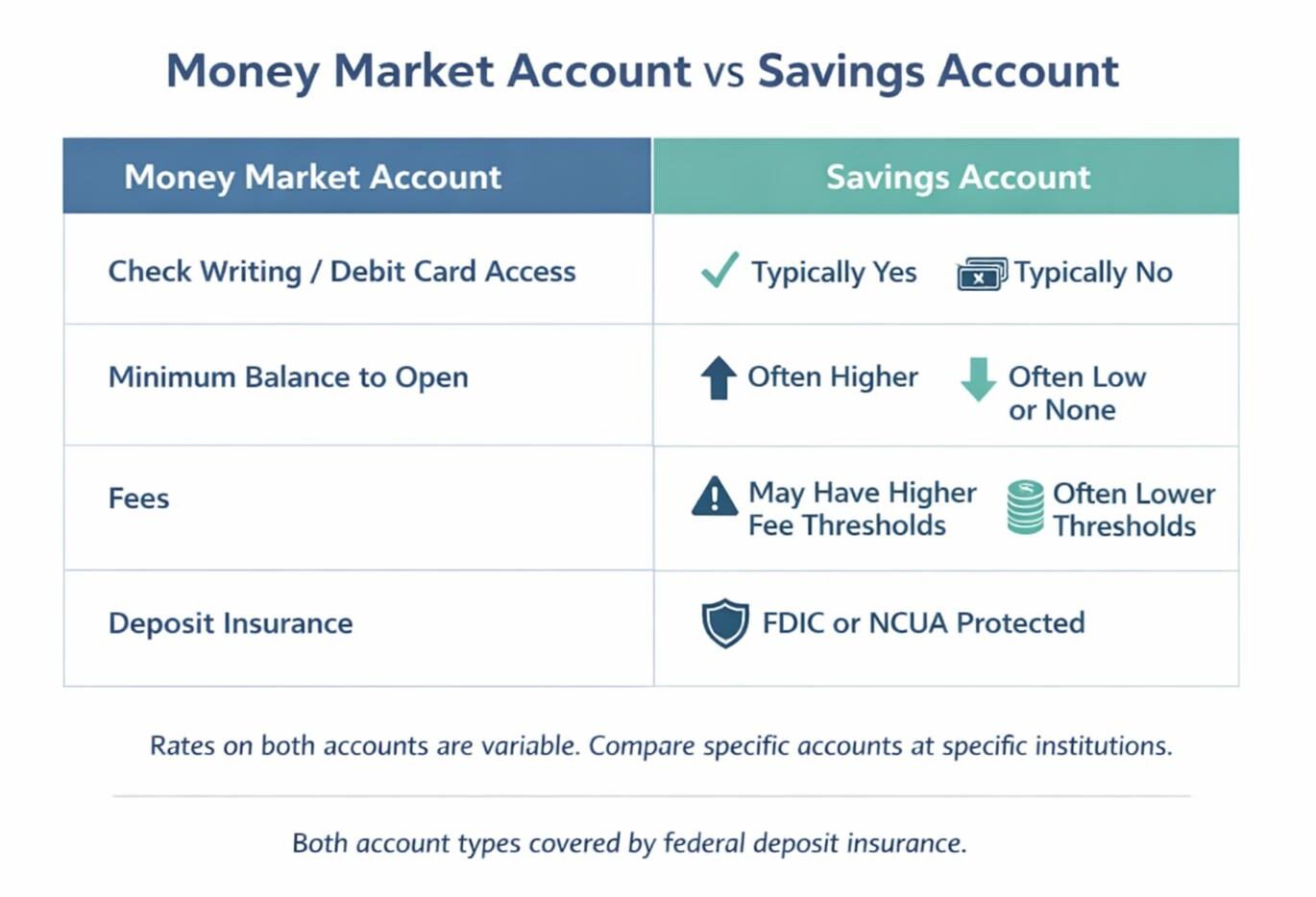
The practical differences between a money market account and a savings account largely come down to access and minimum balance requirements rather than fundamental structural differences. Here is a comparison of the areas where they typically diverge.
- Check writing and debit access: Money market accounts usually allow check writing or come with a debit card. Savings accounts typically do not. This makes money market accounts more flexible for occasional direct payments from the account.
- Minimum balance requirements: Money market accounts often require a higher minimum balance to open or to avoid fees. Savings accounts, especially at online banks, can frequently be opened with little or no minimum deposit.
- Interest rates: Rates on both account types are variable and change with market conditions. Neither account type is guaranteed to pay a higher rate than the other. Comparing specific accounts at specific institutions is more reliable than assuming one type always pays more.
- Transaction limits: Both account types may have monthly limits on certain withdrawals or transfers, depending on the institution’s own policies. Checking the terms before opening either account is advisable if frequent access matters to you.
- Fees: Both types can carry monthly maintenance fees, though many can be waived by maintaining a minimum balance or meeting other conditions. Money market accounts sometimes have higher fee thresholds tied to their higher minimum balance requirements.
When a Savings Account Makes More Sense
A savings account is often the simpler starting point for people building an emergency fund or setting aside money for a specific goal. If you are just beginning to save, the lower or no minimum balance requirement at many savings accounts means you can start with whatever amount you have available.
High-yield savings accounts at online banks have become increasingly popular because they often offer competitive rates without requiring large balances or charging monthly fees. For someone who wants to hold money safely, earn some interest, and avoid the pressure of maintaining a high balance, a savings account is usually the more straightforward choice.
Savings accounts also tend to have simpler terms. Without check-writing features, there is less to manage and fewer decisions to make about how to use the account day to day.
When a Money Market Account Makes More Sense
A money market account can be a useful option if you want a safe place to hold a larger cash balance while retaining the ability to write occasional checks directly from the account. This can be practical for holding a business reserve, a down payment you plan to use within a year, or a larger emergency fund that you want to access without first transferring funds to a checking account.
Some people use money market accounts to hold cash that is waiting to be deployed, such as money set aside for a large purchase or a planned investment. The check-writing feature allows you to pay directly from the account when needed, avoiding an extra transfer step.
If you can comfortably meet the minimum balance requirement and you value the flexibility of check writing or a debit card, a money market account can offer more convenience than a standard savings account, even when the rate difference between the two is modest.
How to Compare Accounts Practically
When evaluating any savings or money market account, it helps to look beyond the advertised rate and review the full set of terms. Things worth checking include the current APY and how it is structured, any minimum balance requirements to earn the stated rate, monthly fees and the conditions needed to waive them, transaction limits and what happens if you exceed them, and whether the account features a promotional rate that will drop after an introductory period.
Rates and terms across both account types change regularly. An account offering a strong rate today may lower it within months. Comparing options at several banks or credit unions before opening an account is a reasonable step, and revisiting those comparisons periodically can help you identify whether better options have become available.
Safety and Insurance Considerations
Both savings accounts and money market accounts at FDIC-insured banks are protected up to the federal deposit insurance limit per depositor, per institution, per ownership category. Credit union members receive equivalent protection through the NCUA. Coverage limits can change over time, so it is worth confirming the current figures directly with the FDIC or NCUA if your balance is substantial.
If you hold more than the insured limit at a single institution, the amount above that threshold is not covered by federal insurance. One approach in this situation is to spread deposits across multiple insured institutions. If you are managing balances near or above insurance thresholds, speaking with a financial professional can be worthwhile.
Putting the Choice in Context
The decision between a money market account and a savings account matters less than finding an account with a competitive rate, low fees, and terms that fit how you plan to use it. Both account types serve the same core purpose: holding cash safely while earning some return. The practical differences are real but relatively narrow.
For most people, the right account is the one that offers a fair yield, fits within their balance range, and is straightforward to manage. Comparing a handful of accounts at different institutions, reading the actual terms, and checking rates periodically tends to produce better outcomes than assuming one type is always superior to the other.