
How to Check Your Credit Report for Errors


Your credit report can contain mistakes that lower your credit score without you ever knowing they exist as a study by the Federal Trade Commission found that a meaningful percentage of consumers had at least one error on a credit report that could affect their score.
Some errors are minor, but others, such as accounts that do not belong to you or missed payments that were actually made on time, can have a real impact on your ability to borrow money or secure favorable interest rates. Checking your credit report regularly is a straightforward process, and understanding what to look for makes the task much easier.
What Is a Credit Report and Where Does It Come From?
Your credit report is a detailed record of your borrowing history. It includes information about credit cards, loans, mortgages, and other accounts you have opened. It also shows your payment history on those accounts, any collections activity, public records such as bankruptcies, and a list of recent inquiries made by lenders or other parties who have accessed your file.
The three major credit bureaus that compile and maintain credit reports in the United States are Equifax, Experian, and TransUnion. Each bureau collects information independently, which means your report at one bureau may look slightly different from your report at another. Lenders are not required to report to all three bureaus, so some accounts may appear at only one or two of them. This is why it’s worth checking all three reports rather than assuming they contain identical information.
How to Get Your Credit Reports
Federal law entitles consumers to free credit reports through AnnualCreditReport.com, which is the official site authorized under the Fair Credit Reporting Act. Conveniently, you can request reports from all three bureaus through this site. The frequency at which free reports are available has changed over time, so it is worth checking the current policy directly on the site or through the Consumer Financial Protection Bureau.
Some people choose to space out their requests over the year, checking one bureau every few months, while others prefer to pull all three at once for a side-by-side comparison. Neither approach is wrong. If you have recently been denied credit or are planning a major financial decision such as applying for a mortgage, reviewing all three at the same time can be useful.
Avoid third-party sites that advertise free credit reports but require a credit card or subscription to access them. The official AnnualCreditReport.com site does not require payment information to provide your free reports.
What to Look For When Reviewing Your Reports
Source: Mooloo graphics
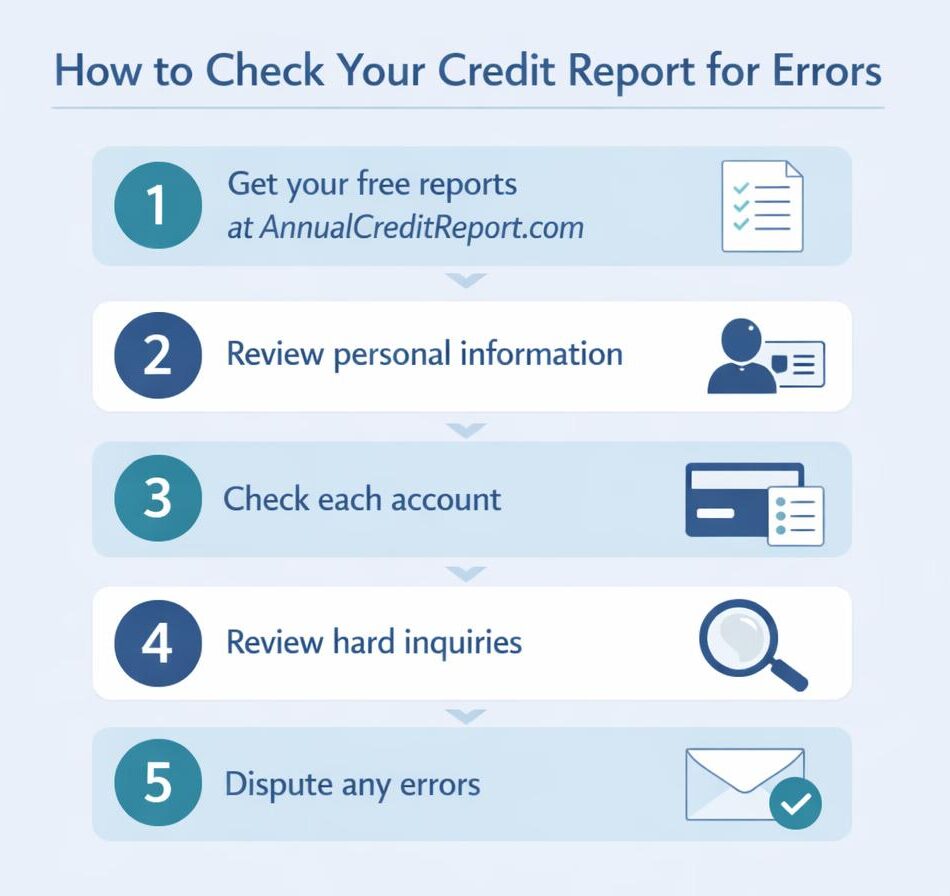
Once you have your reports, go through each one carefully. The volume of information can feel overwhelming at first, but breaking it into sections makes it manageable.
Start with your personal information. Check that your name, current and previous addresses, date of birth, and Social Security number are recorded correctly. Errors in this section do not always affect your score directly, but they can sometimes be a sign of identity theft or a mixed file, where one person’s information gets combined with another person’s account history.
Next, review the list of accounts. For each account, check the following:
- Is the account actually yours, or does it belong to someone else with a similar name?
- Is the account status correct? For example, does it show as open when you closed it?
- Are the payment history records accurate? A late payment that was actually made on time is a common and consequential error.
- Is the account balance or credit limit listed correctly?
- If an account was included in a bankruptcy, is it marked as such rather than showing an unpaid balance?
- Are there any duplicate accounts listed, where the same debt appears more than once?
Negative items such as late payments, collections, and charge-offs generally remain on your credit report for seven years from the date of the original missed payment. Bankruptcies may remain longer depending on the type filed. If a negative item has stayed on your report beyond its legally permitted timeframe, that is worth disputing. If you have received a debt notice and don’t understand what is being asked or stated you can analyze it and receive a full report here at no charge.
Checking the Inquiries Section
Credit reports include a section listing recent inquiries. There are two types: hard inquiries and soft inquiries. Hard inquiries occur when a lender reviews your credit as part of an application decision, and they can have a small, temporary effect on your score. Soft inquiries happen when you check your own credit or when companies pull your information for background checks or pre-approval offers. Soft inquiries do not affect your score.
Look through the hard inquiries and make sure you recognize each one. If you see a hard inquiry from a lender you never applied to, that could indicate someone has attempted to open credit in your name without your knowledge. A single unfamiliar inquiry may not be cause for immediate alarm, but several unrecognized ones deserve prompt attention.
How to Dispute an Error
If you find an error, you have the right to dispute it with the credit bureau reporting the incorrect information. You can also contact the creditor or lender that provided the information, known as the data furnisher.
Filing a dispute directly with the bureau is usually the first step. All three major bureaus allow disputes to be submitted online through their individual websites. You can also submit disputes by mail, which some people prefer because it creates a paper trail. When submitting a dispute, include a clear explanation of what is incorrect and attach any supporting documentation you have, such as a bank statement showing a payment was made on time or a letter confirming an account was closed.
Under the Fair Credit Reporting Act, the bureau is generally required to investigate your dispute and respond within 30 days, though you should verify the current rules as they may be subject to change. If the investigation confirms an error, the bureau must correct or remove the item. If the bureau concludes the information is accurate and you still believe it is wrong, you have the option to add a brief statement to your file explaining your position. You can also escalate the matter by filing a complaint with the Consumer Financial Protection Bureau.
Errors Versus Negative but Accurate Information
It is worth understanding the difference between an error and information that is negative but accurate. If you genuinely missed a payment, that record is not an error, and disputing accurate negative information is unlikely to succeed. The dispute process exists to correct inaccuracies, not to remove legitimate history.
If accurate negative items are affecting your score, the most effective response over time is to build a consistent record of on-time payments going forward and to reduce outstanding balances where possible. Those steps tend to have a more meaningful effect on your score than attempting to challenge accurate information.
Staying on Top of Your Credit File Over Time
Checking your credit report once a year is a reasonable minimum, but there are situations where more frequent reviews make sense. If you are preparing to apply for a mortgage, car loan, or other significant credit in the coming months, reviewing your reports ahead of time gives you a chance to address any issues before a lender sees them.
If you have experienced identity theft or believe your personal information has been compromised, more frequent monitoring is sensible. Some people place a credit freeze on their files as a precaution, which restricts new credit from being opened in their name. A freeze does not affect your existing accounts or your credit score, and it can be lifted temporarily when you need to apply for credit. Each bureau handles freeze requests separately, so you would need to contact all three to put a full freeze in place.
Keeping your contact information current with lenders also helps ensure that account information is reported accurately. Small administrative details, such as making sure your name and address are consistent across accounts, can reduce the chance of records being mixed or misattributed.