How to Open a Bank Account After Being Denied


Being denied when you try to open a bank account is more common than most people realize, and it does not have to be a permanent situation. Banks and credit unions in the United States use consumer reporting agencies to screen new account applicants, and a negative history with a previous account can result in a denial.
Understanding why this happens, what records are involved, and what your realistic options are can help you move forward and establish or rebuild a banking relationship.
Why Banks Deny Account Applications
Most people assume that credit scores are the reason they get denied for a bank account, but that is usually not the case. For checking and savings accounts, banks typically rely on a separate consumer reporting agency called ChexSystems, along with a similar service called Early Warning Services (EWS). These agencies maintain records of banking history, not credit behavior.
A negative ChexSystems or EWS report can include information such as:
- Unpaid negative balances from a previous account
- Overdraft abuse or excessive overdraft history
- Suspected fraud or account misuse
- Bounced checks that were never resolved
- Accounts that were closed involuntarily by a bank
Banks use this information to assess the risk of opening a new account. If your report shows unpaid debts to a previous bank or a pattern of problematic account behavior, many institutions will decline the application. Some banks also run a soft credit inquiry as part of the process, though this is typically secondary to the banking history check.
Your Right to Know Why You Were Denied
Under the Fair Credit Reporting Act (FCRA), if a bank denies your application based on information from a consumer reporting agency like ChexSystems or EWS, they are required to provide you with an adverse action notice. This notice will identify which agency supplied the information used in the decision.
You are then entitled to request a free copy of your report from that agency. ChexSystems and Early Warning Services both allow you to request your consumer disclosure report at no cost, either through their websites or by mail. Reviewing your report is an important first step because it shows you exactly what negative information is on file and gives you something concrete to work with.
It is worth reviewing your report carefully, as errors do appear in these records. If something is inaccurate or outdated, you have the right to dispute it. Both ChexSystems and EWS have formal dispute processes, and inaccurate information that cannot be verified must be corrected or removed. Negative information in ChexSystems typically remains on your record for up to five years, though you should confirm current timeframes directly with the agency.
Resolving Outstanding Issues on Your Report
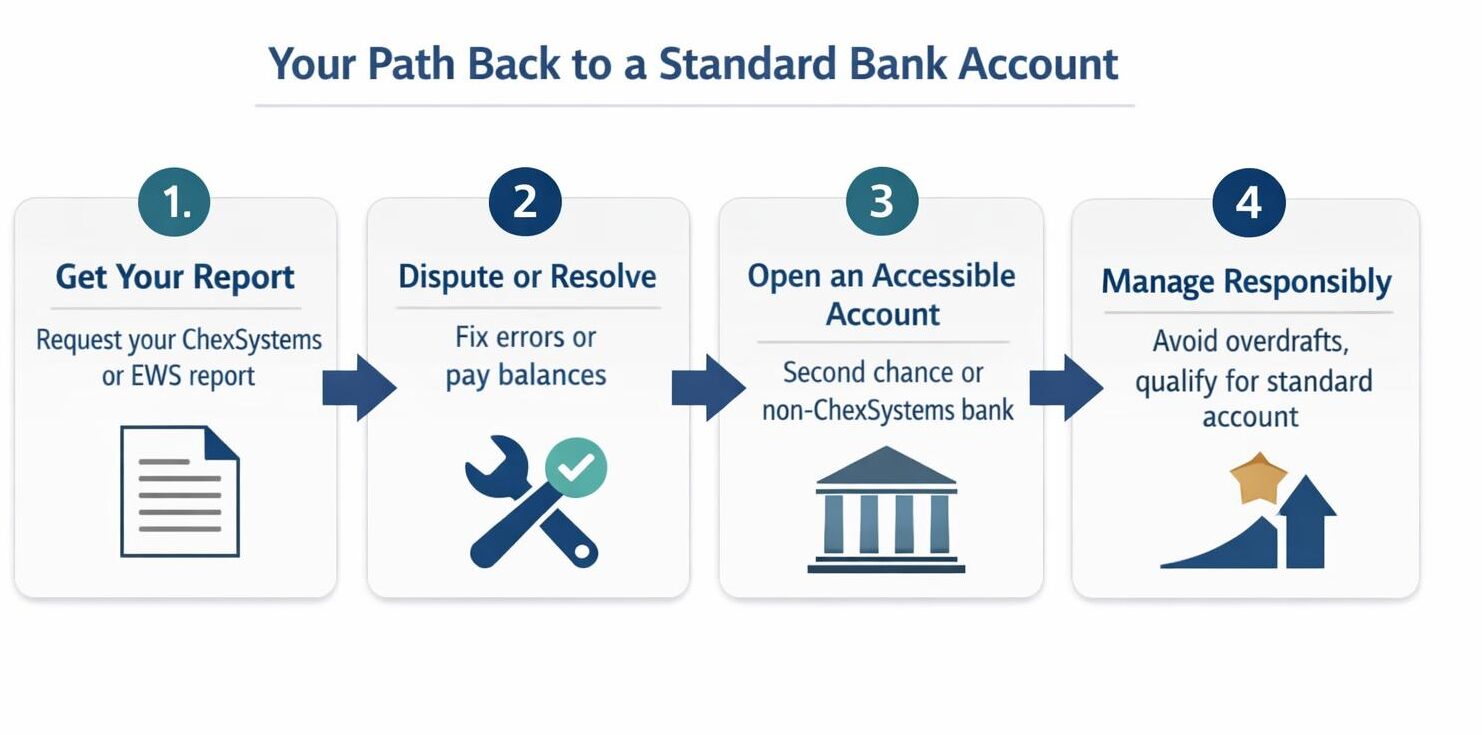
If you have a legitimate negative entry on your banking report, the most direct path forward is to address it. If you owe a balance to a previous bank from an overdrawn account, paying that debt may help in more than one way. Some banks will not open an account for you while you have an unresolved balance with another institution, and settling the debt removes that barrier.
Once you pay off an old banking debt, you can contact ChexSystems or EWS to request that the entry be updated to reflect the payment. Not all entries are automatically removed when you pay, so following up is often necessary. Keep records of your payment in case there is any dispute later.
If the negative entry is old and approaching the end of the reporting window, waiting for it to age off may be a reasonable option, particularly if the amount involved is small or the cost of resolving it outweighs the near-term benefit.
Second Chance Checking Accounts
A second chance checking account is designed for people who have been denied a standard checking account. Many banks and credit unions offer them as an accessible starting point rather than a full-featured account.
These accounts typically come with some limitations compared to a standard checking account. Common features and restrictions include:
- Monthly fees that may not be waivable
- No overdraft protection or limited overdraft options
- Debit card access for everyday spending
- Direct deposit capability
- No paper checks or limited check writing
The key benefit of a second chance account is that it gives you a functional banking relationship. You can receive direct deposits, pay bills electronically, and build a positive track record with an institution. Some banks will upgrade you to a standard account after a period of responsible use, though the criteria and timeframes vary by institution.
Credit unions sometimes offer more flexible second chance programs than large national banks. Because credit unions are member-owned, they may be more willing to work with people who have complicated banking histories. Eligibility requirements vary, but many credit unions are open to broad groups based on geography, employer, or other criteria.
Bank Accounts That Do Not Use ChexSystems
Some banks and financial institutions do not use ChexSystems or Early Warning Services when evaluating new accounts. These institutions may still run identity verification, but they do not screen based on past banking history in the same way.
This can be a practical option if your ChexSystems report has unresolved issues and you need immediate access to banking services. Online banks and fintech companies have expanded this space, with some offering accounts that bypass the traditional ChexSystems review. The list of institutions that do not use these services changes over time, so it is worth researching current options rather than relying on any fixed list.
One important consideration is that accounts offered by non-bank financial technology companies may not carry FDIC insurance in the same straightforward way a traditional bank account does. Always confirm whether an account is held at an FDIC-insured bank and understand the terms before depositing money. FDIC insurance protects deposits up to applicable limits per depositor, per insured bank, and per ownership category. Current coverage details are available through the FDIC’s official website at fdic.gov.
Prepaid Debit Cards as a Short-Term Option
A prepaid debit card is not a bank account, but it can serve as a functional alternative while you work toward qualifying for one. You load money onto the card and spend up to that balance, with no credit check and no ChexSystems review involved.
Prepaid cards are useful for everyday purchases and can often receive direct deposits. However, they typically carry fees that a standard bank account would not, such as activation fees, monthly maintenance fees, ATM withdrawal fees, and reload fees. These costs accumulate over time, which is why a prepaid card tends to work better as a short-term bridge than a long-term substitute for a bank account.
Building Toward a Standard Account
If you open a second chance account or a non-ChexSystems account, managing it carefully is the most effective way to work toward qualifying for a standard checking account. This means avoiding overdrafts, keeping the account in good standing, and not allowing a negative balance to go unresolved.
Positive account behavior does not automatically appear in your ChexSystems report the way negative behavior does. However, some banks and credit unions do report positive account history to EWS, and responsible account management over time builds a track record you can point to when applying elsewhere. Keeping documentation such as statements showing consistent use can be helpful when you apply for a standard account in the future.
The path back to standard banking services is available to most people who have been denied. It typically involves some combination of resolving past issues, using accessible account options responsibly, and allowing negative records to age off. None of these steps are complicated on their own, but they do require a consistent and patient approach over time.