Index Funds vs ETFs: Key Differences


Index funds and ETFs are often mentioned in the same breath, and for good reason as they both track market indexes and offer low-cost diversification. But the way they work and how you can use them are meaningfully different.
For investors trying to build a simple, low-cost portfolio, understanding the distinction between these two vehicles matters more than you think. The differences show up in how you buy and sell them, how they handle taxes, what minimum investments apply, and how they behave inside different types of accounts. Neither is universally better. Each suits different situations, and knowing how they compare helps you make more informed choices about how to structure your investments.
What an Index Fund Actually Is
An index fund is a type of mutual fund designed to replicate the performance of a specific market index, such as the S&P 500, the total US stock market, or a bond index. Rather than having a portfolio manager actively select securities, the fund simply holds the same securities as the index it tracks, in roughly the same proportions.
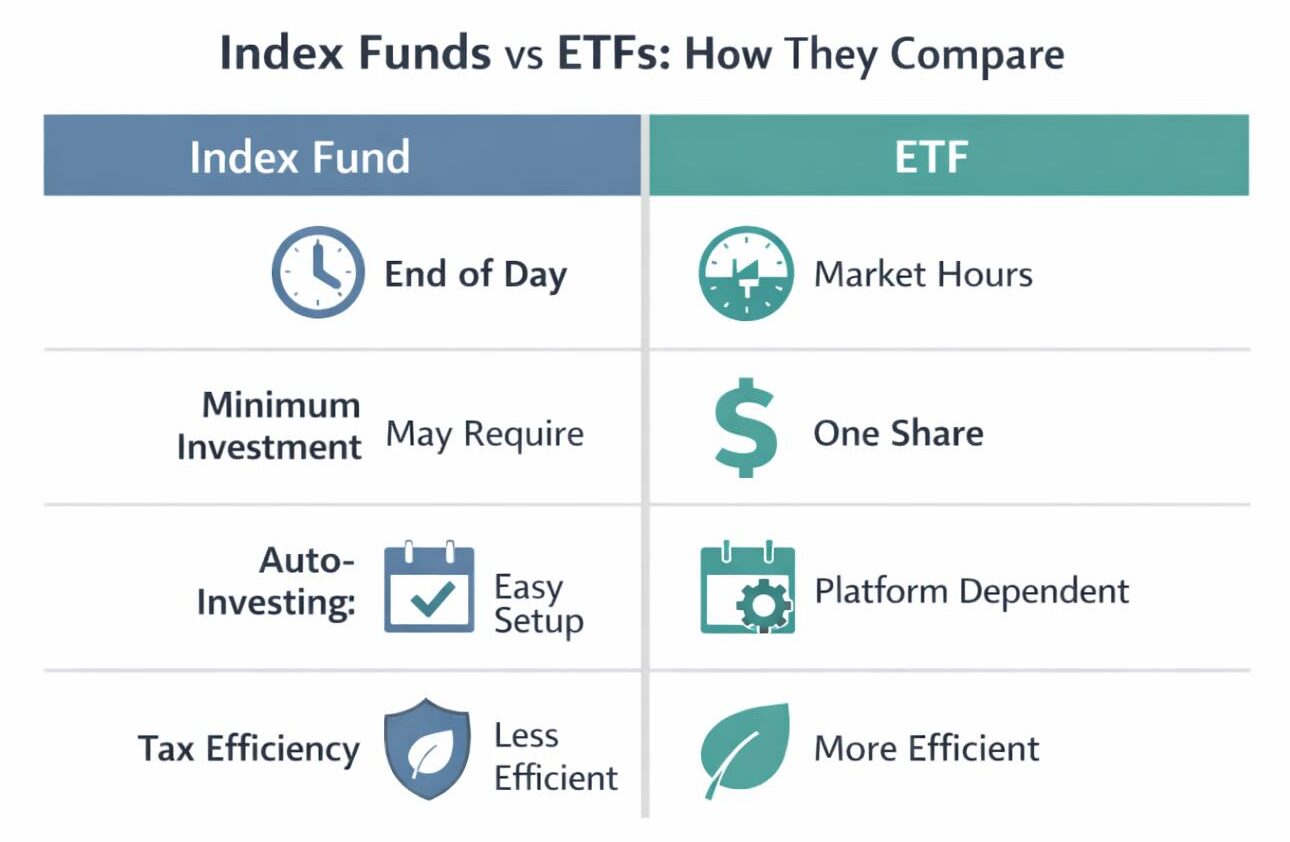
You buy shares of an index fund directly through the fund company or through a brokerage account. The price you pay is the fund’s net asset value, which is calculated once per day after the market closes. No matter when you place your order during the trading day, every investor who buys or sells that day receives the same end-of-day price.
Index funds sometimes have minimum initial investment requirements. Some fund families set these minimums at several hundred or several thousand dollars, while others have reduced them to zero for certain funds. It is worth checking current minimums directly with fund providers, as these figures change from time to time.
What an ETF Actually Is
An ETF, or exchange-traded fund, is a fund that holds a basket of securities, often tracking an index. But unlike index funds which you purchase directly from the provider, ETFs trade on a stock exchange throughout the day just like an individual stock. You buy and sell ETFs through a brokerage account, and the price fluctuates in real time based on supply and demand during market hours.
Most ETFs are structured as index-tracking vehicles, which is why they are frequently compared to index funds. Indeed, the underlying holdings can be nearly identical. For example, a Vanguard S&P 500 index mutual fund and a Vanguard S&P 500 ETF may hold essentially the same stocks in the same proportions, but the mechanics of owning them differ.
ETFs typically have no minimum investment beyond the price of a single share. With many brokerages now offering fractional shares, the barrier to entry can be even lower. This makes ETFs accessible to investors who are just starting out with smaller amounts.
How Trading Works Differently
Source: Mooloo graphics
The most practical difference between the two comes down to how you actually buy and sell them. With a traditional index mutual fund, you place an order and receive the closing price for that day, regardless of market movements earlier in the session. This simplicity suits investors who are not concerned with intraday price changes, which most long-term investors are not.
ETFs trade continuously during market hours. You can buy at one point in the day and sell at another if you choose. You also have access to order types like limit orders, which let you set a maximum price you are willing to pay, and stop orders, which can trigger a sale if the price falls to a specified level. For long-term investors holding through decades, these features would typically go unused, but they do add flexibility for those who want it.
The real-time trading of ETFs also introduces a concept called the bid-ask spread. When you buy an ETF, you pay the ask price; when you sell, you receive the bid price. The difference between these two figures is a small, often overlooked transaction cost that does not exist with mutual fund transactions. For widely traded ETFs, this spread is typically very narrow, but it is worth being aware of.
Tax Efficiency Differences
For taxable brokerage accounts, the structural difference between index funds and ETFs has real tax implications. ETFs generally hold a tax advantage due to how they handle redemptions.
When investors want to exit a mutual fund, the fund typically sells underlying securities to raise cash for the payout. Those sales can generate capital gains distributions that all remaining shareholders receive, potentially creating a tax bill even for investors who did not sell anything themselves. This can occur with index mutual funds, though it happens less frequently than with actively managed funds.
ETFs use a different mechanism called in-kind creation and redemption. Large institutional investors exchange baskets of the underlying securities for ETF shares, rather than cash. This process allows ETFs to transfer out low-cost-basis securities without triggering a taxable sale at the fund level. As a result, ETFs tend to distribute capital gains far less frequently than mutual funds do.
For accounts where taxes are deferred or avoided, such as traditional IRAs, Roth IRAs, or 401(k) plans, this difference largely disappears. Inside those accounts, capital gains distributions do not create an immediate tax event, so the tax efficiency advantage of ETFs becomes less relevant.
Cost Comparisons
Both index funds and ETFs are known for low expense ratios compared to actively managed funds. The expense ratio is the annual fee charged as a percentage of your investment, and it is deducted from the fund’s assets rather than billed separately.
Many index mutual funds and their ETF counterparts from the same provider carry identical or nearly identical expense ratios. In some cases, a mutual fund version of a strategy carries a slightly lower expense ratio than the comparable ETF, particularly for investors who meet certain asset thresholds. In other cases, the ETF version is marginally cheaper. The gap, where it exists, is generally small.
Beyond the expense ratio, ETF investors may encounter brokerage commissions when buying or selling, though most major brokerages have eliminated commissions on ETF trades. The bid-ask spread remains a real, if typically small, transaction cost. Index mutual funds purchased directly through the issuing fund company generally have no transaction costs.
Automatic Investing and Account Considerations
One area where index mutual funds have a practical edge for many investors is automatic investing. Many fund companies allow you to set up scheduled contributions, directing a fixed dollar amount into a mutual fund on a regular basis. Because purchases are priced at the calculated net asset value, fractional shares are handled automatically.
ETFs are priced like stocks, which historically made automated dollar-cost averaging more complicated. Investors generally had to buy whole shares, meaning a fixed contribution amount might leave small cash balances uninvested. The growth of fractional share investing has addressed this at many brokerages, but availability still varies by platform.
Inside employer-sponsored retirement plans like 401(k)s, index mutual funds are the standard option. Most 401(k) platforms do not offer ETFs as investment choices. If your primary investment vehicle is a workplace retirement account, you are almost certainly investing through mutual funds, and the comparison may not apply to that portion of your portfolio at all.
Which Situations Each Tends to Suit
For investors using tax-advantaged accounts and preferring simplicity, index mutual funds are a practical and time-tested choice. The automatic investing features, straightforward end-of-day pricing, and absence of bid-ask spreads make them easy to use consistently over time.
For investors using taxable brokerage accounts, ETFs offer a meaningful tax efficiency advantage that can compound over the years. They also work well for investors who prefer holding a diversified portfolio alongside individual stocks in a single brokerage account, since all positions are traded and settled the same way.
- ETFs may suit taxable accounts where minimizing capital gains distributions matters.
- Index mutual funds may suit investors who want straightforward automatic investing without managing share prices.
- Either can work well inside IRAs and Roth IRAs, where the tax efficiency difference is largely neutralized.
- Investors in 401(k) plans will typically only have access to mutual funds, making the comparison less relevant for that portion of their portfolio.
- For smaller starting balances, ETFs available as fractional shares and index funds with no minimums both offer accessible entry points.
The decision between index funds and ETFs is rarely about which one is objectively superior. Both can serve as effective building blocks for a diversified, low-cost investment portfolio. The more useful question is which one fits the type of account you are using, how you prefer to invest, and what matters most to you in terms of tax management, convenience, and flexibility.