
Can You Work While Collecting Social Security?


Working while collecting Social Security is allowed, but the rules around how it affects your benefits depend heavily on your age and how much you earn.
A lot of people assume that claiming Social Security means stepping away from work entirely, or that earning a paycheck will cancel out their benefits. Neither of those things is automatically true. The reality is more nuanced, and understanding how the earnings rules work can help you make better decisions about when to claim and whether to keep working after you do.
The Full Retirement Age Dividing Line
Social Security uses a concept called Full Retirement Age, often abbreviated as FRA, to determine how earnings affect your benefits. Your FRA is the age at which you can collect your full Social Security retirement benefit without any reduction. For most people working today, FRA falls between age 66 and 67, depending on your birth year. The Social Security Administration’s website allows you to look up your specific FRA based on when you were born.
This age matters a great deal when you are also working, because the rules that apply before you reach FRA are quite different from those that apply after. Once you pass your FRA, working has no direct effect on your monthly Social Security payment, regardless of how much you earn. Before FRA, there are limits on how much you can earn without triggering a temporary reduction in benefits.
How the Earnings Test Works Before Full Retirement Age
If you claim Social Security before reaching your FRA and you continue working, the Social Security Administration applies what is called the retirement earnings test. This is not a tax, but it does result in Social Security temporarily withholding some of your benefits if your earned income exceeds certain thresholds.
The thresholds adjust each year, so you should always verify the current figures directly with the Social Security Administration rather than relying on numbers from previous years. As a general framework, there are two different limits that apply depending on where you are in relation to your FRA.
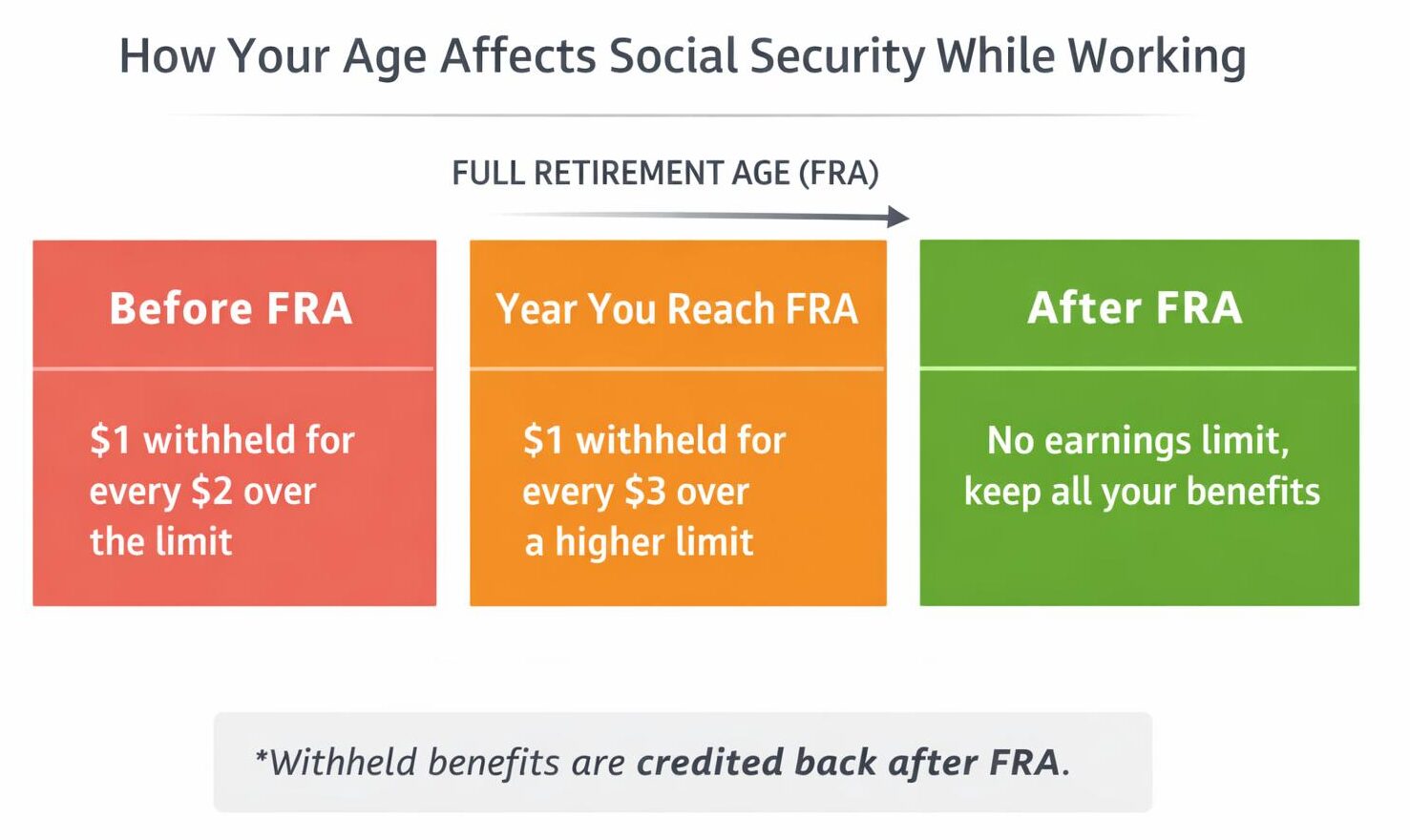
- For most of the years before you reach FRA, one dollar in benefits is withheld for every two dollars you earn above the annual limit.
- In the specific calendar year that you reach your FRA, a higher limit applies, and the withholding rate drops to one dollar for every three dollars earned above that limit.
- Once you actually reach your FRA month, the earnings test no longer applies, and you can earn any amount without affecting your benefit.
The withheld amounts are not lost permanently. After you reach FRA, the Social Security Administration recalculates your benefit upward to credit you for the months when benefits were withheld. The reduction is temporary, though the time it takes to recover those withheld amounts depends on how long you continue collecting benefits.
Earned Income Versus Other Income
Source: Mooloo graphics
The earnings test applies specifically to earned income, meaning wages from a job or net earnings from self-employment. It does not apply to other types of income such as investment returns, pension payments, rental income, interest, or capital gains. This distinction matters for people who have income from multiple sources, because only money you actively work for counts toward the earnings limit.
For example, if you claim Social Security at 63 and you receive dividends from a brokerage account, rental income from a property, and a part-time salary, only the salary counts when the Social Security Administration calculates whether you have exceeded the earnings threshold.
How Working Can Actually Increase Your Benefit
Continued employment can increase your benefit over time, even after you have started collecting. Social Security calculates your retirement benefit based on your 35 highest-earning years. If you are still working and earning a meaningful income, those new earnings can potentially replace a lower-earning year in your record, raising your average and resulting in a modest benefit increase.
This recalculation happens automatically each year. You do not need to apply for it. The Social Security Administration reviews updated earnings records annually and adjusts benefits upward if your recent work history improves your 35-year average.
Taxes on Social Security Benefits When You Work
Working while collecting Social Security can affect how much of your benefit is subject to federal income tax. Social Security benefits are partially taxable depending on your combined income, which is calculated by adding your adjusted gross income, any tax-exempt interest, and half of your Social Security benefits together.
Depending on your combined income, up to 50 percent or up to 85 percent of your Social Security benefits may be included in your taxable income. Earning wages while collecting Social Security can push your combined income higher, which may bring more of your benefit into taxable territory. The income thresholds for this calculation have not been adjusted for inflation since they were established, which means a broad portion of beneficiaries are affected by them today. Current thresholds are published by the IRS and are worth reviewing with a tax professional to understand your specific situation.
Claiming Early Versus Waiting: The Trade-Off
Choosing to claim Social Security before your FRA while still working involves a real trade-off. You receive benefits sooner, but you accept a permanent reduction to your monthly benefit and may face temporary withholding if your earnings exceed the limit. Waiting until FRA or beyond avoids both of those issues.
Delaying past FRA increases your benefit further through what are called delayed retirement credits. Each year you wait beyond FRA, up to age 70, your benefit grows by a set percentage. This results in a higher monthly payment for the rest of your life, which can be especially valuable if you expect to live a long time or want to maximize survivor benefits for a spouse.
There is no single right answer about when to claim. People in good health who plan to keep working often find that delaying makes financial sense. Others have financial needs or health considerations that make claiming earlier the more practical choice. The key is understanding what you are giving up and what you are gaining under each scenario.
Practical Steps if You Plan to Work While Collecting
If you are weighing whether to claim Social Security while continuing to work, a few practical steps can help you navigate the decision clearly.
- Review your earnings history and projected benefit at different claiming ages using the Social Security Administration’s online tools. The my Social Security portal lets you see estimates based on your actual record.
- Check the current year’s earnings limits directly with the Social Security Administration, since these figures change annually and figures from prior years may no longer be accurate.
- Consider how your combined income will affect your federal tax situation. A tax professional can help you estimate what percentage of your benefit may become taxable based on your expected income.
- If your income exceeds the earnings limit, keep in mind that withheld benefits will be credited back to you after FRA, so a temporary reduction is not a permanent loss.
- If you are self-employed, note that the earnings test uses net self-employment income after deductions, not gross revenue.
State Taxes on Social Security
Some states also tax Social Security benefits, though many do not. The rules vary significantly by state, and some states that do tax benefits offer exemptions based on age or income level. If you live in a state that taxes Social Security income and you are also earning wages, it is worth factoring state-level taxes into your overall picture. Your state’s department of revenue or a local tax professional can clarify how your state handles this.
The Bigger Picture
Working while collecting Social Security is a realistic option for many people, whether by choice or necessity. Before FRA, the earnings test can create a temporary reduction in benefits for higher earners, but that reduction is recoverable. After FRA, there are no earnings restrictions at all. Understanding where you stand in relation to your FRA, what your earned income looks like, and how taxes interact with your benefit gives you a clearer picture of what your net income will actually be in retirement.