
CD vs Savings Account: Which Is Better?


Choosing between a certificate of deposit and a regular savings account comes down to one core trade-off: how much access you need to your money versus how much interest you want to earn.
Both products are offered by banks and credit unions, both are insured by the FDIC up to standard limits, and both are considered low-risk ways to hold cash. But they work quite differently in practice. Understanding those differences helps you decide which one fits a particular financial situation, whether you are building an emergency fund, saving for a specific goal, or simply trying to earn more on money you are not currently using.
How a Savings Account Works
A savings account is a deposit account that pays interest while keeping your money accessible. You can typically deposit and withdraw funds at any time, though some banks impose limits on certain types of withdrawals per month. The interest rate is variable, meaning the bank can adjust it at any time based on market conditions and its own pricing decisions.
High-yield savings accounts, often offered by online banks, tend to pay significantly more interest than traditional savings accounts at large brick-and-mortar banks. The rate difference between these two types can be substantial, so it is worth comparing options rather than assuming all savings accounts pay similar rates. Rates fluctuate with the broader interest rate environment, so what a bank offers today may look quite different in six months.
Savings accounts are well suited to money you may need quickly. An emergency fund, for example, should generally be held somewhere accessible. Locking that money into a time-restricted product could create problems if an unexpected expense arises.
How a Certificate of Deposit Works
A certificate of deposit, or CD, is a deposit account where you agree to leave a fixed sum of money with a bank for a set period of time (in other countries they’re often called ‘term deposits’). In exchange, the bank pays you a fixed interest rate for that term. Terms commonly range from a few months to five years or longer, though specific offerings vary by institution.
The defining feature of a CD is that the interest rate is locked in when you open the account. If market rates fall after you open your CD, you still earn the rate you agreed to at the start. The flip side is that if rates rise, you remain locked into the lower rate until your CD matures.
When the CD reaches its maturity date, you can withdraw the full principal plus earned interest, roll it into a new CD, or transfer it to another account. Most banks offer a short grace period around the maturity date during which you can make changes without penalty.
If you need to access the money before the CD matures, you will typically face an early withdrawal penalty. These penalties vary by institution and term length, but commonly involve forfeiting a portion of the interest you have earned. With longer-term CDs, some penalties are large enough to reduce your principal as well. Reading the terms carefully before opening a CD is important so you understand exactly what the penalty would be in your specific situation.
Interest Rates: Fixed vs. Variable
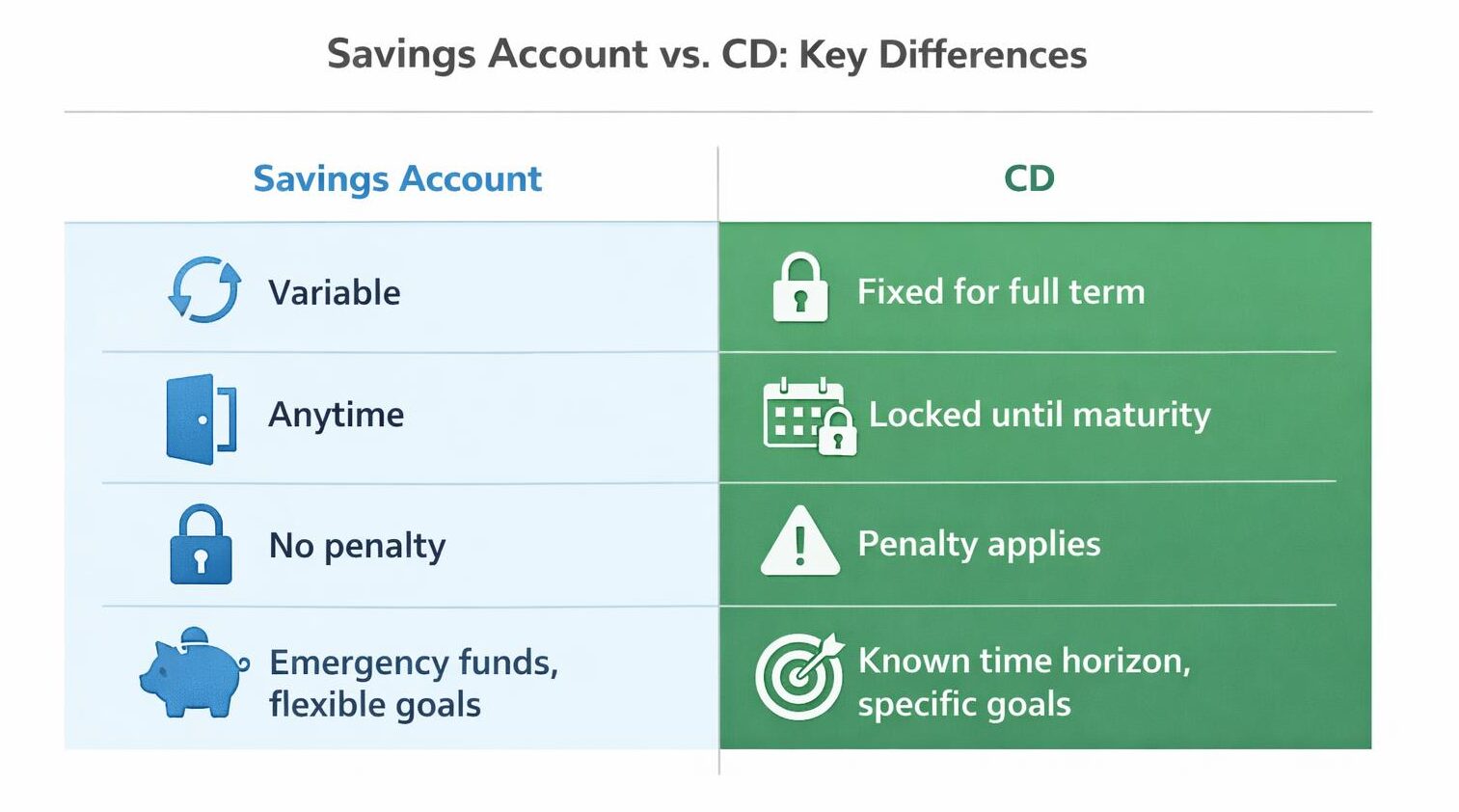
One of the most meaningful differences between these two products is how their interest rates behave over time. A savings account rate is variable. When central bank policy shifts or market conditions change, banks adjust their savings rates accordingly. This can work in your favor when rates are rising, but it means you cannot count on a specific rate remaining in place.
A CD locks in a rate for the full term. This predictability can be useful when you want to calculate how much a sum of money will grow by a specific date. If you deposit a set amount into a CD at a stated annual percentage yield, you can project the expected return with reasonable precision, assuming you hold it to maturity. Savings account projections require more guesswork because the rate may change multiple times over the same period.
In general, CDs tend to offer higher rates than savings accounts, particularly for longer terms. However, this is not always the case. During periods when banks compete aggressively for deposits, high-yield savings account rates can sometimes approach or match shorter-term CD rates. Comparing current rates across multiple institutions before committing is always worth the time.
Liquidity and Access
Liquidity refers to how quickly and easily you can access your money without incurring a financial cost. Savings accounts offer high liquidity. You can generally move money in or out whenever you need to, making them flexible for ongoing financial management.
CDs are less liquid by design. The structure assumes you will not need the money during the term. For funds you genuinely will not need for a defined period, this is not a problem. But for money that might be needed unexpectedly, committing to a CD requires careful consideration.
Some banks offer products marketed as no-penalty CDs or liquid CDs, which allow early withdrawal without a fee. These can provide a middle ground between the flexibility of a savings account and the fixed rate of a traditional CD. The trade-off is that no-penalty CDs often pay lower rates than standard CDs of a similar term. Whether that added flexibility justifies the rate difference depends on your specific situation.
Federal Deposit Insurance
Both savings accounts and CDs at FDIC-insured banks are covered by federal deposit insurance up to the standard limit per depositor, per institution, per account ownership category. Credit unions offer equivalent coverage through the National Credit Union Administration. You can verify current coverage limits directly with the FDIC or NCUA, as these may be updated over time.
From a safety standpoint, both products carry similar protection for balances within those limits. Neither is inherently safer than the other when it comes to federal insurance coverage.
CD Laddering as a Strategy
One approach some savers use to manage the trade-off between rate and liquidity is called CD laddering. Rather than placing all available funds into a single long-term CD, you divide the money across several CDs with different maturity dates. For example, you might open CDs maturing in six months, one year, two years, and three years at the same time.
As each CD matures, you have the option to access that portion of the money or roll it into a new CD. This structure means you regularly have funds becoming available without penalties, while still holding some money in longer-term CDs that may carry higher rates. It also reduces the risk of being locked into a single rate environment for an extended period.
Tax Treatment
Interest earned on both savings accounts and CDs is generally treated as ordinary income for federal tax purposes and is taxable in the year it is received or credited to your account. For CDs that span more than one tax year, the interest is typically reported as it accrues rather than when the CD matures. This means you may owe tax on interest you have not yet physically received. Tax rules can vary based on individual circumstances, so consulting a tax professional for guidance specific to your situation is worth considering.
Choosing Between the Two
The right choice depends heavily on what you intend to do with the money and when you might need it. A few practical considerations are worth thinking through before deciding.
- If the money serves as an emergency fund or covers near-term expenses, a savings account offers the flexibility those situations require.
- If you have a specific savings goal with a known time horizon, such as a down payment you plan to make in 18 months, a CD with a matching term may allow you to earn a higher rate while keeping the goal clearly defined.
- If you are uncertain when you might need the funds, a savings account or a no-penalty CD may be more appropriate than committing to a longer-term CD.
- If interest rates are falling, locking in a CD rate before rates drop further may preserve a more favorable return than leaving money in a variable-rate savings account.
- If interest rates are rising, staying in a savings account allows you to benefit as rates increase, whereas a CD locks you into a rate that could look less competitive over time.
Neither product is universally better than the other. They serve different purposes, and many people find it useful to hold both at the same time, using each for the role it fits best. Comparing current rates from multiple institutions before opening either type of account is a straightforward way to ensure you are getting reasonable value for your deposit.