
What Is the ‘Collectables’ Tax Rate and What Does It Apply To?


When you sell a baseball card collection, a vintage wine cellar, or a set of rare coins for a profit, the IRS does not treat that gain the same way it treats a profit from selling stocks or real estate.
Collectibles occupy a unique category in the US tax code, and the rate that applies to long-term gains on these assets is notably higher than the rate most investors encounter on other capital assets. Understanding how this works can help collectors and investors make more informed decisions about buying, selling, and holding physical items that may appreciate over time.
What Counts as a Collectible for Tax Purposes
The IRS defines collectibles in Section 408(m) of the Internal Revenue Code. The category is broader than many people expect. It includes physical assets held primarily for their aesthetic, historical, or rarity value rather than for conventional industrial or investment purposes.
Items that qualify as collectibles under this definition include:
- Works of art, including paintings, sculptures, and photographs
- Rugs and antiques
- Metals such as gold, silver, and platinum in coin or bullion form (with some exceptions for certain IRS-approved coins and bullion)
- Gems and jewelry
- Stamps and coins
- Alcoholic beverages, including rare wine and whiskey collections
- Any other tangible personal property the IRS designates as a collectible
Sports cards, comic books, vintage toys, and similar items generally fall under the broader “any other tangible personal property” language, and the IRS has treated many of these as collectibles for tax purposes. If you are unsure whether a specific asset qualifies, a tax professional familiar with collectibles can help you assess it.
The Collectibles Tax Rate Explained
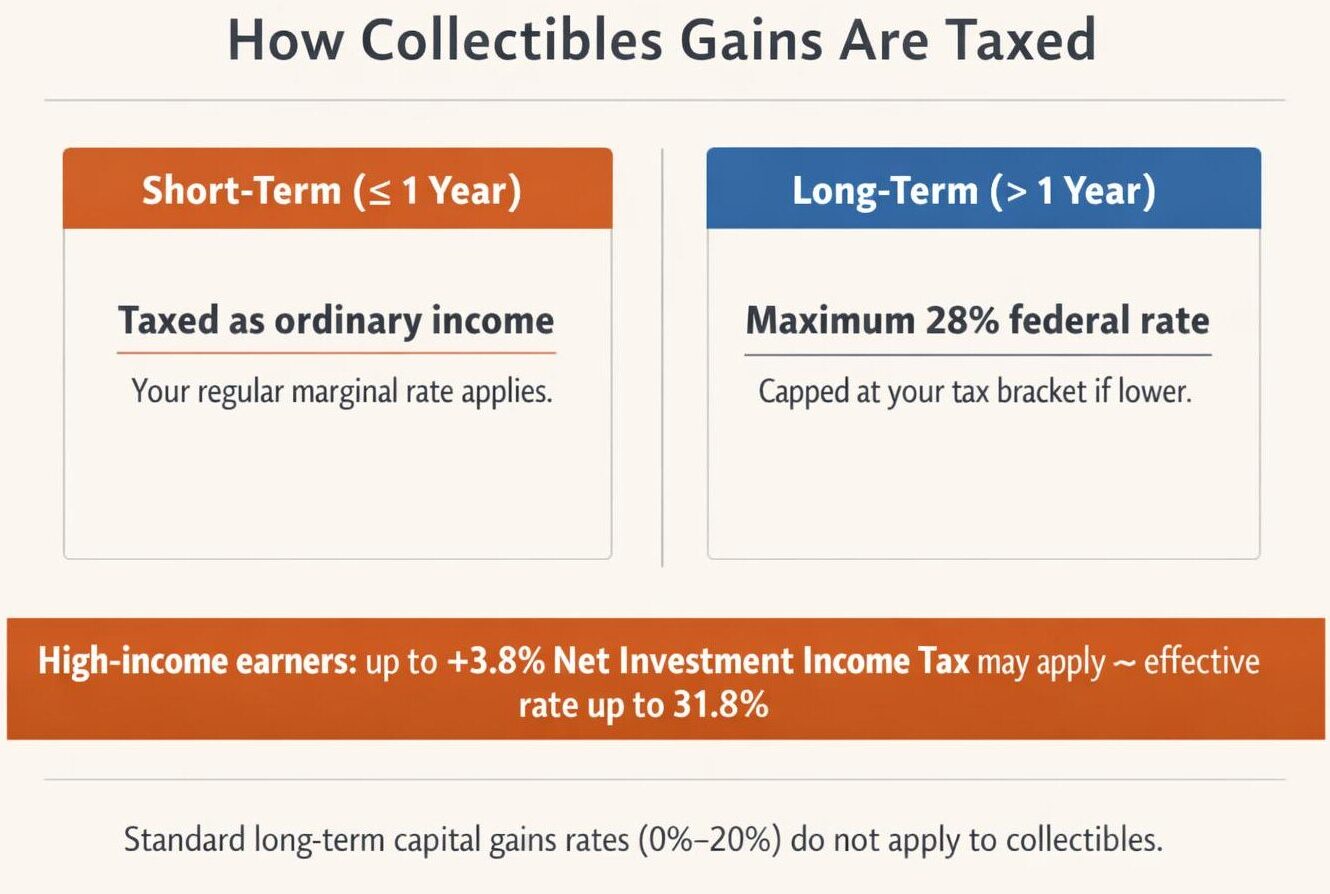
For most long-term capital gains, the federal tax rate is 0%, 15%, or 20% depending on your taxable income. These preferential rates reflect a policy choice to encourage long-term investment in assets like publicly traded stocks and real estate. Collectibles do not receive this same treatment, however, and are taxed at a maximum federal rate of 28%. This rate applies when you have owned the collectible for more than one year before selling. If you are in a lower ordinary income tax bracket, your effective rate may be less than 28% This is because while the collectibles rate is capped at 28%, it can also not exceed your regular marginal rate. Thus, in practical terms, a taxpayer in the 22% bracket would pay 22% on long-term collectibles gains, not 28%. The 28% figure is a ceiling, not a flat rate that applies to everyone.
Short-term gains on collectibles held for one year or less are taxed as ordinary income at your regular marginal rate. Depending on your income, this could exceed 28%, which is one reason why holding period matters when selling collectibles.
How the Holding Period Affects Your Tax Bill
Source: Mooloo graphics
The difference between short-term and long-term treatment can be meaningful. If you purchase a painting for $10,000 and sell it nine months later for $25,000, the $15,000 gain is short-term and taxed as ordinary income. A taxpayer in the 32% bracket would owe $4,800 in federal tax on that gain. If they waited until more than one year had passed, the same $15,000 gain would be subject to a maximum rate of 28%, reducing the federal liability to no more than $4,200.
For higher-income sellers, both the short-term and long-term rates can be substantial. The timing of a sale relative to the purchase date is one of the few variables within a seller’s direct control.
State Taxes on Collectibles Gains
Unfortunately, federal tax is only part of the picture. Most states that impose an income tax will also tax capital gains from collectibles sales. Some states tax all capital gains as ordinary income regardless of asset type or holding period. Others offer preferential rates. A handful of states impose no income tax at all.
State tax treatment varies considerably, and the combined federal and state burden on a collectibles sale can be meaningfully higher than the federal rate alone. Reviewing your state’s current rules before completing a significant transaction is a practical step.
The Net Investment Income Tax and Collectibles
Higher-income taxpayers may also owe the Net Investment Income Tax (NIIT) on gains from selling collectibles. This is an additional 3.8% tax that applies to net investment income when modified adjusted gross income exceeds certain thresholds. Those thresholds are adjusted periodically, so it is worth checking current IRS guidance or consulting a tax professional if your income may be in the affected range.
When the NIIT applies, the effective federal rate on long-term collectibles gains can reach 31.8% even before any state taxes are considered.
Collectibles Inside Retirement Accounts
One point that trips up some investors is the treatment of collectibles inside IRAs and similar retirement accounts. Most collectibles are prohibited investments within IRAs. If an IRA acquires a collectible, the IRS treats the purchase amount as a taxable distribution, which may also trigger early withdrawal penalties.
There are narrow exceptions for certain coins minted by the US Treasury and for IRS-approved gold, silver, platinum, and palladium bullion that meets specific purity standards. Outside those defined exceptions, placing collectibles in a retirement account creates tax consequences that are difficult to reverse.
Losses on Collectibles
Not every collectibles transaction results in a gain. If you sell a collectible for less than you paid, you have a capital loss. Losses on collectibles can generally be used to offset capital gains from other investments, including gains from stocks, bonds, or other collectibles. If your total capital losses exceed your capital gains in a given year, you can deduct up to $3,000 of the excess against ordinary income, with any remaining losses carried forward to future tax years.
Because collectibles gains are taxed at a higher maximum rate, losses that offset those gains can provide a comparatively greater tax benefit than losses applied against gains taxed at lower rates.
Record Keeping and Cost Basis
Accurately tracking what you paid for a collectible is essential when calculating your gain or loss at sale. Cost basis includes the original purchase price plus costs directly associated with acquiring the item, such as auction fees, shipping, and insurance paid at the time of purchase. Costs for restoration or significant improvements may also be added to basis in some circumstances.
Without adequate records, you may report a larger gain than you actually realized, or face challenges if the IRS questions your return. Retaining purchase receipts, appraisal records, auction documentation, and related expense records is a practical habit for anyone who actively buys and sells collectibles.
Inherited and Gifted Collectibles
The tax rules for inherited collectibles differ from those for purchased items. When you inherit a collectible, you generally receive a stepped-up basis equal to the fair market value at the time of the original owner’s death. If the item appreciated significantly before you inherited it, that prior appreciation is typically not subject to capital gains tax when you sell.
Gifted collectibles work differently. When someone gives you a collectible during their lifetime, you generally take on the original owner’s cost basis rather than receiving a step-up. If the original owner paid very little for the item years ago, you could be taking on a substantial embedded gain that becomes taxable when you sell. Understanding the basis of a gifted collectible before selling it helps avoid unexpected tax obligations.
Practical Considerations for Collectors
The 28% maximum rate on long-term collectibles gains is among the higher rates in the capital gains system, and it is worth factoring into decisions about buying and selling. Some collectors treat this as part of the overall cost of participating in markets for physical assets. Others manage it by timing sales carefully, offsetting gains with losses, or accounting for the tax cost when setting price expectations.
Tax rules in this area can be nuanced, particularly for high-value transactions, items held inside trusts or estates, or assets with complicated ownership histories. Tax law can change, and individual circumstances vary. Reviewing current IRS publications or speaking with a qualified tax professional before making decisions on significant collectibles transactions is a sound practice.