
Proving Financial Dependency for a Social Security Dependent Parent Claim


When a worker who paid into Social Security dies, most people think first of spouses and children. But a dependent parent, someone who relied on the deceased worker for at least half of their financial support, can also qualify for survivor benefits.
The eligibility rules are different from those covering a spouse or child, and the paperwork involved is more detailed. Proving financial dependency is the single biggest hurdle in this type of claim, and it is where most delays and denials happen. This guide explains exactly what the Social Security Administration requires, what documents actually satisfy that requirement, and how to avoid the most common mistakes.
Who Qualifies as a Dependent Parent
Before dependency even becomes a question, a parent has to meet a few baseline requirements. The parent must be age 62 or older, and the deceased worker must have been fully insured under Social Security. The parent must not have remarried after the worker’s death in a way that would end eligibility, and critically, the parent must have been receiving at least half of their support from the worker at the time of death.
That last point is the one that requires documentation. Age and insured status are simple to confirm. Dependency is not, because it requires reconstructing a financial relationship that existed before the worker died, sometimes years before the claim is filed.
The Legal Standard: One-Half of Support
For Social Security survivor benefits, the SSA’s rule for dependent parents is specific: the worker must have provided at least one-half of the parent’s support at the time of death, or at the time the worker became disabled if the claim traces back to a disability period. This is not a loose or subjective standard. It is a mathematical threshold, and SSA expects the parent to be able to show, in real terms, that the worker’s contribution outweighed every other source of the parent’s income and support combined.
This means a parent who received occasional gifts or informal help from the worker, but who was primarily supported by their own pension, Social Security retirement benefit, or another family member, would not meet the standard. Conversely, a parent who lived with the worker, had housing and living costs covered by them, and had minimal independent income would typically qualify.
Form SSA-760: The Certificate of Support
The primary form used to document dependency is Form SSA-760, Certificate of Support. This form is separate from the main application (Form SSA-7, Application for Parent’s Benefits) and is specifically where SSA collects the evidence behind the dependency claim.
The SSA-760 asks for detailed information, including:
- Your total income from every source, including your own Social Security benefits, pensions, wages, investment income, and any other support you received
- Whether the worker paid your rent, mortgage, property taxes, or repair costs, and if so, how much and how often
- The names of any other individuals who contributed to your support, what specifically they paid for, and how much
- A signed certification, made under penalty of perjury, that you were receiving at least half your support from the worker
If the deceased worker has another living parent, the SSA-760 also asks about that parent’s income and support situation, since a surviving parent’s benefit percentage depends on whether one or two dependent parents are involved.
What Actually Counts as Proof
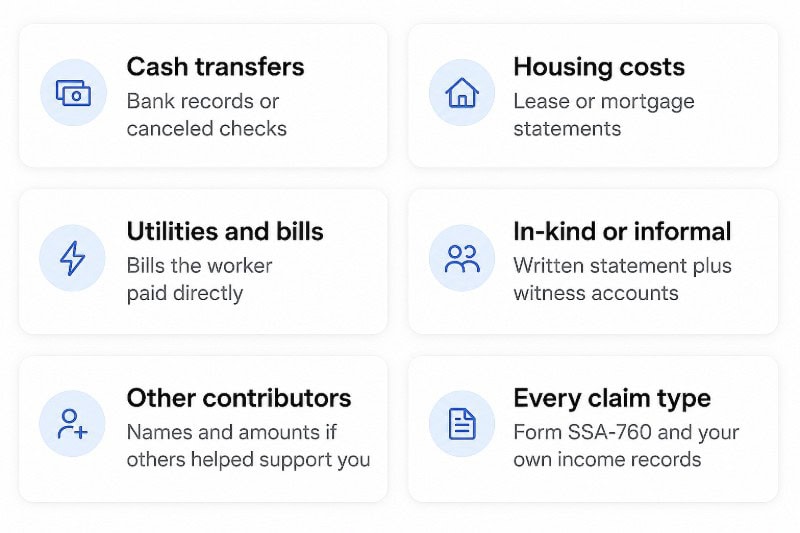
Because the SSA-760 is a sworn statement rather than a document review in itself, SSA generally expects supporting records behind the answers you give. The most useful and commonly accepted forms of proof include:
- Bank records showing regular transfers, deposits, or payments from the worker to the parent
- Canceled checks or payment records for rent, mortgage payments, or utility bills paid on the parent’s behalf
- Lease agreements or mortgage statements showing the parent’s housing costs and who covered them
- The parent’s own tax returns or income statements, to establish what income the parent had independent of the worker
- A written, detailed statement describing the living arrangement, especially in cases where support was largely in-kind, such as the parent living in the worker’s household and having food, utilities, and housing covered directly rather than through cash transfers
Evidence does not need to be perfect or exhaustive. SSA representatives are accustomed to working with partial records, especially when a support arrangement was informal or when the worker’s death occurred some time before the claim was filed. The goal is to build a reasonably complete financial picture, not to produce airtight accounting.
Fig 1. Evidence of dependency
When the Support Was Informal or In-Kind
Many real-world dependency arrangements are not clean paper trails. A parent may have lived with the worker, had no formal lease, and received support in the form of groceries, utilities, and general household costs rather than a documented monthly transfer. This is common, and SSA does account for it.
In these situations, a written statement carries more weight than in a straightforward cash-transfer case. The statement should describe, as specifically as possible, the living arrangement, what the worker covered, and roughly how much of the parent’s total living costs that represented. Statements from other family members who can independently confirm the arrangement can also help, though they are typically supplementary rather than sufficient on their own.
Applying Without Complete Documentation
As with every part of the survivor benefits process, SSA’s official guidance is not to delay filing simply because financial records are incomplete or difficult to locate. The dependency claim can be started on the initial application, and the SSA-760 and supporting evidence can often be supplied afterward. Waiting to gather every bank statement before making the first call risks pushing back the filing date, which matters because survivor claims are generally only paid retroactively for up to six months before the month of filing.
The practical approach is to file first, then work with the assigned claims representative to identify what additional evidence, if any, is needed to complete the dependency determination.
Common Reasons Dependency Claims Get Delayed or Denied
- Support that falls under the halfway threshold. If the parent had a meaningful independent income, such as their own Social Security retirement benefit or a pension that covered a significant share of their costs, the worker’s contribution may not clear the one-half bar even if it was substantial.
- No documentation of in-kind support. Cash transfers are easier to prove than covered housing or living costs, so parents relying on an in-kind arrangement should be prepared to explain it in detail rather than assuming it is self-evident.
- Conflicting information from other family members. If another sibling or relative is asked to confirm the arrangement and their account differs meaningfully from the parent’s, it can slow down the determination while SSA reconciles the discrepancy.
- Treating the SSA-760 as a formality. Because it is framed as a certificate and signed under penalty of perjury, it is worth completing carefully and accurately rather than quickly, since inconsistencies between the form and later supporting documents can trigger additional review.
How This Fits Into the Broader Survivor Benefits Process
Dependency proof is one piece of a larger application. Once dependency is established, the claim proceeds through the same steps as any other survivor benefit: SSA calculates the deceased worker’s Primary Insurance Amount, applies the appropriate percentage (82.5 percent if the parent is the only dependent parent, or 75 percent each if two parents qualify), and factors in the family maximum rules that cap total household benefits. The dependency determination does not change how payments are made or when they begin. It is simply the eligibility gate that has to be cleared first.
The Bottom Line
Proving financial dependency for a dependent parent survivor claim comes down to demonstrating, with reasonable documentation, that the deceased worker covered at least half of the parent’s support. Form SSA-760 is the central document in that process, but bank records, housing costs, and a clear written account of the living arrangement all help build the case, particularly when support was informal or in-kind. As with every stage of the survivor benefits process, the safest approach is to file the claim promptly and work through the documentation with SSA afterward rather than waiting until every record is in hand.