Fake Investment Platforms: How AI-Powered DeFi Scams Are Draining Billions


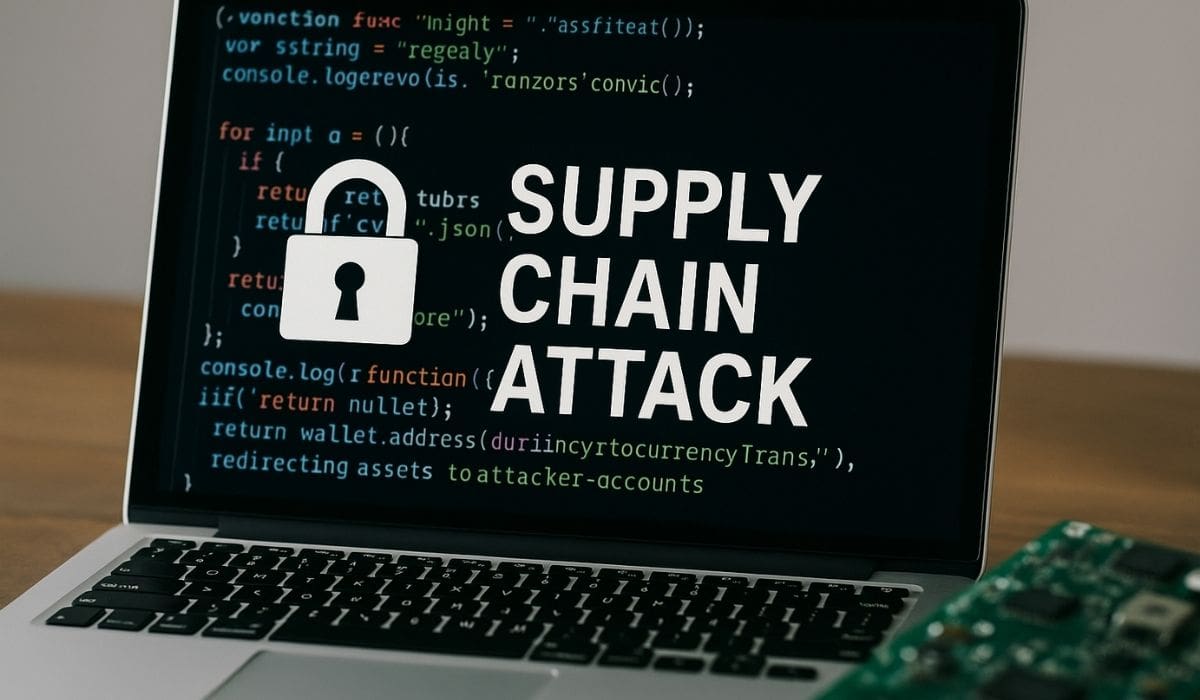
Decentralized finance promised to eliminate middlemen, but in 2025 it’s facing a crisis of trust. As Chainalysis reports over $2.17 billion in crypto thefts in just the first half of the year, DeFi’s openness has become fertile ground for AI-driven fraud. Criminals now use AI-powered scam-as-a-service platforms and flash loans to fabricate legitimacy, inflate Total Value Locked (TVL), and lure investors into cloned protocols and malicious smart contracts.
- AI-driven deception: Reports of AI crypto scams rose 456% year-over-year, with deepfake fraud losses topping $4.6 billion.
- Flash-loan fakery: Scammers borrow millions briefly to inflate TVL, making fake projects appear credible before rug-pulling investors.
- Structured exploitation: Modern DeFi frauds follow a four-stage kill chain, lure, manipulate, drain, disappear, often leaving victims with no recovery options.
- Vanishing recourse: Blockchain immutability and cross-border complexity mean average recovery rates stay below 3%.
- Defense playbook: Verify teams across multiple sources, demand time-locked smart contracts, and treat outsized returns or unlimited token approvals as red flags.
The promise of decentralized finance was simple: cut out the middleman, democratize access to financial services, and let code, not institutions, govern transactions. But as DeFi protocols have matured into a sector holding $135 billion in total value locked, they’ve also become hunting grounds for a new breed of fraudster armed with artificial intelligence, flash loans, and social-engineering tactics.
The numbers tell a grim story. Crypto-related thefts exceeded $2.17 billion in the first half of 2025 alone, already surpassing the full-year 2024 total of about $2.2 billion, according to Chainalysis.
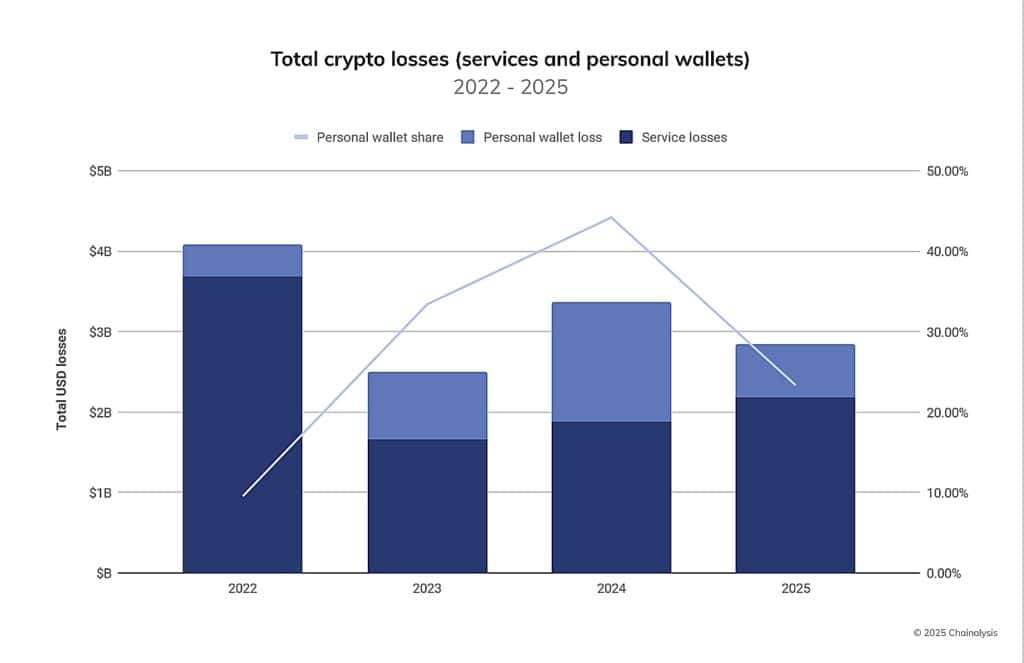
Source: Chainalysis
In 2023, DeFi protocols lost roughly $1.95 billion to hacks and scams, based on De.Fi’s annual REKT Report. What’s particularly disturbing is how these attacks have evolved, from crude phishing attempts into sophisticated AI-assisted exploits capable of deceiving even experienced investors.

Source: De.Fi
The AI Scam Factory
Walk into any fraudster’s toolkit today and you’ll find something that barely existed three years ago: AI-powered scam-as-a-service platforms. These systems allow criminals to auto-generate professional decentralized app interfaces complete with cloned logos, fake testimonials, and even fully functional-looking smart-contract front-ends mimicking protocols like Uniswap, Aave, or Compound.
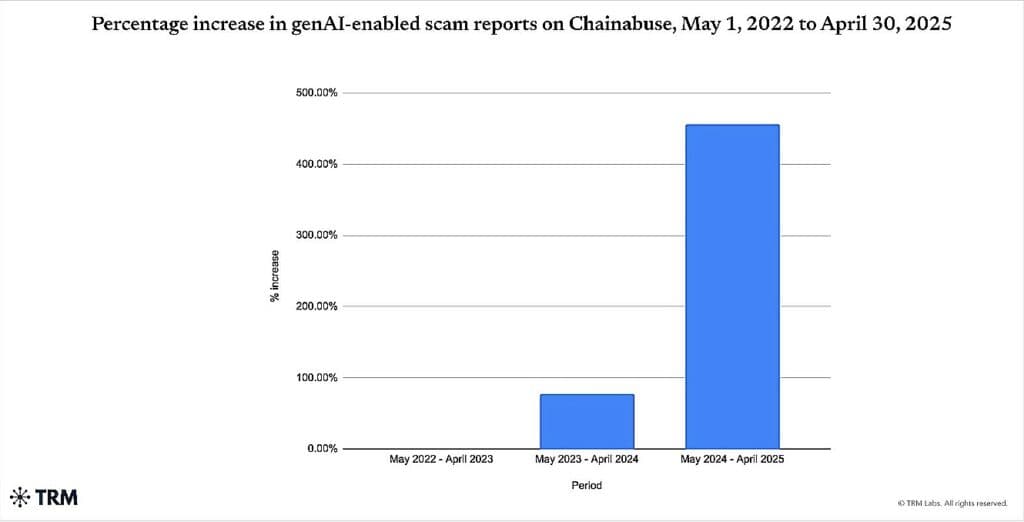
According to data from TRM Labs, reports of AI-driven crypto scams surged 456% between May 2024 and April 2025. Deepfake scams alone have caused billions in estimated losses, with an industry anti-scam report citing $4.6 billionin AI-assisted crypto fraud across 2024 and noting that 87 deepfake scam rings were dismantled in early 2025.

Source: TRM Labs
These counterfeit platforms don’t just look legitimate, they’re engineered to pass every surface-level check an investor might perform. They feature polished UI/UX design, cloned whitepapers with minor edits, fake team profiles scraped from LinkedIn, and fabricated audit reports. Victims are driven to these fake sites through paid social-media ads, phishing campaigns, or even compromised Discord and Telegram channels of real projects.
The Flash Loan Illusion
The real innovation in DeFi fraud lies in how scammers manipulate the very metrics investors use to gauge legitimacy. Total Value Locked (TVL), the total capital deposited in a protocol, is often seen as the industry’s gold standard of credibility. A platform showing $50 million in TVL appears established; one with $500 million looks bulletproof.
Enter the flash loan. These uncollateralized loans exploit blockchain atomicity, allowing users to borrow and repay funds within a single transaction. In fraudulent schemes, flash loans aren’t used to steal from existing protocols but to fabricate legitimacy for fake ones.
Here’s how it works: a scammer launches a bogus yield farming platform and takes out a large flash loan, say, $10 million in stablecoins. They deposit this into their own liquidity pool, briefly inflating the TVL to impressive levels. On-chain dashboards and analytics bots detect the surge, displaying striking volume metrics. Screenshots circulate on social media, lending the illusion of credibility. Before the transaction closes, the scammer withdraws the funds and repays the loan. The cost is limited to transaction fees, often minor compared with the apparent inflows. The gain: a convincing illusion of a thriving ecosystem.
Security researchers have repeatedly warned about fake yield farming projects that use flash loans to artificially inflate TVL and lure investors. These borrowed funds never belonged to real users, but by the time investors realize the deception, they’ve already connected their wallets and approved malicious contracts.
The Four-Stage Kill Chain
Understanding the scammer’s playbook is crucial to recognizing attacks before they succeed. Modern DeFi fraud follows a structured lifecycle:
Lure: Victims are identified through social media engagement, crypto forums, or even romance scams where attackers spend weeks building trust before introducing “joint investment opportunities.” Fraudulent platforms promise unrealistic returns, often 20% to 30% weekly, which then vanish with millions in investor funds.
Manipulate: Once interest is secured, victims are directed to professional-looking platforms. Flash loans inflate Total Value Locked (TVL), creating the illusion of credibility. Fake testimonials and audit reports are prominently displayed. In some cases, scammers even pay small returns to early investors, classic Ponzi behavior designed to build social proof.
Drain: Victims connect their wallets, approve token spending, or deposit funds into liquidity pools. In rug pulls, developers drain these pools and vanish. In more sophisticated schemes, malicious smart contracts slowly siphon assets or trigger once a threshold is reached.
Disappear: Common tactics include developers vanishing after draining liquidity, phantom protocols with heavy marketing but no working product, and front-end attacks using cloned DeFi sites to harvest wallets. Social media accounts are deleted, websites go dark, and smart contracts self-destruct or transfer ownership to burn addresses.
Why Recovery Is Nearly Impossible
The blockchain’s immutability, its greatest strength, becomes its greatest weakness when fraud occurs. Once funds move to a scammer’s wallet, there’s no bank to call, no credit card company to dispute charges with, and no centralized authority to freeze accounts. Most DeFi platforms explicitly disclaim liability for user-side exploits, leaving victims with limited recourse. Law enforcement efforts, while growing, remain fragmented across jurisdictions, making coordination slow and recovery rare.
According to 2025 data from TradersUnion, detection times vary by scam type. Phishing and fake UI scams are typically identified within about 12 hours but yield recovery rates of only 3.1%. Address-poisoning attacks are slower to detect, averaging over 24 hours, and result in even lower recovery odds of roughly 1.7%.
Source: TradersUnion
Protect Yourself. No really, Protect YOURSELF!
The sophistication of modern DeFi scams means traditional due diligence is no longer enough. A sleek website, polished white paper, or impressive Total Value Locked (TVL) figure cannot guarantee legitimacy against attackers who have industrialized deception.
Investors must now adopt a more vigilant mindset: verify project teams through multiple independent channels, demand time-locked smart contracts that prevent instant liquidity drains, treat any protocol offering outsized returns as suspicious until proven otherwise, and never grant unlimited token spending approvals for new or unverified platforms.
According to Chainalysis, roughly 60% of on-chain deposits into identified scam wallets now flow into schemes that leverage AI tools, underscoring how artificial intelligence has transformed fraud into an industrial-scale operation.
The DeFi sector’s survival depends on making security innovation as aggressive as the scams it faces. Until then, the invisible heist will continue, one wallet approval at a time.