
Why Is My Bank Transfer Pending?


A pending bank transfer can be frustrating, especially when you are expecting funds to arrive or a payment to clear. Understanding why transfers enter a pending state, how long they typically stay there, and what factors affect timing can help you plan around delays and avoid being caught short.
Pending status is a normal part of how the US banking system processes money, and it does not always mean something has gone wrong.
What “Pending” Actually Means
When a bank transfer shows as pending, it means the transaction has been initiated but has not yet fully settled. Think of it as the banking equivalent of a check that has been written but not yet cashed. The money is in motion, but it has not officially moved from one account to another in a final, irreversible way.
From the sender’s side, the funds are often already reserved or deducted from the available balance, meaning they cannot be spent elsewhere. From the receiver’s side, the incoming amount may appear as a pending deposit but remain unavailable until the bank confirms the transfer has fully cleared. This distinction between available balance and total balance is something many people find confusing when they first encounter it.
The Different Types of Bank Transfers and Why Timing Varies
Not all bank transfers work the same way, and the method used has a significant effect on how long a transfer stays in pending status.
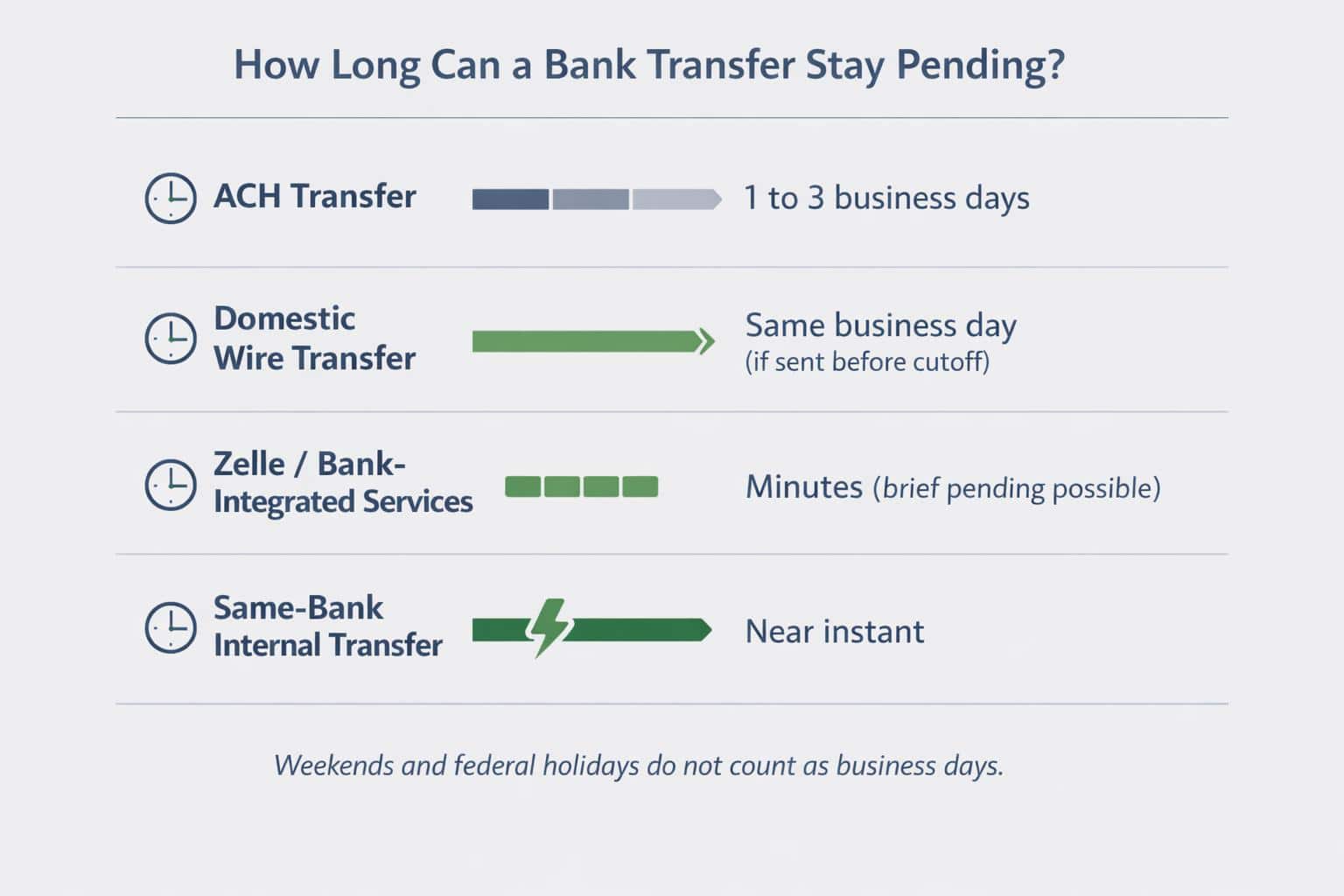
- ACH transfers are the most common type of electronic bank transfer in the US. ACH stands for Automated Clearing House, a network that processes payments in batches rather than in real time. Because of this batch processing, ACH transfers typically take one to three business days to clear, and some banks place additional holds on incoming ACH deposits.
- Wire transfers are faster and typically process within the same business day if sent before the bank’s cutoff time. They move through a separate system and are generally used for larger or time-sensitive transfers, which is reflected in the fees involved. Domestic wires usually clear quickly, but international wires can take several business days depending on the banks and countries involved.
- Zelle and similar bank-integrated services often move money within minutes, but even these can briefly show a pending status while the system verifies the transaction.
- Internal transfers between accounts at the same bank are usually the fastest and may clear almost instantly, though some banks still apply a short processing window.
Common Reasons a Transfer Is Pending
There are several reasons a transfer might sit in pending status longer than expected. Most are routine, but a few warrant closer attention.
Bank processing schedules: Banks do not process transactions around the clock. Most operate on business day schedules, and transfers submitted on a Friday afternoon, over a weekend, or on a federal holiday will typically not begin processing until the next business day. This is one of the most common reasons a transfer appears stuck.
Funds availability holds: Even after a transfer arrives at your bank, the bank may place a hold on some or all of the funds before making them available. Federal Regulation CC establishes rules around how quickly banks must make deposited funds available, but exceptions exist for large amounts, accounts with a history of overdrafts, or deposits the bank considers higher risk. The length of any hold depends on your bank’s policies and the specific circumstances of the deposit.
Verification checks: Banks routinely screen transfers for fraud, compliance requirements, and accuracy. If something about a transfer triggers an automated review, it may remain in pending status while the bank takes a closer look. This is particularly common with first-time transfers to new recipients or transactions that are unusually large for a given account.
Incorrect account details: If the routing number or account number provided for a transfer contains an error, the transfer may stall in the processing system. In some cases the bank will catch the error quickly, but in others the funds may remain in an unresolved state while the issue is investigated.
Insufficient funds on the sender’s end: If the sending account does not have enough money to cover the transfer, the transaction may be initiated but then fail to process. This can sometimes appear as pending briefly before being returned or declined.
How Long Should You Expect a Transfer to Stay Pending
There is no single answer, because it depends on the transfer type, the banks involved, and whether any holds or reviews have been applied. As a general guide, standard ACH transfers typically clear within one to three business days. Domestic wire transfers sent before the bank’s cutoff time usually complete the same day. Transfers involving international banks or currency conversions often take longer, and several business days is not uncommon.
If a transfer has been pending longer than expected, it is worth checking whether a bank holiday falls within the processing window, since those days do not count as business days. You should also check whether your bank has sent any communications about a hold or review.
What to Do When a Transfer Has Been Pending Too Long
If the standard processing window has passed and the transfer is still showing as pending, there are a few practical steps worth taking.
- Contact your bank directly to ask about the status of the transfer. They can tell you whether a hold has been placed, whether there was an issue with the account details, or whether the transfer is still in the processing queue.
- If you sent the transfer, confirm with your bank that it was successfully submitted and that the account details you provided were correct.
- If you are expecting to receive funds, the sender’s bank is often the right starting point, since that is where the transfer originates.
- Keep a record of any reference numbers, confirmation emails, or screenshots related to the transfer, as these will be helpful when speaking with customer service.
For wire transfers specifically, banks can sometimes recall or trace a wire if there is an error, though this process is time-sensitive and may not be possible once the funds have been received by the destination bank.
Pending Transfers and Your Available Balance
One practical issue that catches people off guard is the difference between a pending deposit and funds you can actually use. A transfer might appear in your account as pending, and the amount might be reflected in your total balance, while not yet being part of your available balance. If you spend money assuming a pending deposit has cleared, you could overdraw your account.
Checking your available balance rather than your total balance before making purchases or sending other payments can help avoid this situation. This is especially worth keeping in mind when you are coordinating the timing of an incoming transfer with an outgoing payment.
Pending Outgoing Transfers
Pending status applies to outgoing transfers as well. When you send money, the amount is often deducted from your available balance immediately, even if the transfer has not yet been received by the other party. Your balance reflects the reservation of those funds, but the recipient may not have access to them yet.
Outgoing transfers can sometimes be cancelled while still pending, depending on the transfer type and how far along in processing they are. ACH transfers often have a short window during which the sender can request a reversal, though this is not guaranteed and policies vary between banks. Wire transfers are generally much harder to reverse once sent, which is why it is important to verify recipient details carefully before initiating one.
Protecting Yourself from Transfer-Related Scams
Pending transfer status is sometimes exploited in scams. A common example involves someone sending a fraudulent check or initiating a fake transfer, waiting for the bank to show a pending deposit, and then asking you to send some of the money back before the original transfer has fully verified. When the fraudulent transfer eventually fails and is reversed, you are left having sent money that cannot be recovered.
If someone you do not know well asks you to send money based on a transfer that has not yet cleared, treat that as a significant warning sign. Legitimate transactions do not require you to send money to a third party in exchange for funds that have not fully settled in your account. Consumer protection guidance generally recommends waiting until funds have fully cleared before treating them as available, particularly when dealing with unfamiliar parties.