The World Is Your Employer: How to Compete in the Global Job Market


As of 2025, nearly 23% of U.S. employees work remotely, marking a permanent shift toward borderless employment. Geographic boundaries no longer define opportunity, skills, adaptability, and digital fluency do. Global hiring platforms, cross-border pay arbitrage, and AI-driven collaboration tools have created a competitive marketplace where talent thrives anywhere, but strategy determines success.
- Global pay equity is emerging: Remote professionals in lower-cost regions now earn 2–3× more by working directly with U.S. or EU employers, while high-cost regions face downward wage pressure.
- The new skill stack wins: Bilingualism, cultural agility, and digital fluency now drive 5%–20% salary premiums.
- Remote finance demands strategy: Currency shifts, dual taxation, and residency rules require professional tax planning.
- Infrastructure is ready: Platforms like Remote.com, Deel, and Wise simplify compliance, payroll, and global payments for borderless teams.
- Compliance is competitive advantage: Understanding visa, tax, and labor rules across countries prevents costly missteps and builds trust with global employers.
The global workforce is undergoing a profound transformation. Today, a software engineer in Austin can earn Berlin-level pay without ever relocating. A graphic designer in Manila can charge rates once exclusive to New York freelancers. A financial analyst in Buenos Aires can work London hours while benefiting from a far lower cost of living. These examples aren’t rare, they represent a new era of remote work that’s redefining global employment, pay equity, and career mobility.
The Borders Are Down
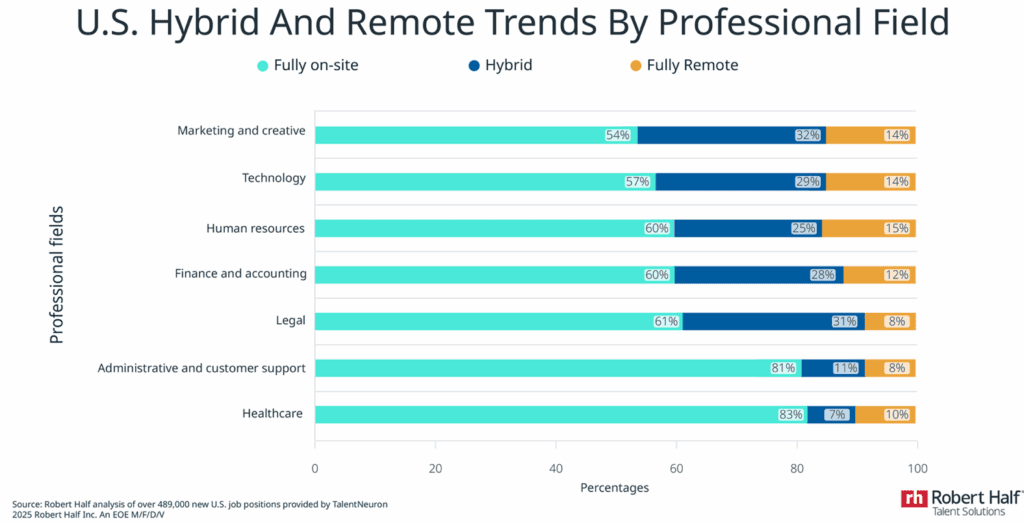
The pandemic didn’t just normalize remote work, it erased the boundaries of where talent can thrive. As of early 2025, about 22.8% of U.S. employees work remotely at least part of the time, roughly 36 million people, according to recent U.S. Bureau of Labor Statistics data. Meanwhile, hiring trends show that 24% of new job postings offer hybrid options and 12% are fully remote, reflecting a lasting structural shift in how organizations hire and manage teams.
Source: Robert Half
This global flexibility is fueling what economists call the democratization of opportunity. A graphic designer in Lagoscan now compete for the same role as one in London. A marketing manager in Buenos Aires can command compensation once reserved for talent in San Francisco, all while benefiting from a lower cost of living.
The new competitive advantage isn’t location, it’s value creation. Employers are increasingly sourcing talent worldwide, and workers are optimizing for lifestyle, cost, and flexibility. Geographic salary arbitrage, once the niche strategy of digital nomads, has gone mainstream, redefining what fair pay, global hiring, and career mobility look like in 2025’s borderless economy.
The New Skill Stack
Competing in today’s global workforce demands more than technical skills, it requires borderless professionalism, a blend of cultural agility, bilingual communication, and digital fluency that transcends geography.
Language proficiency is now an economic multiplier. Research shows bilingual and multilingual professionals earn 5%–20% higher salaries on average than monolingual peers. English-Mandarin, English-Spanish, and English-Arabic combinations are among the most sought-after skill sets in international markets, helping professionals unlock broader career and income opportunities.
Cultural agility, the ability to adapt across social and professional norms from Mumbai to Montreal, has become just as valuable as coding or finance expertise. Those who understand context, etiquette, and communication nuances across borders build stronger client relationships and leadership potential.
Time-zone flexibility is the new competitive edge in remote work. Professionals who adjust their schedules to overlap with global teams often secure higher-value contracts and more diverse opportunities. In a distributed economy, availability across regions equals influence.
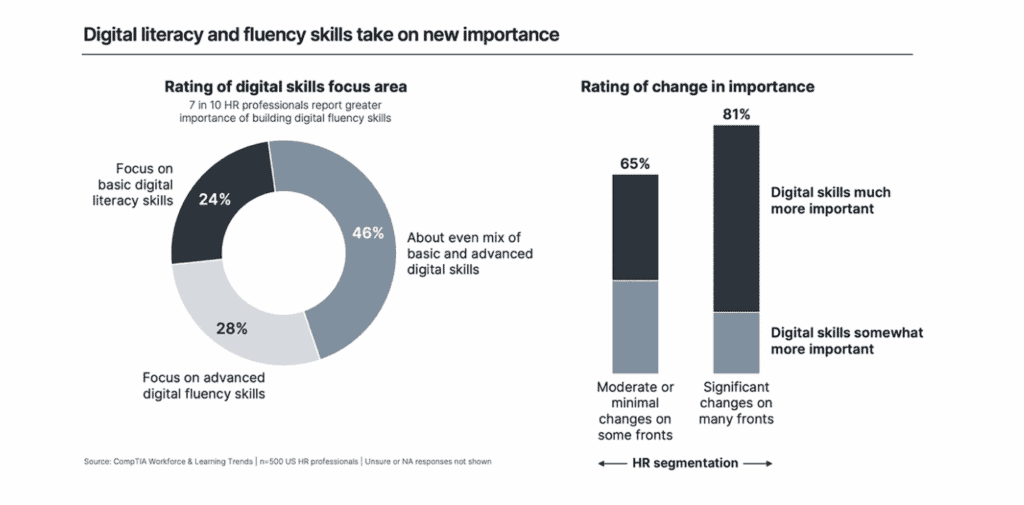
Finally, digital fluency means more than mastering Slack or Zoom. It’s about communicating asynchronously, maintaining tone across cultures, and building trust without physical presence. In many global teams, these soft-digital skills now outweigh traditional certifications in determining long-term success.
Source: HR Executive
As remote work continues to dissolve borders, those who invest in this new skill stack, language, cultural, temporal, and digital adaptability, will define the next generation of high-earning, globally mobile professionals.
Follow the Money
The financial dynamics of global employment cut both ways. For skilled professionals in developing markets, remote work has unlocked unprecedented earning potential. In India, for example, a senior software developer typically earns between ₹1 million and ₹2 million annually (about $12,000–$24,000) in the domestic market. Yet by working directly with U.S. or European companies, the same professional can command $45,000 or more, still cost-efficient for employers, but life-changing for employees.
Meanwhile, workers in high-cost regions face new wage pressures. Why pay a New York-level salary when equally skilled developers in Lisbon or Porto can deliver the same work for far less? This geographic pay arbitrage has already reshaped industries from software development to customer support and digital marketing.
Many professionals are also leveraging location flexibility to maximize income and minimize costs. So-called digital migrants, remote workers who relocate to lower-cost destinations, are flocking to cities like Mexico City, Lisbon, and Bali, combining high foreign salaries with affordable lifestyles. This model allows them to save or invest the difference, accelerating wealth building.
But global earnings come with global risks. Currency fluctuations can erode income when you’re paid in one currency and spend in another. More importantly, tax obligations often span multiple jurisdictions. Remote professionals frequently discover they owe income tax both in their home country and where their employer is based. According to Fidelity Investments, residency rules, duration of stay, and income thresholds all affect liability, making professional tax guidance essential, not optional.
In today’s borderless job market, understanding compensation strategy, tax compliance, and exchange-rate exposureis just as vital as mastering technical skills. Those who manage these cross-border challenges intelligently can turn global employment into a long-term financial advantage.
The Infrastructure of Borderless Work
A powerful new ecosystem has emerged to support the rise of global employment. Employer-of-record (EOR) platforms like Remote.com and Deel have simplified the legal, tax, and payroll complexities of hiring across borders, allowing companies to onboard full-time talent in over 100 countries without opening local entities.
Global payments have become just as frictionless. Wise and Payoneer now serve millions of freelancers and remote workers, offering multi-currency accounts and low-fee cross-border transfers that rival traditional banks. Meanwhile, innovations in digital identity verification, international background checks, and automated payroll systems have turned once-painful compliance tasks into streamlined digital workflows.
Professional networking has gone truly global too. LinkedIn’s algorithm increasingly prioritizes skills and engagement over geography, meaning your next opportunity could just as easily come from a recruiter in Singapore as one in San Francisco. Virtual career fairs, global hiring platforms, and online professional communities are rapidly replacing local networking events, connecting talent and employers across every time zone.
The result is a new employment infrastructure built for borderless work, where geography matters less than capability, and opportunity is no longer limited by location.
Playing Offense, Not Defense
The professionals thriving in today’s borderless job market share one key trait, they play offense, not defense. They build location-independent careers in high-demand fields like software development, digital marketing, content creation, and financial analysis, roles where performance matters more than physical presence.
These workers invest heavily in personal branding and global visibility. Whether through thought leadership on LinkedIn, professional communities, or virtual conferences, they create reputations that transcend geography. In a world where recruiters source talent from anywhere, a visible online footprint is no longer optional, it’s a competitive advantage.
They also treat continuous learning and certification as career insurance. With automation and AI reshaping nearly every industry, the most successful remote professionals stay ahead through upskilling in globally relevant areas such as data analytics, cybersecurity, AI and machine learning, and UX design.
Perhaps most importantly, they think like free agents. Even while employed, they maintain updated portfolios, active professional networks, and real-time awareness of global pay trends. Loyalty today is measured not by tenure, but by mutual value creation, staying where your growth aligns with opportunity.
The takeaway? In a global, remote-first economy, thriving means taking control of your career narrative, investing in skills, visibility, and adaptability that keep you on offense, no matter where you live.
The Regulatory Reality Check
The rise of borderless work has outpaced global regulation. While digital nomad visas have multiplied, with programs in Portugal, Estonia, and Dubai leading the way, legal gray areas remain. Immigration and labor laws were built for traditional employment, not for remote workers earning income from abroad.
Stay too long in a country, and you could face unexpected tax obligations. Many nations, including those offering nomad visas, apply residency-based taxation once you exceed 183 days or establish economic ties. Even working “temporarily” without a proper visa can trigger compliance issues or require a work permit, especially if you provide services locally.
Employment protection adds another layer of complexity. A remote employee of a U.S. company living in Southeast Asia might fall between jurisdictions, covered by neither local labor law nor U.S. worker protections. As PwC’s global mobility experts note, cross-border work can create both personal tax exposure and corporate permanent establishment risk for employers.
For global professionals, compliance isn’t optional, it’s a competitive advantage. Understanding visa terms, tax residency rules, and employment rights can prevent costly mistakes and ensure your remote career stays fully legal and sustainable.
The Next Chapter
As artificial intelligence and automation reshape industries, the global job market is entering its most competitive era yet. Routine and repetitive tasks, whether handled by people or algorithms, are steadily migrating to the lowest-cost providers. What remains in highest demand are uniquely human skills: creativity, complex problem-solving, emotional intelligence, and the ability to bridge cultures in global teams.
For professionals embracing this new borderless economy, the transformation offers more than higher pay. It unlocks access to global projects, remote collaborations, and diverse perspectives that fuel innovation, and raise the bar for performance.
In the AI-driven economy, opportunity and obligation now go hand in hand. Talent can thrive anywhere, but complacency is no longer an option. Those who continuously adapt, learn, and upskill will define the next generation of global leaders. The question isn’t whether to compete globally, the future of work has already arrived. The question is how strategically you’ll position yourself to succeed in it.