The AI Job Apocalypse? History Says Relax – We’ve Been Here Before


Headlines warning that “AI will eliminate 30% of jobs” miss the deeper truth: every generation has faced a comparable wave of technological disruption. From farms to factories to offices, roughly half of all jobs have been reshaped each era. Artificial intelligence fits that historical pattern, accelerating task automation, not mass unemployment. The difference is speed: what once took decades now unfolds in years. The challenge ahead isn’t job loss, but job churn, faster reskilling, shorter career arcs, and a premium on adaptability.
- Historical pattern: Since 1900, U.S. employment has reinvented itself every 30–40 years, agriculture fell from 41% to 2% of jobs; mid-skill roles declined from 60% to 46% by 2012.
- AI disruption scale: Current forecasts show 20–30% of roles affected, within historical norms for past revolutions.
- What’s new: AI compresses change into a single decade, reaching higher-skill, cognitive roles once considered safe.
- What endures: Employment rebounds as industries reinvent; creativity, empathy, and strategic judgment remain human differentiators.
- The real issue: Managing rapid job churn, continuous education, reskilling, and equitable distribution of AI’s productivity gains, will determine who thrives in the next economy.
Every week brings a new headline meant to alarm: “AI Will Eliminate 30% of Jobs!” “ChatGPT Threatens Millions of Workers!” “The Robot Takeover Is Here!”
The anxiety is understandable. Professionals across industries, from copywriters to paralegals to financial analysts—worry their careers have an expiration date. Parents question whether their children’s degrees will be obsolete before graduation. The narrative of AI-driven job destruction dominates the conversation. But here’s the truth: this isn’t new. The world has seen it before, many times.
A review of labor history shows that every major technological revolution has reshaped work on a massive scale. The shift from farms to factories, and later from factories to offices, transformed more than half of all jobs over the 20th century. Between 1900 and 2000, U.S. agricultural employment fell from about 41% of the workforce to just 2%, while entirely new industries, from computing to healthcare, emerged in their place, according to research from MIT Economics.
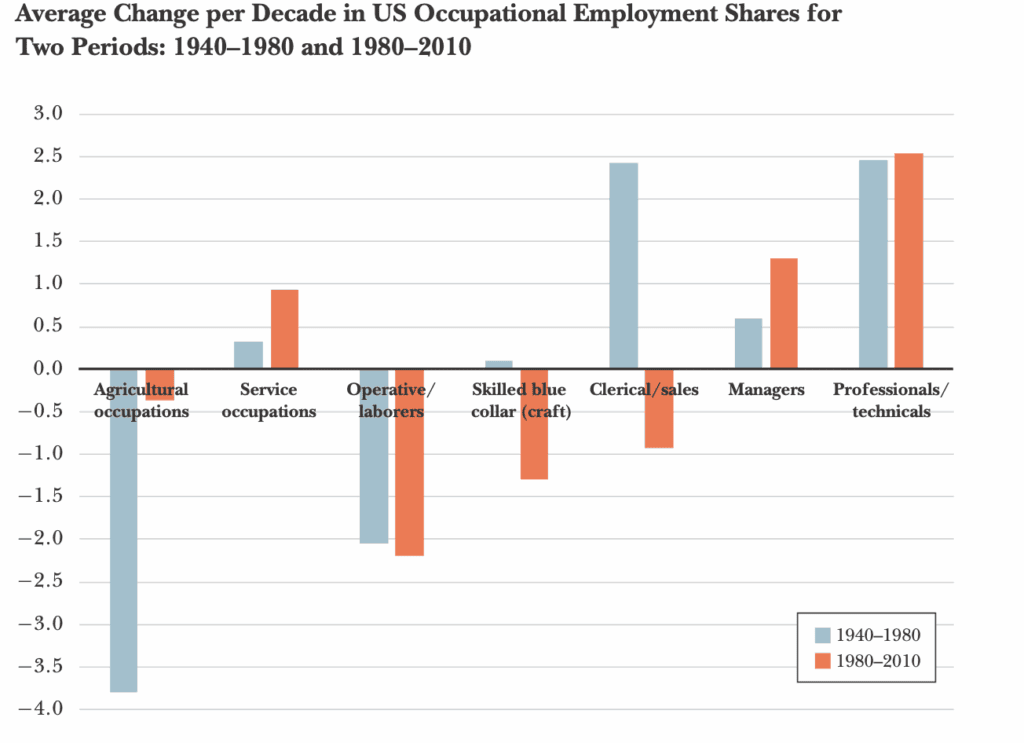
Source: MIT Economics
Today’s projections that AI may disrupt 20–30% of jobs fall squarely within that historical range of transformation. Studies by OpenAI and the University of Pennsylvania and the World Economic Forum indicate that large language models could significantly affect one-fifth to one-third of all roles, but primarily by automating tasks, not eliminating entire professions.
In that light, AI isn’t an unprecedented apocalypse. It’s the latest chapter in a long story of innovation that destroys old tasks while creating new industries, skills, and opportunities.
Your Parents’ Career: When Half the Jobs Vanished
Consider someone who started working in 1985 and is retiring now in 2025. They entered a world of paper filing systems, switchboards, and typing pools. Here’s what happened to that world:
Roles that disappeared: Typists and word-processing operators who transcribed dictation, filing clerks managing physical records, switchboard operators connecting phone calls, telex operators handling global messages, non-specialized travel agents booking routine trips, photo lab technicians developing film, and large numbers of bank tellers replaced by ATMs and online banking.
Roles that transformed: Journalists now create multimedia content, not just articles. Graphic designers use digital tools instead of drafting tables. Engineers rely on CAD and simulation software, not slide rules. Teachers integrate digital learning platforms. Accountants use automated systems instead of paper ledgers.
Studies by MIT and Oxford Martin show that roughly 16–20% of jobs have been displaced by automation since the 1980s, and nearly half have undergone major task transformation. Middle-skill jobs fell from about 60% of the U.S. workforce in 1979 to 46% by 2012.
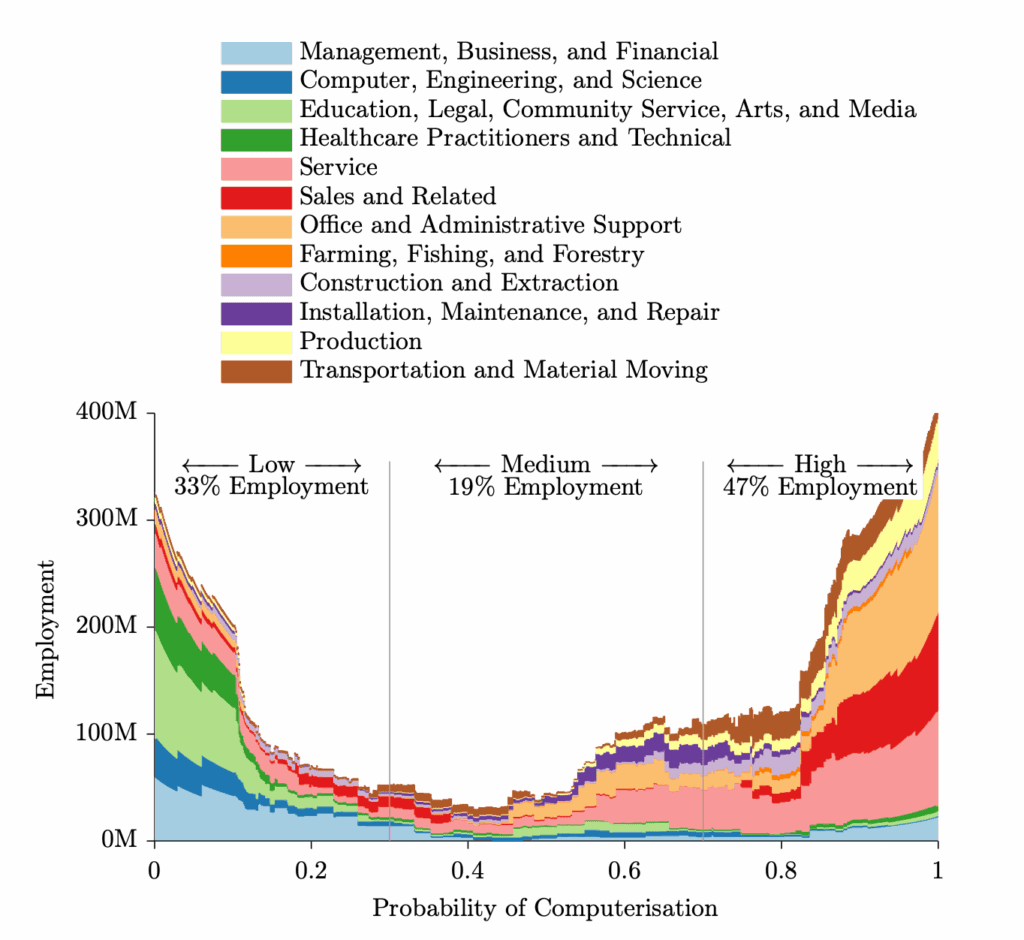
Source: Oxford Martin
Add it up, and about half of the work landscape has been rebuilt in a single generation, a reminder that technological disruption isn’t new, it’s the rule.
Your Grandparents Had It Worse (Or At Least No Better)
Go back another generation, people who started working in the 1950s and retired in the 1990s. They lived through an equally massive transformation, driven by mechanization, automation, and globalization.
In 1950, the U.S. still had roughly 10–12% of workers in agriculture, a figure that dropped to around 2–3% by 1990. Manufacturing also saw a dramatic shift, falling from about 30% of the workforce in 1950 to nearly 16% by 1990, according to Federal Reserve data.
Roles that vanished:
- Farmhands replaced by mechanized harvesters
- Elevator operators (once ubiquitous in office buildings)
- Switchboard operators connecting calls manually
- Stenographers taking dictation in shorthand
- Telegraph operators
- Factory assembly workers (many replaced by automation)
What replaced them:
- The rise of the white-collar office economy
- Service sector expansion
- Early computer operators and programmers
- Healthcare and education sectors growing rapidly
By the 1990s, nearly half of mid-century jobs had either disappeared or evolved beyond recognition. The world of work your grandparents entered in the 1950s looked nothing like the one they left four decades later, reshaped by machines, computers, and an emerging global economy.
The Pattern: Every Generation Rebuilds Half the Economy
| Generation | Career Span | Jobs Transformed/Lost | Primary Driver |
|---|---|---|---|
| 1950s starters | 1950–1990 | Manufacturing employment roughly halved; agricultural share dropped from ~25–30% to under 5% | Mechanization + globalization |
| 1980s starters | 1980–2025 | Major decline in routine and middle-skill jobs; rising demand for digital and service roles | Computers + internet + early AI |
| 2025 starters | 2025–2065 | Estimated 30–40% of jobs subject to automation or significant task change | AI + robotics |
In other words, massive workforce disruption isn’t unique to AI, it’s a recurring feature of economic evolution. Each generation has watched its job landscape reshaped by new technologies, global trade shifts, and productivity revolutions.
For those who started careers in the 1950s, mechanization and globalization dismantled much of the agricultural and factory workforce, cutting U.S. manufacturing’s share of total employment from roughly 35% to about 17%. By contrast, the 1980s cohort experienced a new upheaval driven by computers, the internet, and automation, which eroded routine office and production roles but created entirely new industries in technology, finance, and services.
Now, for the generation beginning in 2025, the forces of AI and robotics are expected to transform between 30% and 40% of existing jobs, many through task reconfiguration rather than outright elimination. But history shows a consistent outcome: while the nature of work changes, employment itself adapts. Old roles fade, new skills rise, and the economy continues to rebuild itself roughly once every generation.
What’s Actually Different About AI (And What Isn’t)
Let’s be clear: artificial intelligence is truly transformative, but not in the apocalyptic way headlines suggest.
What’s Historically Normal
Major technological shifts have always shaken labor markets. The scale of AI disruption, projected at 20–30% of roles impacted, is modest compared to past eras. During industrialization, over half of U.S. jobs changed as agriculture collapsed from 41% of employment in 1880 to under 6% by 1960, according to research from the Economic Strategy Group.
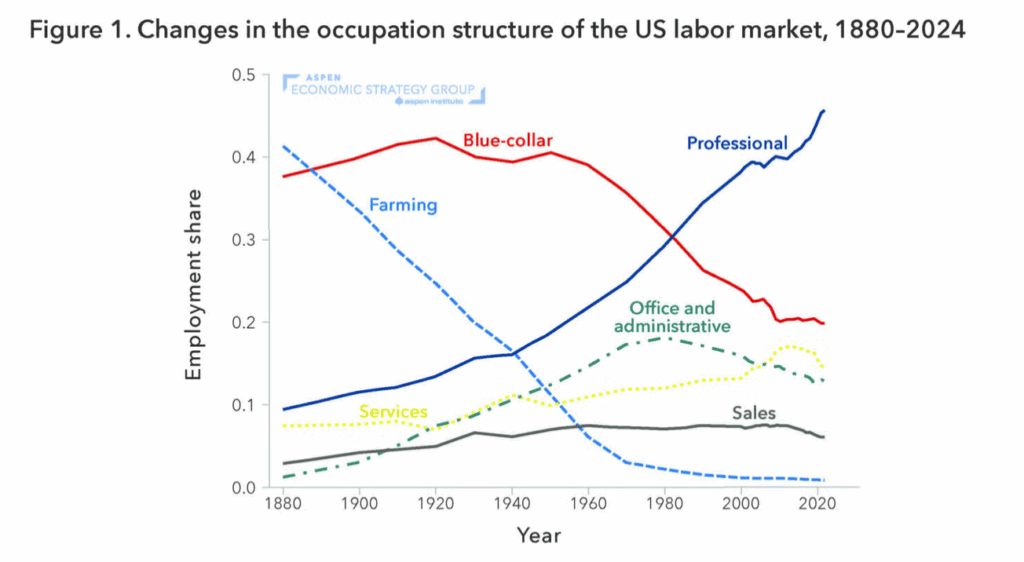
Source: Economic Strategy Group
Yet each time, new industries emerged, workers adapted, and economies reorganized. The process follows Joseph Schumpeter’s cycle of creative destruction, where job losses are offset by new creation in emerging sectors. Workers reskill, industries evolve, and anxiety spikes during each transition. From mechanization to the internet, every wave produced short-term disruption but long-term growth.
What’s Genuinely Different
The speed is unprecedented. Earlier transformations unfolded over 30–40 years; AI may compress that to a single decade as automation scales across industries. The target has shifted from physical labor to cognitive work, writing, data analysis, design, and decision-making, unsettling professionals once insulated from automation risk, according to the World Economic Forum.
The visibility is also new: social media turns every layoff and AI milestone into a viral headline, amplifying collective anxiety. And the skill half-life has shortened dramatically, the average job’s skill profile now changes by 30% within three years, based on findings from Lightcast.
Still, the underlying dynamic remains familiar: technology disrupts, jobs churn, societies adapt. AI is rewriting the rulebook faster and higher up the skill ladder, but the game itself hasn’t changed.
The Jobs That Actually Disappeared (Spoiler: Office Work Already Got Hit)
When people fear AI eliminating jobs, they’re often describing what’s already happened. Consider the Brookings Institution’s research, which found that more than 30% of U.S. workers could see at least 50% of their tasks disrupted by generative AI. That sounds alarming. until you realize this cycle has played out before.
- In the 1980s–1990s, computers erased typing pools, filing clerks, and switchboard operators as offices digitized.
- In the 1990s–2000s, the internet gutted travel agents, stockbrokers, and newspaper classifieds; the number of travel agents fell from about 132,000 in 1990 to roughly 74,000 by 2014.
- In the 2000s–2010s, smartphones and e-commerce upended retail clerks and traditional sales roles as shopping habits moved online.
We’ve already experienced multiple waves of large-scale job disruption in just forty years. AI is simply the next wave. The difference now is who’s being hit. Instead of factory or clerical workers, AI is reshaping the roles of people who write code, analyze data, and process information. The shock isn’t the scale, it’s the social class of disruption, as automation reaches the educated middle tier once considered safe.
The Forgotten Half: Jobs That Didn’t Exist
Here’s what gets lost in the panic: while old jobs disappear, new ones emerge, and they often reshape entire industries.
Jobs that barely existed in 1980 now define the modern economy: web developers and UX designers, social media managers, data scientists and machine learning engineers, app developers, cloud architects, cybersecurity analysts, digital marketers, podcast producers, drone operators, and renewable energy technicians.
These aren’t niche roles, they employ millions globally. When today’s retirees began their careers, none of these were mainstream professions. The rise of the internet, smartphones, and clean energy created entirely new labor markets.
The same pattern is repeating with AI-driven innovation. Emerging roles like prompt engineers, AI ethics officers, synthetic data specialists, and human-AI interaction designers show how technology continually builds new career frontiers. The next generation won’t just adapt to change, they’ll create jobs we can’t yet imagine.
Why The Panic Feels Different This Time
If disruption is historically normal, why does AI feel so threatening?
It’s happening to “knowledge workers”
Previous automation waves hit farmers, factory workers, and clerical staff. This time it’s affecting journalists, lawyers, accountants, and programmers, the people who write the articles and shape the narrative. Research from the Brookings Institution shows that generative AI now threatens non-routine cognitive roles once considered safe. When the disrupted are the communicators, the anxiety amplifies.
The compressed timeline
Your grandparents had 40 years to adapt to mechanization. Your parents had 35 years for computerization. You might have 10-15 years for AI. The adaptation curve is steeper. Studies from McKinsey note that digital diffusion is accelerating faster than any previous industrial wave, tightening the window for reskilling.
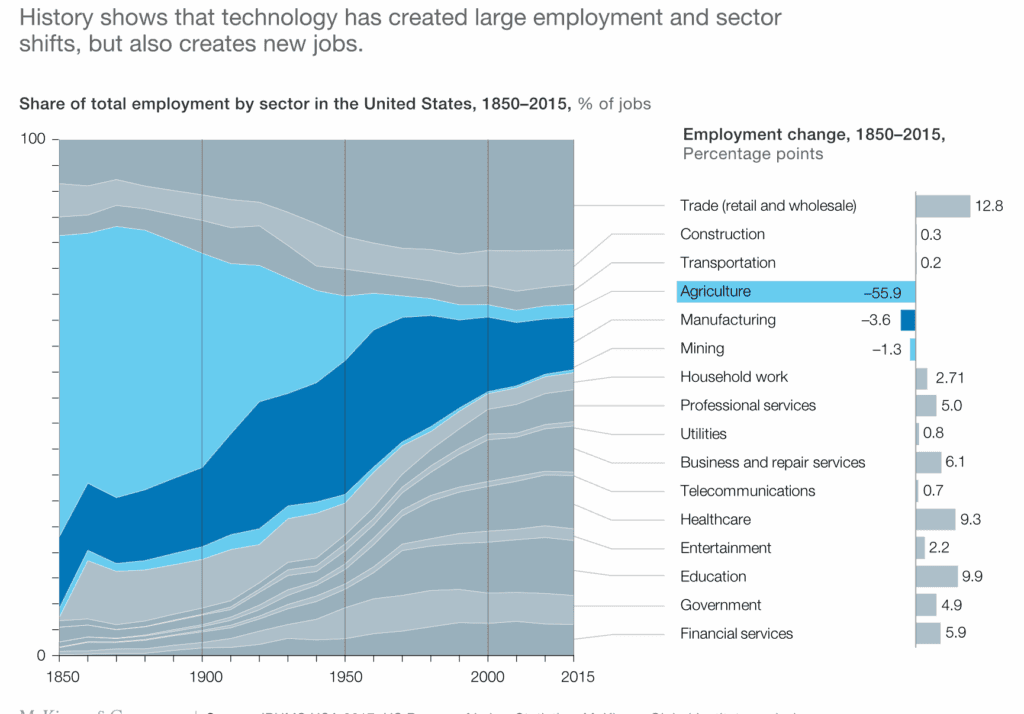
Source: McKinsey
The visibility
In 1985, laid-off typists didn’t have Twitter to share their anxiety. Today, every journalist worrying about ChatGPT writes an article about it. Every software engineer concerned about Copilot posts on LinkedIn. Social media amplifies fear in real time, turning private disruption into a collective spectacle that fuels widespread unease.
The uncertainty about the ceiling
Previous technologies had obvious limits. Robots couldn’t write. Computers couldn’t be creative. AI is breaching those boundaries, producing text, code, and art at human levels. As Harvard Business Review notes, this wave reaches higher into cognitive and creative domains, making it harder to see what remains uniquely human.
These differences make the transition more psychologically challenging, but they don’t change the fundamental pattern.
What History Actually Teaches
Looking at decades of labor-force transformation reveals several consistent lessons that shape every major economic shift.
1Disruption Is Painful but Temporary
Every technological revolution brings short-term pain, layoffs, obsolete skills, and struggling communities. Yet historically, total employment has rebounded as new sectors absorbed displaced workers. After the mechanization of agriculture and the computerization wave of the 1980s, overall employment continued to rise as innovation generated new opportunities.
Predictions of Permanent Unemployment Always Miss the Mark
Each automation era sparked dire warnings that never materialized. In the 1960s, experts feared computers would cause mass joblessness. The 1980s brought panic over robots destroying factory work. The 2000s saw predictions that offshoring would wipe out the middle class. Yet global labor-force participation and job creation continued to grow. The work simply evolved.
The Most Valuable Skills Shift: Human Judgment Endures
In 1950, strength and manual precision were prized. By 1980, procedural and technical knowledge mattered most. By 2010, digital literacy became essential. Now, in the AI era, skills like creativity, empathy, and strategic reasoningdefine value. Tools change, but human judgment and collaboration remain irreplaceable.
Education Must Become Continuous
Earlier generations could train once and rely on those skills for decades. That world is gone. Today’s workers must engage in lifelong learning, reskilling, adapting, and shifting careers as industries evolve. The World Economic Forum projects that over 40% of workers will need new skills by 2025. The challenge is real, but so is the opportunity to remain relevant in a dynamic economy.
The Real Challenge Isn’t Job Loss – It’s Job Churn
The historical record shows AI isn’t triggering an unprecedented jobs apocalypse. But it is accelerating something genuinely hard: rapid job churn.
The problem isn’t that work will disappear. It’s that:
-
Careers will fragment into shorter job tenures
-
Reskilling will need to happen more frequently
-
Uncertainty will persist as industries continuously reorganize
-
Income volatility may increase during transitions
-
Education systems struggle to keep pace
This is difficult. It requires stronger safety nets, more accessible retraining, and policies that support workers through transitions. But it’s not the end of work.
What You Should Actually Worry About
Stop worrying about: “Will AI eliminate all jobs?”
Start worrying about:
-
Will we create adequate support for workers during transitions?
-
Can we reduce the psychological toll of constant reskilling?
-
Will we preserve meaningful human work that provides purpose and dignity?
These are real challenges, but they’re also solvable if we focus on policy, education, and equity rather than panic. History shows that societies that invest in adaptability, not fear, emerge stronger from every technological revolution.
The Bottom Line
When you read that “AI will disrupt 30% of jobs,” remember, that’s not unprecedented. Your parents’ generation saw roughly half of all jobs transformed by computers and globalization. Your grandparents’ generation watched agriculture and factory work shrink from nearly a third of U.S. employment to under 10%. Both generations adapted and kept working.
AI isn’t breaking the pattern, it’s continuing it. The Industrial Revolution created factories, the computer age created digital work, and the AI era will automate routine cognitive tasks while creating new industries and roles we can’t yet name.
The challenge isn’t job loss, it’s job churn. Careers will evolve faster, skills will expire sooner, and adaptation will matter more than ever. But history is clear: technology changes work, not the need for it. Humans remain essential, for creativity, empathy, and problem-solving. The work will change. It always does.