Open Banking vs. Traditional Banking: Understanding the Key Differences


Open banking doesn’t replace traditional banking or change where your money lives. Your bank still holds your deposits, processes transactions, and provides core protections. What open banking changes is how your financial data and payments can be shared with third-party services, only with your explicit, time-limited consent. Instead of exporting statements or sharing login credentials, open banking lets authorized apps securely access specific account data or initiate payments through standardized APIs. This enables better budgeting tools, streamlined payments, and multi-account visibility without transferring custody of funds. If you never opt in, your banking experience remains the same. Open banking extends traditional banking by adding controlled, permission-based data access, not by replacing banks themselves.
- Your bank relationship stays the same: Accounts, deposits, and insurance protections remain with your bank.
- The real change is data access: You can grant apps read-only or payment permissions without sharing credentials.
- Payments can be initiated by consent: Authorized providers can trigger bank payments you approve, often cheaper than cards.
- Security improves vs. screen scraping: Banks authenticate you directly and issue time-limited access tokens.
- Open banking is optional: No consent means no change to your day-to-day banking.
The term “open banking” suggests something fundamentally new, a complete departure from how banking has always worked. In reality, open banking doesn’t replace traditional banking; it extends it. Your bank account continues to function exactly as it always has. You can still visit branches, use ATMs, transfer money, and check your balance through your bank’s own app or website.
What changes is not the core banking relationship, but who else can access your financial data, or, in some cases, initiate transactions on your behalf, and under what specific conditions. That access only occurs with your explicit consent, is limited in scope and duration, and applies solely to authorized third-party services operating within applicable regulatory or contractual frameworks.
Understanding the distinction between open banking and traditional banking requires looking past the terminology and hype to see what actually changes in practice, and what remains fundamentally the same.
The Core Relationship: Unchanged
In traditional banking, your relationship is directly with your bank. You open an account, deposit money, use the bank’s services, and interact with the bank’s customer support when issues arise. That fundamental relationship does not change with open banking. Your bank remains responsible for holding your money, processing transactions, providing customer service, and meeting its core regulatory obligations.
Open banking does not create a new type of bank account or replace your existing one. It does not transfer custody of your funds to third parties. Your money remains with your bank, under the same banking license, supervision, and protections that apply regardless of whether open banking is used.
While authorized third parties may access data or initiate payments with your explicit consent, deposit insurance coverage remains unchanged and continues to apply to bank failure, with other consumer protections governing third-party access and liability depending on jurisdiction.
The Key Difference: Data Access and Usage
The substantive difference between traditional and open banking lies in how your financial data can be accessed and used. Traditional banking operates on the principle that your bank owns the relationship with you and controls access to your account information. If you want to use your transaction history with another service, say, a budgeting app or a loan comparison tool, you’d need to either manually export the data or share your actual login credentials.
Open banking creates standardized mechanisms for you to grant third parties read access to your account information without sharing your credentials. The bank provides this access through secure Application Programming Interfaces according to specifications that ensure consistency across different financial institutions.
Consider a concrete example. In traditional banking, if you want a budgeting app to track your spending, you might download monthly statements as CSV files and upload them manually. Or you might give the app your username and password, allowing it to log in as you and extract the data, a practice called screen scraping that violates most banks’ terms of service and creates security risks.
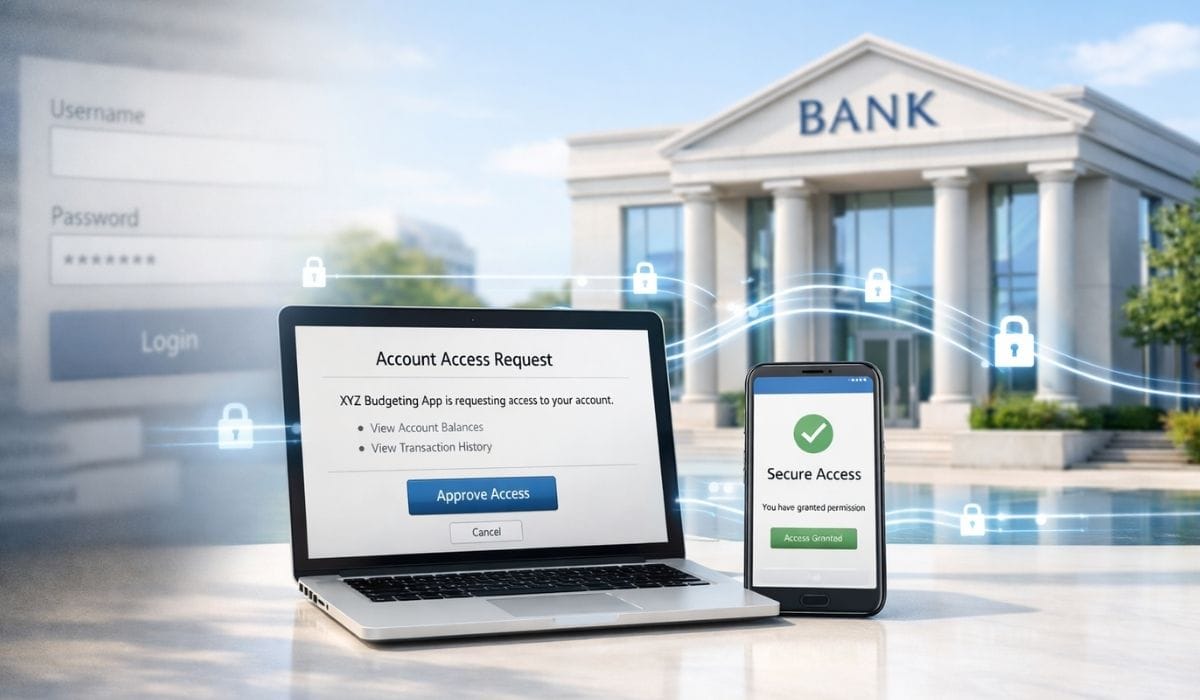
With open banking, the budgeting app connects directly through your bank’s API. You explicitly authorize what data the app can access (say, transactions from your checking account but not your savings account), for how long, and you can revoke that access at any time. Your actual banking credentials never leave your control.
Payment Initiation: A New Capability
Traditional banking limits who can initiate payments from your account. You can move money yourself through online banking, set up direct debits with merchants, or authorize specific regular payments. But third-party services couldn’t trigger payments on your behalf without you first sharing your login credentials.
Open banking introduces payment initiation services as a regulated category. With your explicit consent for each transaction, an authorized third party can initiate a payment directly from your bank account. This creates opportunities for faster payments, lower merchant fees compared to card networks, and streamlined checkout experiences for online shopping.
In the UK, variable recurring payments now account for 16% of open banking payments, demonstrating that consumers find value in granting trusted services limited ability to initiate payments within parameters they’ve approved.
The Authentication Experience
Traditional banking typically involves username and password authentication, often with two-factor authentication sending codes to your phone. You log into your bank’s website or app, enter your credentials, and access your account.
Open banking maintains this secure authentication but adds a layer. When a third party wants to access your data, they redirect you to your bank’s authentication system. You log in there, not in the third party’s app, and explicitly approve the requested access. The bank then provides the third party with a time-limited access token, not your credentials.
This distinction matters enormously for security. In traditional banking with screen scraping, the third party holds your actual login details, potentially seeing them in plain text, storing them in their systems, and using them to log in repeatedly as you. Under open banking, the third party never sees or stores your credentials.
The OAuth 2.0 authorization code flow forms the foundation of secure open banking API implementations, enabling third parties to access user data without ever exposing actual user credentials. This protocol has been widely adopted across different open banking implementations precisely because it solves the credential-sharing problem that plagued traditional approaches.
What Stays the Same: Core Banking Functions
Despite these changes in how data can be shared, many fundamental aspects of banking remain the same whether or not you use open banking services.
Your account balance continues to be held and maintained by your bank, and your deposit insurance protections apply in exactly the same way. The processing of transactions, the actual movement of money when you make a payment, still relies on bank-operated payment rails and settlement systems, including instant payment schemes where they exist. Regulatory oversight of your bank’s capital requirements, liquidity standards, and core consumer protection obligations remains unchanged, while separate regulatory frameworks apply to authorized third-party providers.
Most importantly, open banking is opt-in. If you never authorize a third party to access your account data, your day-to-day banking experience remains functionally the same. You can continue using only your bank’s own services without any practical difference.
The Ecosystem Expansion
Perhaps the most significant difference between traditional and open banking is philosophical rather than technical. Traditional banking assumed a vertically integrated model where one institution provided all your financial services. You’d get your checking account, credit card, mortgage, and investment products all from the same bank.
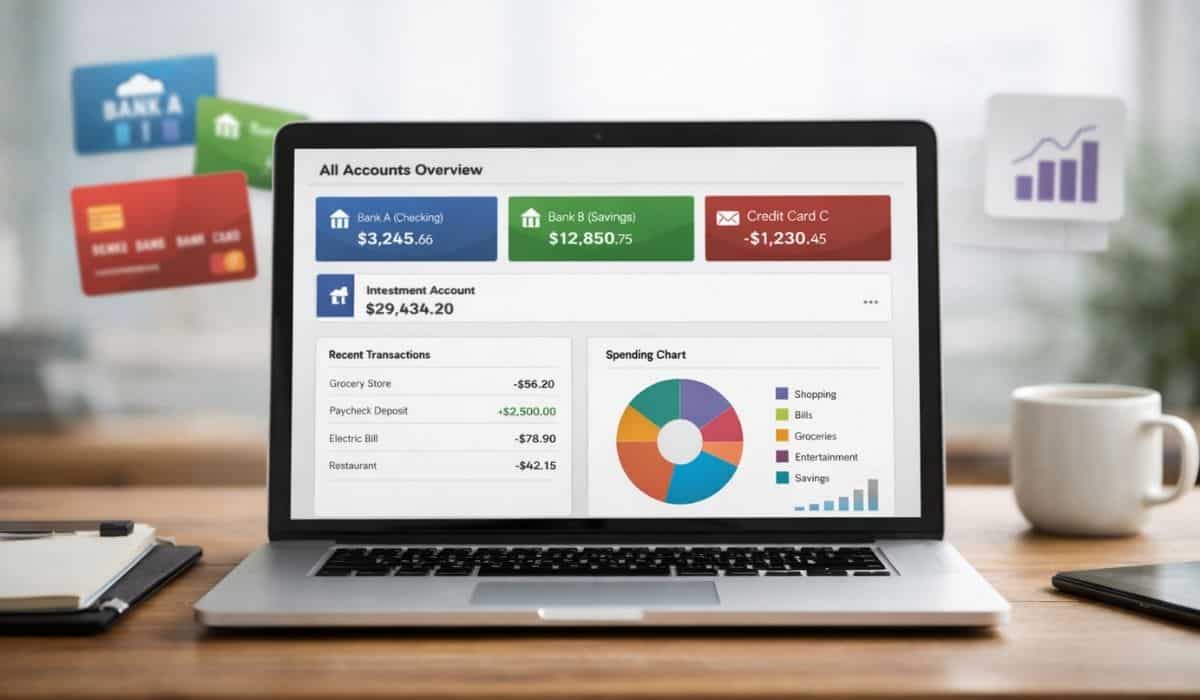
Open banking enables a more modular approach. You might still hold your primary account at a traditional bank but use a specialized budgeting app to track spending across multiple accounts, a different service to optimize savings, and yet another platform to compare loan offers based on your actual transaction history. Each service accesses only the specific data it needs, with your explicit permission, for as long as you choose to allow it.
This ecosystem approach creates both opportunities and complexities. On one hand, you can assemble best-of-breed services tailored to your specific needs rather than settling for whatever your bank offers. On the other, you must manage relationships with multiple providers, understand what data each one holds, and make informed decisions about the tradeoffs between convenience and privacy.
Regulatory Framework: Different Obligations
Traditional banks operate under comprehensive regulatory frameworks covering capital requirements, consumer protections, deposit insurance, and operational standards. They are supervised by central banks and financial regulators with broad enforcement powers.
Third-party providers in the open banking ecosystem operate under different and more limited regulatory regimes. In Europe, Account Information Service Providers and Payment Initiation Service Providers must be authorized and regulated under the Payment Services Directive 2 (PSD2), but their obligations differ significantly from those applied to full-service banks. They are not permitted to take deposits, lend, or hold customer funds, and they are not subject to bank-level capital or liquidity requirements.
In the United States, the CFPB’s final rules under Section 1033 establish consumers’ rights to access and share their financial data and impose requirements on authorized third parties related to privacy, data security, purpose limitation, and data retention. These rules do not create a bank-style licensing regime, and oversight of third-party providers remains distributed across existing regulatory authorities.
The result is a tiered regulatory structure. Banks continue to carry the full scope of banking regulation, while third-party providers accessing data through open banking interfaces must meet defined standards for consent, security, and permitted data use, without being subject to the prudential and balance-sheet requirements imposed on banks.
The User Experience Divide
In traditional banking, your user experience is determined entirely by your bank’s choices about interface design, feature sets, and service quality. If your bank’s mobile app is clunky, you’re stuck with it unless you switch banks—a decision that involves significant friction.
Open banking potentially improves this by allowing you to access your account data through alternative interfaces that might offer better design, more useful features, or superior customer support. Your underlying account remains at your bank, but you interact with it through services built by providers who specialize in user experience rather than regulatory compliance and infrastructure.
However, this potential hasn’t been uniformly realized. Authentication experiences can vary significantly. In the UK, the uniform open banking standard delivers consistent terminology and reliable user flows. In Europe, without a unified API standard, user experience varies dramatically between regions, with some European banks implementing up to 17 authentication steps taking four minutes to complete a single connection.
Cost Structures: Different Economics
Traditional banking revenue models are well established, relying on interest margins on loans and deposits, account maintenance fees, transaction charges, and fees for specific services. These costs are borne directly by consumers or embedded indirectly in interest rate spreads.
Open banking changes how costs are distributed across the ecosystem. Banks are required to invest in secure API infrastructure, regulatory compliance, and ongoing maintenance to enable third-party access. In regulated open banking regimes such as the UK and EU, banks are generally not permitted to charge third-party providers for standard API access, limiting opportunities for direct cost recovery and shifting the economic rationale toward indirect benefits such as competition, innovation, and payment efficiencies.
Third-party providers must sustain their operations through subscription fees, transaction-based pricing, or revenues generated from services built using authorized data access. Their use of customer data is tightly constrained by explicit consent, purpose limitation, and data-minimization requirements; monetization occurs through delivering permitted services rather than through resale or unrestricted exploitation of user data.
The long-term commercial sustainability of open banking remains an area of active policy development. In the UK, the successor governance model to Open Banking Limited, often referred to as the Future Entity, is still under design and consultation. A central challenge for this new body is establishing a durable funding model to support ongoing standards development and ecosystem governance in a commercially sustainable manner.
The Consent Mechanism: Explicit vs. Implicit
Traditional banking operates on broad, ongoing consent. When you open an account, you explicitly agree to your bank’s terms and conditions, and that authorization generally remains in effect unless you close the account or the terms change. You are not required to repeatedly reauthorize the bank to hold your money or use your account information for core banking purposes.
Open banking requires explicit, informed consent for third-party access. You must actively approve what data is shared, with which provider, and for how long. This consent is granular and time-limited, and it can be revoked at any time through your bank or the third-party service.
This shift from broad, ongoing consent to explicit, purpose-limited consent represents a significant change in how consumer authorization works. It introduces additional friction, users must actively approve data sharing rather than relying on a single account agreement, but it also provides greater transparency and control over who can access financial data and for what specific purposes.
Looking Forward: Convergence or Divergence?
As open banking matures, an important question emerges: will traditional banks and third-party providers converge toward similar offerings, or will they continue to diverge into more specialized roles?
Some banks are responding to open banking by improving their own digital services, investing in better apps, and adding features that compete more directly with those offered by third parties. Others are pursuing platform-oriented strategies, emphasizing their role as regulated account providers and financial infrastructure, while allowing specialized fintech companies to deliver certain customer-facing services layered on top of that infrastructure.
The next phase of development, driven by open finance initiatives that seek to extend data-sharing beyond payment accounts to areas such as investments, pensions, and insurance, will test whether this division between infrastructure providers and service providers becomes more entrenched or whether new hybrid models combining both roles begin to emerge.
The Practical Reality for Consumers
For most people, the distinction between traditional and open banking matters less than the practical question: does open banking meaningfully improve their financial life? The answer depends on individual circumstances and specific use cases.
If you’re satisfied with your bank’s existing services and don’t need to view or manage multiple accounts in one place, traditional banking may already meet your needs. Open banking is optional and doesn’t add value if it doesn’t address a real problem.
However, for consumers who manage finances across multiple banks, need more advanced budgeting and cash-flow tools, want to streamline payments, or need to share financial data securely with accountants or financial advisors, open banking can offer clear advantages. By enabling standardized, permission-based data access, it reduces reliance on manual exports, fragmented logins, and insecure workarounds.
The key point is that open banking doesn’t replace traditional banking, it extends it. Your bank still holds your money and performs core banking functions, while open banking expands how your data and payments can be used, with your consent. Understanding this distinction helps clarify both what is genuinely new about open banking and what remains reassuringly familiar.