Is an Ivy League Education Worth the Cost? What 20 Years of Research Reveals


The ‘Ivy Advantage’ Is Real – At the Very, Very Top
If your goal is to reach the highest levels of professional success, an Ivy League or Ivy-Plus degree offers a measurable edge.
A landmark 2023 study by Harvard economist Raj Chetty found that attending an Ivy-Plus school, the Ivy League plus Stanford, MIT, Duke, and the University of Chicago, increases your odds of reaching the top 1% of earners by about 60% compared to a flagship state university. It also nearly doubles your chances of attending an elite graduate school and almost triples your chances of landing at a prestigious firm, according to Opportunity Insights.
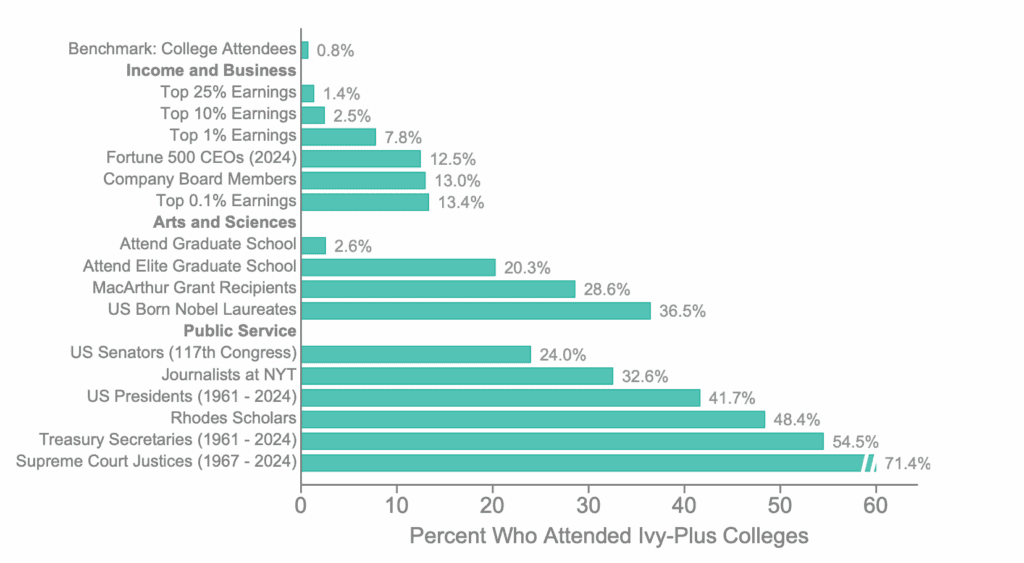
Source: NBER
The elite pipeline is undeniable. Ivy-Plus graduates make up roughly 10% of Fortune 500 CEOs, a quarter of U.S. senators, and about three-quarters of Supreme Court justices appointed in the last 50 years, even though these schools enroll less than 1% of all U.S. college students.
For those aiming to lead major corporations, argue before the Supreme Court, or shape national policy, the Ivy pathway delivers tangible, lifelong advantages.
The Exception: First-Generation and Minority Students
Before families celebrate skipping elite schools, there’s an important caveat. Research by Stacy Dale and Alan Krueger found that while the overall earnings premium from attending a more selective college is nearly zero after adjusting for student ability, it’s significant for certain groups, including first-generation, low-income, and minority students.
For these students, elite college attendance often leads to higher lifetime earnings. The likely reason: privileged students already benefit from family networks and access to opportunity, while first-generation and underrepresented students gain those advantages primarily through the elite institutions.
This means the Ivy-versus-state-school decision can have very different long-term consequences depending on a student’s background.
What You Major In Matters More Than Where You Go
For most students, it is the choice of major that matters more than the choice of college. Research from Georgetown University’s Center on Education and the Workforce shows that median earnings for prime-age workers range from about $58,000 for education and public service majors to $98,000 for STEM fields, a $40,000 annual gap that compounds over time.
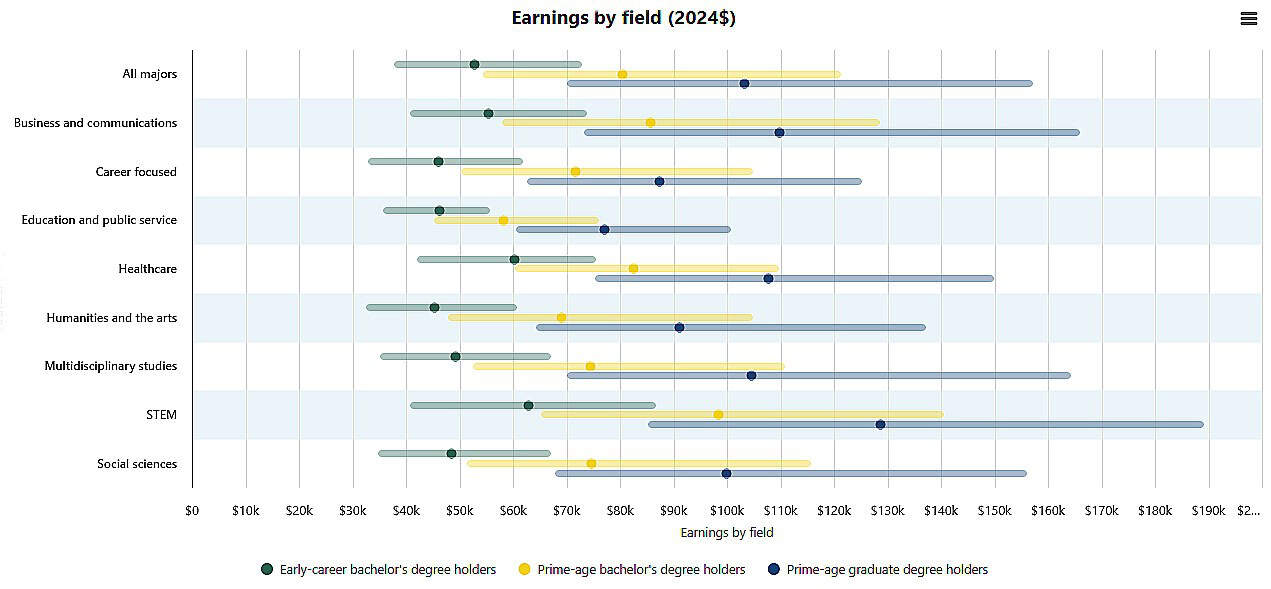
Source: Georgetown University
In simple terms, an engineering graduate from a strong state university can out-earn a humanities graduate from an Ivy League school. A computer science major from a regional college may secure six-figure opportunities, while liberal arts graduates from elite institutions often start closer to $60,000. The data make one thing clear: your field of study is one of the strongest predictors of long-term earnings potential.
The Return on Investment Picture Is Complex
When Georgetown University’s Center on Education and the Workforce analyzed the return on investment (ROI) for 4,600 U.S. colleges, the results challenged the usual Ivy-versus-state-school debate.
Many public universities delivered strong ROI, especially for in-state students paying lower tuition. Several non-Ivy private colleges with solid career placement also ranked high. While most Ivy League schools performed well, they weren’t always at the very top.
The variation comes down to key factors:
-
Net cost: Paying $320,000 full price versus $100,000 with aid changes the equation entirely.
-
Major mix: Schools with more STEM or business majors show stronger average outcomes.
-
Location: Proximity to major job markets improves internship and job opportunities.
-
Individual results: Even within the same major and school, career outcomes differ widely.
For families, ROI is deeply personal. A full-ride to a state flagship may beat a full-pay Ivy, while an Ivy with generous aid could outperform a modest scholarship elsewhere.
Social Mobility: A Different Measure of Success
Some researchers argue that we’re asking the wrong question about higher education. Instead of focusing on which colleges produce the most top 1% earners, they suggest asking a more meaningful one, for example, which colleges actually help students from modest backgrounds move up the economic ladder?
According to Opportunity Insights’ Mobility Report Cards, the key metric of success is the percentage of students who start in the bottom 20% of household income and rise to the top 20% of earners as adults. By this measure, many non-Ivy public universities, including the City University of New York (CUNY), the California State University system, and several regional state universities, emerge as powerful engines of upward mobility. These schools enroll large numbers of low-income students and consistently help them reach the middle and upper-middle class.
Elite Ivy-Plus institutions also deliver excellent outcomes for the limited number of low-income students they admit. Research shows that those students have strong chances of reaching the top income brackets, even the top 1%. However, the overall mobility impact of these schools remains limited because they enroll far fewer low-income students compared to large public universities.
In short, while elite colleges may dominate headlines, many public universities play the most significant role in promoting real economic mobility, helping students from working-class families achieve long-term financial success.
So What Should Families Do?
After reviewing two decades of higher education research, one clear message emerges: the best choice depends on your goals, finances, and field of study.
Consider elite schools if:
-
Your student has clear ambitions in fields where Ivy networks dominate, such as finance, law, academia, or politics.
-
They’re a first-generation or underrepresented minority student who would gain access to transformative networks and mentorship.
-
The financial aid package makes the net cost comparable to other strong options.
-
Your student is deeply motivated to engage with rigorous academics and take full advantage of the opportunities available.
Consider strong alternatives if:
-
You’re facing significant debt to afford an Ivy education.
-
Your student plans to enter fields like engineering, tech, or healthcare, where skills and experience matter more than pedigree.
-
Your state flagship or other well-ranked universities offer excellent programs and strong career placement at lower cost.
-
You value a campus culture, location, or specific program that aligns better with your student’s goals, even if it’s not highly selective.
Either way, prioritize:
-
Choosing a marketable major or developing practical, in-demand skills.
-
Securing internships and early career experiences that open real-world opportunities.
-
Graduating with minimal debt, preserving flexibility for graduate school or entrepreneurial ventures.
-
Focusing on fit and engagement, since research shows students who are actively involved and take advantage of opportunities thrive regardless of prestige.
Recent studies from Opportunity Insights, Georgetown University’s Center on Education and the Workforce, and Brookings Institution reinforce this conclusion: for most students, what you study, how you engage, and how much you borrow often matter more than the name on the diploma.
The Bottom Line
Is an Ivy League education worth it? The evidence says: it depends, on your finances, your student’s goals, and the specific offer on the table. Decades of economic research, from Raj Chetty’s Harvard Equality of Opportunity Project and Georgetown University’s Center on Education and the Workforce, confirm that elite universities open doors to top 1% career outcomes and elite graduate programs. Yet they also show that motivated students at strong public or private universities can achieve comparable long-term earnings and career satisfaction.
What truly determines success isn’t prestige alone, it’s major choice, internships, first-job quality, and financial strategy. Students who choose high-ROI majors, pursue meaningful opportunities, and graduate with minimal debt consistently outperform peers from more selective schools burdened by high costs.
For families deciding between an Ivy League acceptance and a strong alternative, the key is fit, academic, financial, and personal. The right school isn’t necessarily the most famous one; it’s the one that aligns with your goals, budget, and future plans.