How to Qualify for Medicaid Before Age 65: Understanding Disability Eligibility


- SSI is the core pathway: In most states, receiving SSI automatically qualifies you for Medicaid. Some states still require a separate Medicaid application.
- Disability definition: To qualify, you must have a medical impairment that prevents substantial gainful activity ($1,620/month in 2025, or $2,700 if blind) and is expected to last 12+ months or result in death.
- The SSA Blue Book: Lists qualifying medical conditions across 14 body systems; however, you can still qualify if your impairment “equals” a listed condition in severity.
- State flexibility: Beyond SSI, most states offer Medicaid Buy-In, Medically Needy, or Poverty-Level Aged and Disabled programs to cover those with higher incomes.
- Fast-track cases: ALS and End-Stage Renal Disease qualify for immediate Medicare and often Medicaid; Compassionate Allowances expedite claims for 300+ severe conditions.
More than 9 million Americans qualify for Medicaid based on a disability, nearly one in four of all enrollees, according to the Medicaid and CHIP Payment and Access Commission (MACPAC). While most people associate Medicaid eligibility with turning 65, millions become eligible much earlier through disability pathways tied to Supplemental Security Income (SSI).
The Core Pathway: SSI and Automatic Medicaid
The most common route to Medicaid for people under 65 with disabilities runs through Supplemental Security Income (SSI), a federal cash assistance program. More than one-third of Medicaid beneficiaries who qualify on the basis of disability do so through SSI, according to the Medicaid and CHIP Payment and Access Commission (MACPAC).
In most states, if you receive SSI, you’re automatically eligible for Medicaid, meaning you meet the eligibility criteria without having to file a separate determination. However, the process varies: some states enroll SSI recipients automatically, while others require a separate Medicaid application even though SSI receipt still guarantees eligibility. The Social Security Administration (SSA) confirms that in a few states, applicants must apply directly with the state Medicaid agency to activate coverage.
This SSI-based pathway remains the primary gateway to Medicaid for working-age adults with disabilities, ensuring access to essential health coverage alongside cash benefits.
What Counts as a Disability?
Here’s where it gets specific. Most Medicaid disability pathways use the same definition that the Social Security Administration (SSA) applies for Supplemental Security Income (SSI) eligibility. This standard isn’t based on general functional limitations, it’s centered on your ability to work.
To qualify as disabled under this definition, you must have a medically determinable physical or mental impairment that:
-
Prevents you from engaging in substantial gainful activity (SGA)
-
Has lasted or is expected to last at least 12 months, or is expected to result in death
For 2025, “substantial gainful activity” means earning more than $1,620 per month (or $2,700 if you’re blind), according to the Social Security Administration.
While states administer Medicaid individually, most align their disability standards closely with the SSA definition to maintain federal consistency.
The Blue Book: Your Disability Reference Guide
The Social Security Administration (SSA) maintains the Blue Book, officially called Disability Evaluation Under Social Security, a comprehensive listing of medical conditions considered severe enough to qualify as disabling. While not exhaustive, it serves as the framework for evaluating disability claims.
The Blue Book for adults is divided into 14 major categories:
-
Musculoskeletal Disorders – including spinal disorders, fractures, and joint dysfunction.
-
Special Senses and Speech – including vision and hearing loss.
-
Respiratory Disorders – including COPD and asthma.
-
Cardiovascular System – including heart failure and coronary artery disease.
-
Digestive System – including inflammatory bowel and liver disease.
-
Genitourinary Disorders – including chronic kidney disease.
-
Hematological Disorders – including sickle cell disease and hemophilia.
-
Skin Disorders – including burns and chronic infections.
-
Endocrine Disorders – including diabetes with serious complications.
-
Congenital Disorders Affecting Multiple Body Systems – such as non-mosaic Down syndrome.
-
Neurological Disorders – including epilepsy, cerebral palsy, multiple sclerosis, Parkinson’s disease, ALS, and traumatic brain injury.
-
Mental Disorders – including schizophrenia, bipolar disorder, autism spectrum disorder, PTSD, and intellectual disabilities.
-
Cancer (Malignant Neoplastic Diseases) – covering various forms of cancer.
-
Immune System Disorders – including lupus and HIV infection.
Mental and musculoskeletal disorders remain among the most common causes of disability benefit awards under SSA programs.
Important: You Don’t Need an Exact Match
You can still qualify for Social Security disability benefits even if your condition isn’t specifically listed in the Blue Book. The Social Security Administration (SSA) may determine that your impairment “equals” a listed condition in severity. This means that if your symptoms, test results, and limitations are medically comparable to those in the listings, you can still be found disabled.
In addition, many applicants with multiple chronic conditions, such as diabetes, heart disease, and neuropathy, that together prevent them from working may qualify even if no single condition meets a listing. SSA evaluates the combined impact of all medically determinable impairments when deciding eligibility.
Beyond SSI: Optional State Pathways
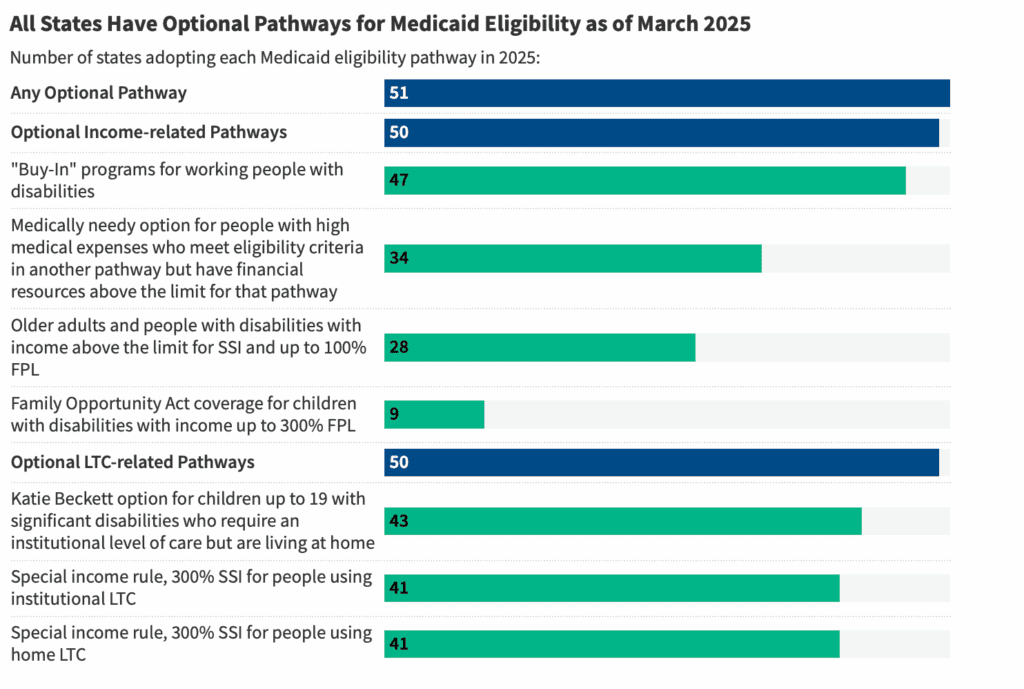
All states except Alabama offer additional Medicaid eligibility routes for people with disabilities whose income is too high for Supplemental Security Income (SSI) but who still need coverage. These include:
-
Medicaid Buy-In programs — Available in 47 states and the District of Columbia, these programs allow people with disabilities who work to buy Medicaid coverage by paying a modest premium.
Source: KFF
-
Medically Needy programs — Offered in 34 states, these allow applicants to “spend down” income by deducting medical expenses until they meet the state’s Medicaid threshold.
-
Poverty-Level Aged and Disabled coverage — Available in 28 states, this pathway extends Medicaid to low-income individuals with disabilities who meet federal poverty guidelines.
These optional programs give states flexibility to expand coverage beyond SSI, helping more people with disabilities maintain access to health care even as their income fluctuates.
Special Cases: Faster Qualification
Two conditions qualify for immediate Medicare (and often Medicaid) coverage without the usual waiting periods:
-
ALS (Amyotrophic Lateral Sclerosis) — Individuals with ALS are automatically eligible for Medicare as soon as their Social Security Disability Insurance (SSDI) benefits begin.
SSA ALS Medicare rule -
End-Stage Renal Disease (ESRD) — People with permanent kidney failure who require dialysis or a transplant qualify for Medicare immediately upon meeting medical criteria.
Medicare ESRD coverage
In addition, the Social Security Administration’s Compassionate Allowances program lists about 300 medical conditions, mostly severe cancers, adult brain disorders, and rare childhood diseases, that receive expedited disability claim processing.
The Application Reality
Understanding the Blue Book is one thing, proving your condition meets the criteria is another. The Social Security Administration (SSA) bases its decisions on detailed medical evidence from licensed healthcare providers, not just a diagnosis. This includes complete medical records, clinical findings, imaging or test results, and documentation that clearly shows how your condition limits daily activities and work capacity.
The SSA requires that this evidence come from acceptable medical sources and demonstrate the severity and duration of your impairment. Statements from your doctors describing your functional limitations are especially important, as they help establish how closely your situation matches or equals a Blue Book listing. The initial application process often takes several months, and many claims are denied at first and must go through reconsideration or appeal. That’s why disability advocates emphasize working closely with your doctor to ensure your medical records specifically address the SSA’s listing criteria for your condition.
The Bottom Line
You don’t have to wait until age 65 to qualify for Medicaid if you have a qualifying disability. Under federal law, individuals under 65 can access Medicaid through disability pathways defined by the Social Security Administration (SSA). The SSA’s definition of disability is specific and based on work capacity, it requires a medically determinable physical or mental impairment that prevents substantial gainful activity for at least 12 months or is expected to result in death.
The Social Security “Blue Book” (officially titled Disability Evaluation Under Social Security) outlines the medical criteria used to evaluate disability claims. However, meeting a listed condition isn’t required, each case is evaluated individually, considering how your condition limits your ability to work and perform daily activities.
If you believe you may qualify, start by reviewing the SSA Blue Book and discussing with your healthcare provider whether your medical documentation supports your claim. Many eligible individuals are initially denied but later approved on appeal, understanding the criteria and maintaining complete medical records are crucial first steps toward securing Medicaid coverage.