
How to Protect Money Above the FDIC Insurance Limit


Most people never need to worry about exceeding FDIC deposit insurance limits, but for those who do, knowing how to protect money above that threshold is a genuine concern, and one with several workable solutions.
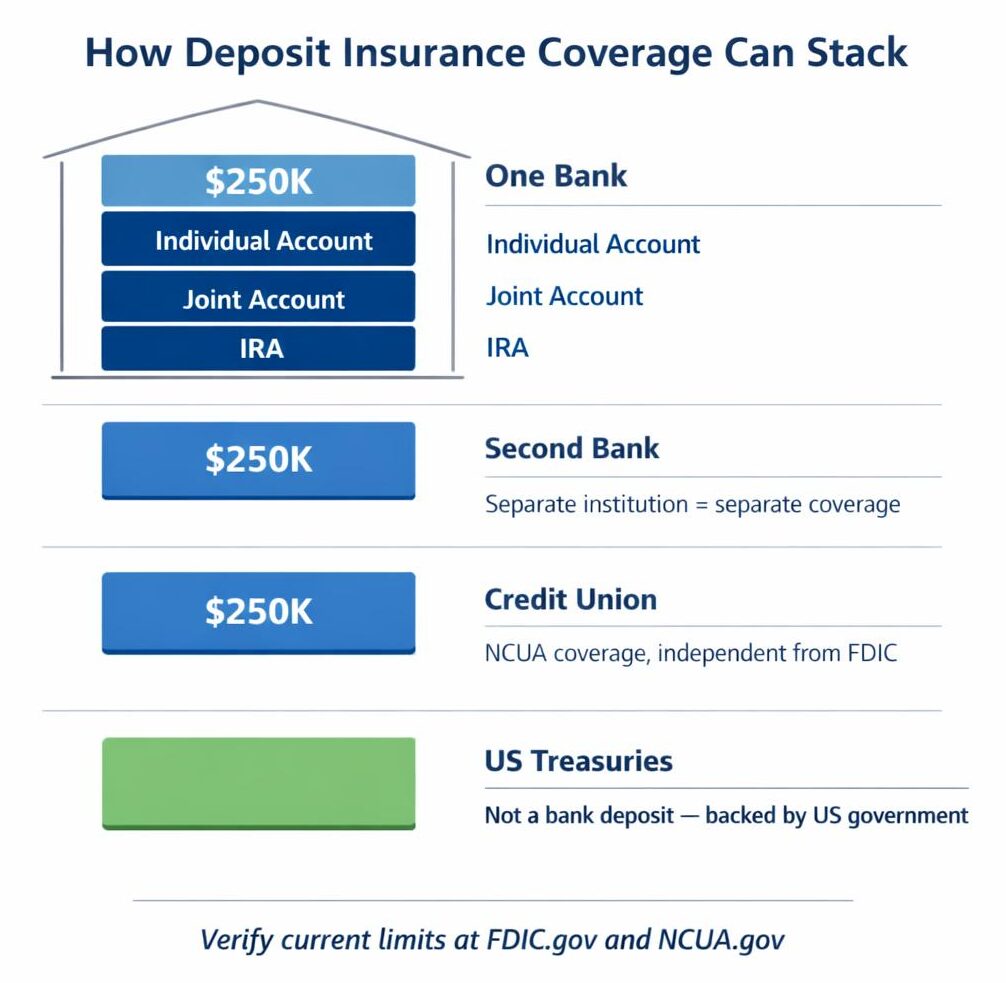
FDIC insurance limit is $250,000 per depositor, per insured bank, per ownership category. If your cash exceeds that amount, you can increase protection by spreading deposits among separately insured banks, using different qualifying ownership categories, considering insured deposit-sweep networks, or placing eligible funds at federally insured credit unions. Short-term U.S. Treasury securities can also be an alternative for large cash balances: they are not FDIC-insured, but Treasury bills, notes, and bonds are backed by the full faith and credit of the U.S. government.
What the FDIC Insurance Limit Actually Covers
When balances grow beyond the $250,000 threshold, whether from an inheritance, a home sale, a business transaction, or accumulated savings, the excess sits uninsured. That means if the bank fails, funds above the limit may not be fully recoverable. Bank failures are uncommon, but they do occur, and knowing how to spread and structure deposits intelligently is worth understanding before the situation arises.
That ‘ownership category’ matters more than most people realize. It refers to how an account is titled and who legally owns it. A single account held in one person’s name is one category. A joint account held with a spouse is a different category. A retirement account such as an IRA is yet another category. This means one person can potentially have more than $250,000 insured at a single bank, depending on how their accounts are structured.
For example, a married couple could hold individual accounts, a joint account, and IRA accounts all at the same bank, with each category potentially qualifying for separate insurance coverage. The FDIC provides an online tool called the Electronic Deposit Insurance Estimator (EDIE) that helps depositors calculate how much of their balance at any given bank is currently insured. Because coverage rules can be updated, it is worth verifying current limits directly through the FDIC website rather than relying on other sources.
Spreading Deposits Across Multiple Banks
Another very straightforward approach to protecting money above the FDIC limit is to spread deposits across multiple FDIC-insured banks. Because the $250,000 limit applies per depositor per institution, placing funds at separate banks effectively multiplies the coverage available.
Someone with $600,000 in cash savings, for instance, might deposit $250,000 at Bank A, $250,000 at Bank B, and $100,000 at Bank C, keeping all balances within insured limits. The practical challenge is managing multiple bank relationships, tracking accounts, and ensuring that any interest earned does not quietly push a balance back over the threshold.
Online banks and high-yield savings accounts have made it easier to hold money at multiple institutions without much added friction. Some people find this approach simple enough to manage independently. Others prefer a more automated solution.
Using a Cash Management Account or Deposit Network
Source: Mooloo graphics
Several financial firms offer what are sometimes called cash management accounts or insured cash sweep programs. These accounts work by automatically distributing deposits across a network of partner banks, with each bank holding an amount within the FDIC insurance limit. The customer sees a single account balance, while the platform manages the distribution behind the scenes.
Brokerage firms, fintech companies, and some banks offer these programs. Because deposits are spread across many institutions, total coverage can be significantly higher than $250,000. Some programs advertise coverage in the millions of dollars, though the actual limit depends on the number of partner banks in the network and how funds are allocated.
Key considerations when evaluating these accounts include:
- Whether coverage is direct FDIC insurance or pass-through insurance, and what documentation confirms that your funds are properly allocated
- The interest rate offered compared to alternatives
- Liquidity terms, including how quickly funds can be accessed
- How the firm handles network changes if partner banks are added or removed
These accounts can be convenient, but understanding the mechanics of how your deposits are held is important. Asking the provider for written confirmation of how insurance coverage applies is a reasonable step.
Exploring NCUA Coverage at Credit Unions
Credit unions are not FDIC-insured, but federally chartered and many state-chartered credit unions carry coverage through the National Credit Union Administration (NCUA), which insures deposits up to $250,000 per depositor, per institution, per ownership category. The structure mirrors FDIC coverage closely.
This means someone who already holds $250,000 at an FDIC-insured bank could deposit additional funds at an NCUA-insured credit union and receive separate coverage for that balance. The two systems operate independently, so holding accounts at both types of institutions can effectively extend total coverage.
Not all credit unions carry federal insurance, so confirming NCUA membership before depositing large sums is important. The NCUA website maintains a searchable database of insured credit unions.
Treasury Securities as a Large-Balance Alternative
For people holding large amounts of cash that will not be spent in the near term, US Treasury securities offer a different form of safety. Treasuries are backed by the full faith and credit of the US government which is a distinct form of protection from deposit insurance. They are not bank deposits and are not subject to FDIC limits.
Treasury bills, notes, and bonds can be purchased directly through TreasuryDirect.gov without a bank intermediary. Money market funds that invest exclusively in government securities are another way to access this category, though money market funds carry a different risk profile than direct Treasury ownership and are not FDIC-insured.
The trade-off with Treasuries is that they are investment instruments, not bank accounts. If sold before maturity, their market value can fluctuate, particularly for longer-dated bonds in a changing interest rate environment. For short-term holdings such as Treasury bills, this is less of a concern. Either way, the distinction between deposit accounts and investment products is worth understanding clearly before moving funds.
Practical Steps for Managing Large Balances
For most people, managing deposits above the FDIC limit comes down to a few clear decisions:
- Audit current account balances and how each account is titled to understand actual coverage today
- Identify any accounts where balances regularly exceed $250,000, including checking accounts used for business or personal transactions
- Consider whether spreading funds across multiple banks, using a cash sweep program, or shifting some funds to Treasuries best fits the situation
- Review joint account titling and beneficiary designations, since these can affect coverage calculations
- Monitor high-balance accounts periodically to ensure that accumulating interest does not push totals above covered limits over time
Large balances held temporarily such as proceeds waiting to be deployed into an investment or a property purchase — create a specific short-term exposure. Planning where those funds will sit during the interim period is worth thinking through before the deposit is made, not after.
The Broader Picture on Deposit Safety
Bank failures in the United States are relatively uncommon, and the FDIC has a strong track record of protecting insured deposits when failures do occur. That said, protection is not automatic above the limit, and the resolution process for uninsured depositors can be slower and may not result in full recovery.
For deposits close to the limit, the risk may feel theoretical. For balances significantly above it, structuring deposits thoughtfully is a practical form of financial housekeeping rather than a reaction to any immediate threat. The tools and options described above are widely available, commonly used, and not especially complicated to implement with some advance planning.