
How Long Do ACH Transfers Take?


ACH transfers are one of the most common ways money moves between bank accounts in the United States, yet the timing of these transfers often catches people off guard.
Whether you are waiting for a direct deposit paycheck, sending money to a friend, or paying a bill through your bank’s online portal, understanding how long an ACH transfer takes can help you avoid overdrafts, missed payments, and unnecessary stress. The answer depends on several factors, including the type of transfer, when it was initiated, and which banks are involved.
What Is an ACH Transfer?
ACH stands for Automated Clearing House. It is a nationwide electronic payment network managed by Nacha, the organization that sets the rules and standards for how these transactions work. Rather than moving money instantly from one account to another, ACH transfers are processed in batches, meaning individual transactions are grouped together and settled at specific times throughout the day.
There are two main types of ACH transactions. An ACH credit pushes money from one account to another, such as when an employer sends your paycheck. An ACH debit pulls money out of an account, such as when a gym membership or utility company withdraws a monthly payment automatically. Both types move through the same network, but the timing can differ slightly depending on the transaction type and the processing rules that apply.
Standard ACH Transfer Timelines
For most standard ACH transfers, the typical processing time is one to three business days. This is the most common answer you will see, but it helps to understand what is actually happening during that window.
When a transfer is initiated, the originating bank sends the payment request to the ACH network. That request is included in a batch, which is submitted to a clearinghouse at set intervals during the business day. The receiving bank then processes the incoming transaction, verifies the account details, and credits or debits the account accordingly. Each of these steps takes time, and processing generally does not happen on weekends or federal holidays.
For example, if you initiate an ACH transfer on a Friday afternoon after the bank’s cutoff time, the transfer may not begin processing until the following Monday. With the standard one to three business day window, the funds might not arrive until Tuesday or Wednesday. This is a common source of confusion for people who assume their transfer will land the next calendar day.
Same-Day ACH Transfers
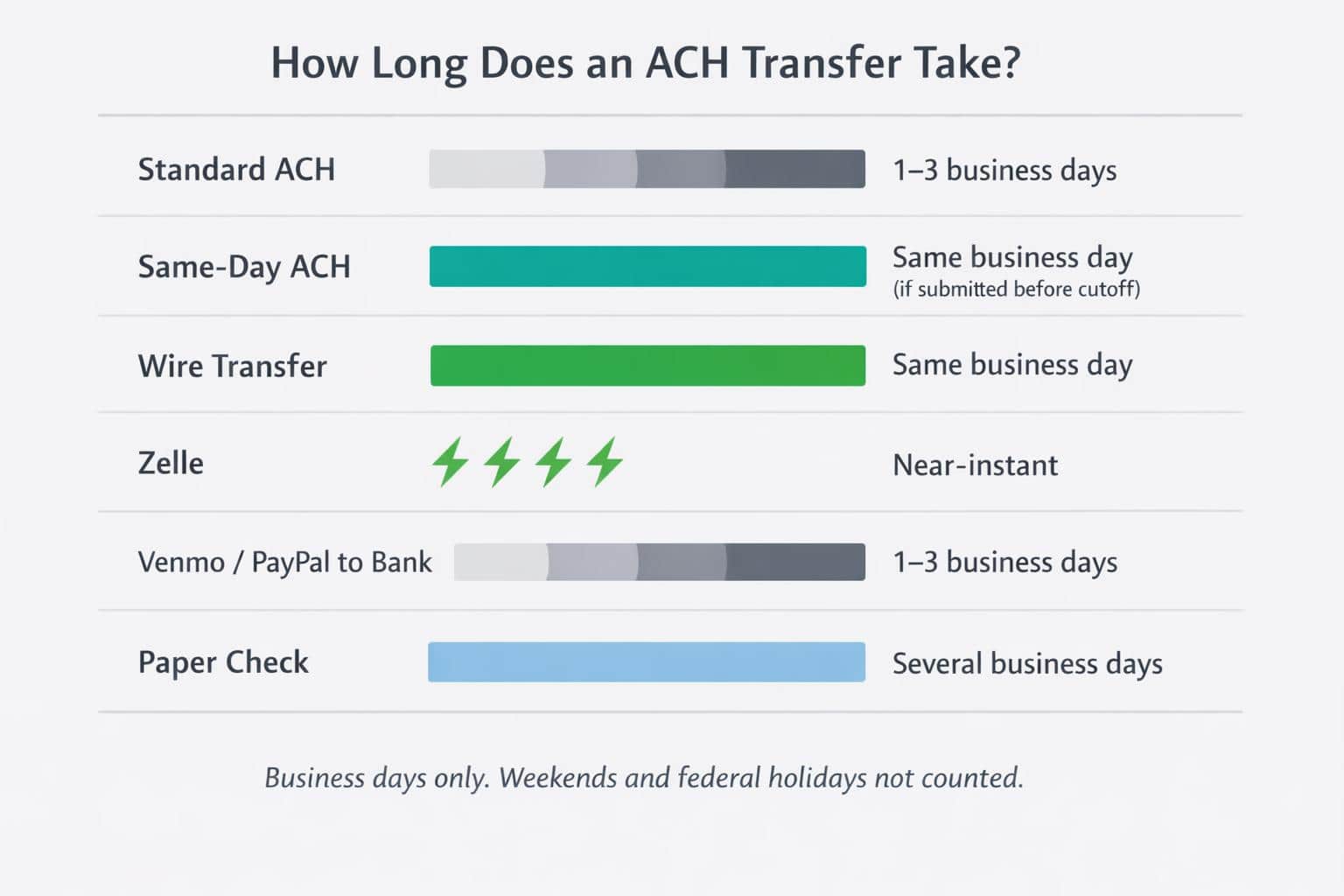
Nacha introduced same-day ACH processing to speed up the network, and it has become widely available for both credits and debits. With same-day ACH, transactions initiated before certain cutoff times can be processed and made available within the same business day.
Same-day ACH applies a per-transaction dollar limit that Nacha has adjusted upward over time as the network has matured. Because this limit is subject to change, it is worth checking Nacha’s current guidelines or confirming with your bank if you need to send a larger amount on a same-day basis. Not all banks and financial institutions support same-day ACH for every account type, and some charge a small fee for the faster processing option.
Same-day ACH only applies on business days within the published processing windows. If you miss the cutoff, even a same-day transfer will be pushed to the next business day. Banks typically publish their cutoff times, and checking this before initiating a time-sensitive transfer is a practical habit.
How Direct Deposits Work on This Timeline
Direct deposit is one of the most familiar uses of ACH technology. Employers typically submit payroll files to their bank one to two business days before payday. The bank processes the ACH credit, and the funds arrive in employee accounts on the scheduled payday.
Some banks offer early direct deposit as a feature, making funds available one or two days before the official payday date. These banks advance access to the money once they can see the pending deposit in the ACH pipeline, rather than waiting until settlement is fully complete. This can be a useful feature, though the exact timing can vary and is not always guaranteed to arrive at a specific hour.
Why Some Transfers Take Longer
Several factors can extend the time it takes for an ACH transfer to complete. Understanding them can help you plan accordingly.
- New account relationships: When you link a new external bank account to a payment service or financial app, the receiving institution may apply a hold period on the first few transfers while it verifies the account and assesses risk. This can add extra business days to the initial transfers.
- Fraud review: Large or unusual ACH transactions may trigger a manual review by the bank’s risk team, which can delay processing beyond the standard window.
- Bank processing schedules: Not every bank submits ACH batches at the same intervals. Some smaller banks or credit unions may submit only one batch per day, while larger banks submit multiple batches. The timing of your bank’s batch submissions can affect when funds arrive.
- Weekends and federal holidays: The ACH network does not operate on these days, so they do not count as business days for processing purposes. A transfer initiated before a long holiday weekend may take noticeably longer to arrive than usual.
- Incorrect account information: If an ACH transfer is sent to a wrong account number or routing number, the transaction may be returned, which adds time to the process of recovering or resending the funds.
ACH Transfers Compared to Other Payment Methods
Understanding ACH timing is more useful when you compare it to the alternatives. Wire transfers are generally faster and can often be completed within the same business day, but they typically carry fees and are not designed for routine transactions. For large, time-sensitive payments such as a real estate closing or a significant business transaction, wire transfers are often preferred despite the cost.
Peer-to-peer payment apps such as Venmo, Zelle, and PayPal handle transfers differently. Zelle moves money directly between participating bank accounts and is often near-instant, using a bank network messaging system rather than standard ACH batch processing. Venmo and PayPal hold funds in an internal account balance by default, and transferring that balance to a linked bank account via standard ACH typically takes one to three business days, with a faster transfer option usually available for a fee.
Checks can take several business days to clear after deposit, particularly for larger amounts, because banks are permitted to place holds on deposited checks under federal Regulation CC rules. ACH transfers, when initiated correctly, tend to have more predictable timing than paper checks.
Practical Tips for Managing ACH Timing
A few simple habits can reduce the chance that ACH timing will disrupt your cash flow.
- Initiate transfers earlier in the day to improve your chances of making the bank’s same-day or next-day batch cutoff.
- Avoid scheduling payments for the last possible day before a due date, especially around weekends or holidays.
- Verify account and routing numbers carefully before sending. Correcting a misdirected ACH transfer can take time and involve communication with both banks.
- Check whether your bank offers same-day ACH and whether a fee applies, particularly if you regularly need to move money quickly.
- Keep a buffer in your account when you have automatic ACH debits set up. If processing runs slightly earlier or later than expected, a buffer can help you avoid an overdraft.
When ACH Transfers Are Returned
Not every ACH transfer completes successfully. If an account has insufficient funds, the account number is invalid, or the account holder has placed a stop payment on the transaction, the transfer can be returned. ACH returns follow a defined set of return codes and typically take one to two business days to process back through the network.
A returned ACH debit, such as a failed bill payment, can result in a returned payment fee from the company you were paying as well as a non-sufficient funds fee from your bank. If the payment was for something important such as rent or a loan, identifying the issue quickly and reinitiating the payment can help you avoid late fees or other consequences. Setting up account alerts through your bank is a practical way to stay informed when ACH transactions are processed or returned.