Healthcare Without Borders: A Strategic Guide to Escaping America’s Health Insurance Chaos


U.S. health costs keep climbing, family premiums reached $26,993 in 2025, with 2026 projections up another 6–7%. But the system isn’t broken, it’s designed for profit, not prevention. By pairing domestic diagnosis with accredited international care, Americans can cut major procedure costs by 60–80% while maintaining world-class standards. Hospitals accredited by Joint Commission International (JCI) deliver the same treatments, often from U.S.-trained surgeons, at rational, transparent prices.
- 2026 Outlook: Employer health-plan costs are rising 6–7%, outpacing wage growth. Workers face higher deductibles and narrower coverage, per KFF.
- Cost Gaps: CABG heart bypass averages $151K in the U.S. vs. $18K–$25K in Thailand; knee replacement $35K U.S. vs. $12K Costa Rica; full-mouth dental implants $60K U.S. vs. $15K Mexico (2024–2025 data).
- Global Quality: JCI- and MSQH-accredited hospitals in Thailand, Malaysia, Costa Rica, and Mexico meet U.S. and EU standards, often publishing transparent outcomes and bundled pricing.
- Strategic Approach: Keep high-deductible coverage for emergencies, handle diagnostics locally, and plan elective or complex care abroad with verified providers.
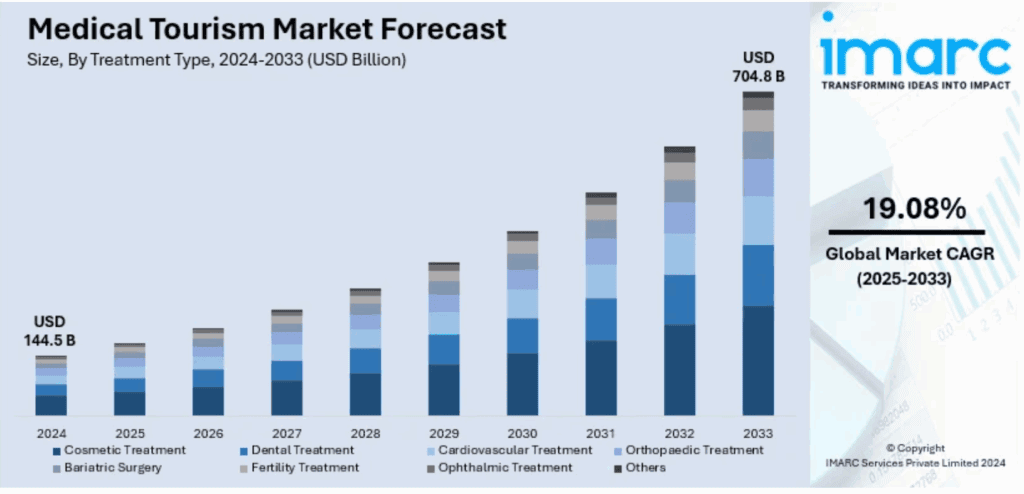
- Big Picture: The global medical tourism market is projected to exceed $700B by 2033. One overseas procedure can offset years of domestic insurance costs.
The U.S. healthcare system isn’t broken, it’s built this way. Every year, premiums rise, coverage shrinks, and patients pay more for less. The system’s structure rewards profit, not prevention, funneling billions toward insurers, hospitals, and shareholders instead of lowering costs for families. And with 2026 health-insurance premium hikes already on the horizon, Americans are bracing for another painful reminder that affordability was never the goal, profitability was.
But here’s the good news: you don’t have to play by those rules. Around the world, thousands of hospitals accredited by the Joint Commission International (JCI) deliver world-class care at a fraction of U.S. prices. From Thailand to Turkey, Mexico to Malaysia, U.S.- and Europe-trained surgeons perform the same procedures, often with comparable or better outcomes, for up to 70-80% less. Global healthcare competition means patients now have real choices: access high-quality, affordable treatment without surrendering to America’s profit-first system.
The 2026 picture – what you’re up against
In 2024, the average family premium for employer-sponsored health coverage hit $25,572, up 7 percent from 2023, according to the KFF Employer Health Benefits Survey. By 2025, premiums climbed another 6 percent to $26,993, marking the fastest two-year surge in over a decade.
Looking ahead, early projections for 2026 signal more steep increases. Mercer expects employer health-plan costs to rise 6 % to 7 %, the largest jump in nearly 15 years. Meanwhile, small-group insurance filings in several states are showing proposed double-digit hikes, with some approaching 10–11 % for 2026 renewals.
Premiums continue to outpace wage growth as rising deductibles, coinsurance, and prior-authorization delays steadily erode the value of coverage. Workers are paying more for less, shouldering higher out-of-pocket costs while facing tighter access to care.
The math that changes everything
Below are typical price windows from verified 2024-2025 data so you can compare like-for-like. U.S. costs vary by region and facility; figures reflect published cash or transparent price estimates when available.
- Heart bypass (CABG): United States: studies on posted prices show mean list prices around $151,271, with bundled self-pay estimates typically $50k-$80k depending on hospital. Thailand: leading Bangkok centres quote ~$18k-$25k, with regional averages $15k-$30k.
- Knee replacement: United States: fair-market and hospital cash prices generally $25k-$40k, though top facilities can exceed $45k. Costa Rica: accredited networks list full-package totals near $11.5k-$12.5k.
- Full-mouth dental implants: United States: comprehensive “all-on-4” restorations usually $50k-$80k for both arches. Mexico: major clinics advertise $10k-$20k for equivalent treatments, with single implants far less.
- IVF per cycle: United States: typical cycle costs $12k-$20k, rising with medications and add-ons. India: reputable clinics quote $3k-$5.5k for standard cycles.
- Hip replacement: United States: bundled episode costs often $25k-$40k. Malaysia: private-hospital quotes commonly $8k-$12k.
Do one major procedure abroad and you can fund several years of high-deductible catastrophe coverage back home. Do two and you’ve bought a decade of flexibility.
The global medical-tourism market is no sideshow: IMARC Group values it at ~$144.5 billion in 2024, projected to exceed $704.8 billion by 2033.
Source: Imarc
The working strategy: diagnose local, heal global
-
Keep catastrophic coverage. Maintain a high-deductible health plan to protect against true emergencies requiring immediate local intervention. Use it as financial backstop, not as the default way to access routine or elective care. Confirm that your plan covers emergency treatment abroad, since many U.S. policies exclude international or elective procedures.
-
Get diagnosed at home. Use trusted local physicians for exams, labs, and imaging. Request organized digital records and summaries for portability. Having clear documentation simplifies follow-up and supports continuity of care when you share it with overseas providers.
-
Vet destinations and providers. Choose hospitals accredited by Joint Commission International (JCI) or similar bodies such as Accreditation Canada or QHA Trent. Seek English-speaking coordinators, published outcomes, and surgeons with U.S. or EU training. Thailand and Malaysia remain strong for complex surgery, while Mexico and Costa Rica attract patients for dental, bariatric, and orthopedic procedures.
-
Verify directly. Contact hospitals yourself and obtain written confirmation of accreditation status, surgeon credentials and case volumes, infection and complication rates, items included in quoted costs, and follow-up procedures. Independent verification protects against misleading marketing claims.
-
Plan the journey. Use refundable tickets when timing is uncertain; many hospitals partner with recovery-friendly hotels. For protection, consider travel-medical plus complication coverage from medical-travel insurers such as Global Protective Solutions. Standard travel-medical policies typically cost a few dollars per day, while comprehensive plans run about 4–6 percent of total trip value. Specialty complication coverage is quoted per procedure and varies by risk.
-
Coordinate follow-up. Leave the facility with digital imaging, operative notes, pathology, medication lists, and detailed after-care instructions. Arrange a prompt follow-up visit at home so your local physician can review results and manage recovery. Confirm before travel that your home-country provider agrees to handle post-operative care.
Destination snapshots
Mexico – nearest and most familiar. Strong for dental, bariatric, cosmetic, and orthopedic procedures, with extensive English-speaking hubs along the border. Patient volumes are large and rising, credible data show over 1 million U.S. medical and dental travelers annually, returning to pre-pandemic levels near 1.2 million.
Thailand – premium experience at mid-tier prices. Bangkok’s leading private hospitals such as Bumrungrad International Hospital, a JCI-accredited facility, cater extensively to international patients, routinely quoting CABG around $15k–$35k and offering packaged pricing for orthopedics and fertility as outlined in the Medical Tourism Thailand Guide 2025.
Costa Rica – comfortable, close, and English-friendly. Dental and orthopedic procedures are common choices; total knee replacement packages average $11.5k–$12.5k, with established providers serving North American patients through the Costa Rica Medical Tourism Guide.
Malaysia – quality-to-price standout. A well-regulated private sector with MSQH and JCI accreditation ensures international standards. Reputable centers list hip replacement costs around $8k–$12k, making it one of Asia’s best value destinations supported by data from the Malaysia Healthcare Travel Council.
What to tell your insurer
If you’re paying out of pocket for treatment abroad, you typically don’t need to proactively notify your insurer. Simply use your existing health plan for pre-treatment diagnostics and post-procedure follow-up care at home.
Most health insurance policies handle emergency complications abroad the same way they treat domestic emergencies, through your plan’s emergency or out-of-area coverage. Review your plan documents or call the member services line to confirm what’s included.
If your employer offers vetted international care options or global health benefits, take advantage of them. Many large U.S. companies and insurers now partner with Joint Commission International (JCI), accredited hospitals overseas to control costs while maintaining top-tier quality. Programs from carriers like Blue Cross Blue Shield Global and Cigna Global are expanding rapidly, giving employees access to trusted facilities and coordinated post-care support.
Risk, quality, and the US reality
No healthcare pathway is entirely risk-free. But comparing overseas treatment risks to an idealized version of U.S. care is misleading. On any given day, about 1 in 31 hospitalized patients in the United States acquires at least one infection related to their medical care, according to the Centers for Disease Control and Prevention. These healthcare-associated infections (HAIs) occur despite advanced technology and strict hospital protocols, underscoring that risk exists even within the U.S. system.
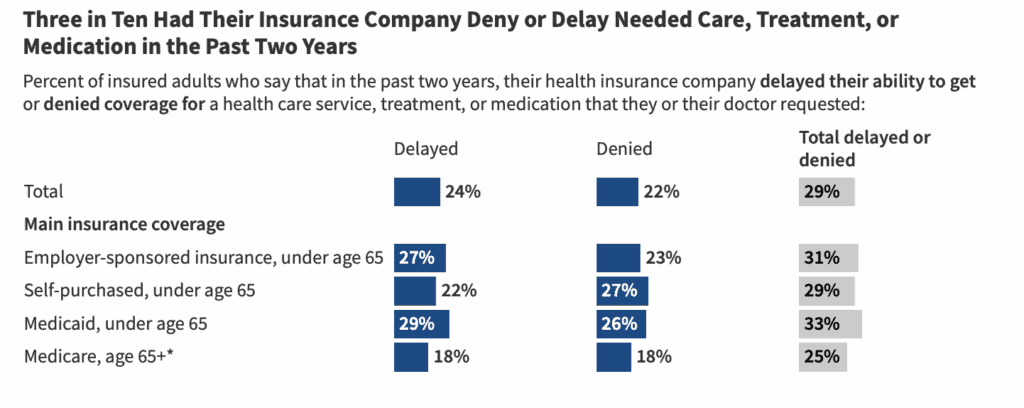
Administrative barriers also add to the problem. A Kaiser Family Foundation analysis found that in 2023, Medicare Advantage insurers made nearly 50 million prior-authorization determinations, with 6.4% fully or partially denied.

Source: Kaiser Family Foundation
Among insured adults needing specialized care, 30% experienced delays and 27% faced denials tied to prior authorization, according to KFF’s national health tracking poll.
Source: Kaiser Family Foundation
The real comparison isn’t “perfect U.S. care versus risky foreign hospitals.” It’s real-world U.S. outcomes versus accredited international options that meet global standards such as Joint Commission International (JCI) or Accreditation Canada. For many patients, vetted international hospitals provide high-quality, transparent care at a fraction of U.S. prices, without the same administrative friction that often defines American healthcare.
Your step-by-step action plan
This Week: Calculate your true annual healthcare cost, add up premiums, deductibles, and average out-of-pocket (OOP) expenses. Identify any treatments or procedures you’ve been postponing, then request written quotes for the same care from at least two JCI-accredited hospitals abroad.
This Month: Update your diagnostics locally and organize your medical records for easy sharing. Shortlist reputable facilities in two countries, and contact their international patient coordinators directly to confirm surgeon experience, what’s included in the package, and post-treatment follow-up details.
This Year: If your health risk profile allows, switch to a high-deductible plan with lower premiums and deposit the difference into a dedicated health fund. When ready, plan one elective procedure internationally with a clear aftercare and continuity plan for long-term results.
The bottom line
The U.S. healthcare system isn’t failing, it’s functioning exactly as designed, maximizing profits while leaving families to absorb rising costs. But you don’t have to stay trapped in that model. By combining domestic diagnostics, emergency protection at home, and accredited international care for planned procedures, you can cut costs by 60–80% without compromising safety or results.
Global competition has rewritten the rules. Whether it’s a knee replacement in Costa Rica, heart surgery in Thailand, or dental restoration in Mexico, accredited hospitals worldwide now offer the same procedures, often by U.S.-trained surgeons, at transparent, rational prices.
The exit exists. Use data, not fear. Compare outcomes, confirm accreditation, and take control of your healthcare future instead of letting America’s profit-first system dictate it.