AI Replacing Jobs: The 40% of Workers Who Should Be Worried Right Now


Artificial intelligence (AI) is no longer just another workplace tool, it is restructuring employment itself. According to the World Economic Forum’s Future of Jobs Report 2025, 40% of employers expect to reduce their workforce where AI can automate tasks.
For workers, this is not a distant concern. Whether you are starting your career or already established, AI and automation are set to redefine how jobs function, how tasks are distributed, and ultimately how much they pay. This article explores which workers should be most concerned, why entry-level employees face the sharpest risks, and what practical steps anyone can take to safeguard their income in the age of AI.
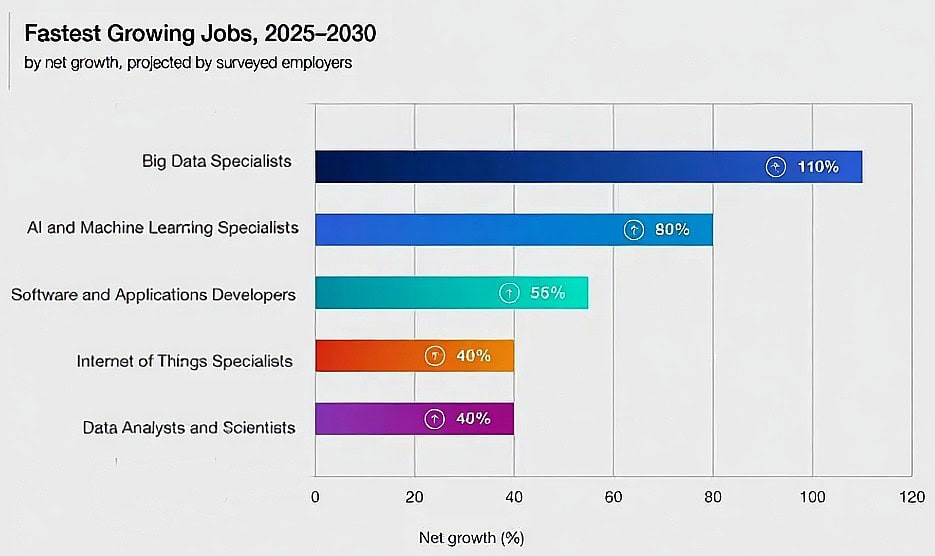
Source: World Economic Forum’s Future of Jobs Report 2025
The 40% Wake-Up Call: Why Workers Should Pay Attention
The 40% figure is more than just a number; it is a signal of intent from employers. Businesses are quickly understanding AI’s impressive capacity for processing vast datasets in seconds, generating polished text through generative models, managing customer service through AI chatbots, and streamlining repetitive back-office operations. For employees, the takeaway is clear: jobs built around predictable, routine tasks are the most vulnerable to automation.
AI and Jobs by 2030: A Reshaped Labor Market
The pace of change is faster than many realize. Even today, it is not easy to be sure if you’re chatting to a help bot or a human being – and Research from National University suggests that by 2030, 30% of U.S. jobs could be fully automated, while 60% will undergo significant task-level changes. This does not necessarily mean widespread job extinction but rather a broad redefinition of work.
For example, accountants may still exist, but AI will handle repetitive data entry while humans focus on financial strategy. Journalists may rely on AI for generating drafts but will increasingly concentrate on verifying facts and conducting deeper analysis. Customer service may become AI-first, with humans intervening only in complex cases. The real question is not whether jobs will survive but whether they will remain valuable enough to provide sustainable wages.
Entry-Level Jobs Face the Sharpest Risks
Perhaps the greatest concern lies with those at the beginning of their careers. Entry-level roles have traditionally provided the foundation for building experience and climbing the career ladder. But if AI takes over those tasks, new workers may struggle to gain a foothold.
A Bloomberg analysis highlights the challenge. More than half of the tasks performed by market research analysts, around 53%, could be automated, while nearly 67% of sales representatives’ work is replaceable. By contrast, managerial tasks in the same fields face far lower exposure, only 9% and 21%, respectively. This creates a career bottleneck: fewer opportunities for entry-level workers, with long-term consequences for income mobility.
The Divide Between Managers and Junior Staff
The divide between junior staff and managers is rooted in the nature of their work. Junior employees tend to handle repetitive responsibilities such as gathering data, entering information, or preparing standard reports. Managers, on the other hand, focus on strategy, decision-making, and leading teams, areas where AI still struggles to compete.
This creates a paradox. The jobs workers need to begin their careers may vanish, while the higher-level positions they aspire to remain intact. Without entry-level experience, fewer workers may ever reach those senior roles.
Industries Most Exposed to AI Automation
AI’s impact will not be uniform. Industries relying heavily on knowledge work face the sharpest disruption:
-
Information and communication: Writers, translators, and editors already see AI tools generating drafts.
-
Sales and customer service: AI chatbots manage large volumes of routine interactions.
-
Market research and analysis: Data interpretation is increasingly automated.
-
Finance and accounting: Bookkeeping and auditing tasks are ripe for automation.
By contrast, fields requiring physical presence, construction, caregiving, healthcare support, and skilled trades, remain less vulnerable in the near term. These roles require dexterity, empathy, and human judgment that AI cannot replicate.
How Job Automation Threatens Earning Capacity
The risk for workers is not just about potential layoffs. AI disruption also affects income in three interconnected ways. First, wages for certain roles may stagnate or even decline if the supply of workers exceeds demand for fewer remaining positions.
Second, career progression may stall if entry-level positions disappear, cutting off the traditional path to higher-paying jobs. Finally, inequality could deepen, as those who lack access to retraining opportunities are left behind while workers who adopt AI thrive.
This means the true challenge is not just job survival but ensuring that one’s role continues to generate long-term financial stability. High-stakes judgment, such as legal strategy, executive decision-making, and medical diagnosis, also remains firmly human territory. Even in creative industries, while AI can generate content, true innovation and originality continue to depend on human imagination.
These sectors may serve as safer career choices or transitional opportunities for workers navigating an AI-driven labor market.
How Workers Can Protect Their Careers from AI Disruption
The future of work is not about competing with AI but collaborating with it. Workers should focus on areas where humans complement technology:
-
Learn AI tools: Master platforms like ChatGPT, Copilot, or industry-specific AI software.
-
Strengthen soft skills: Communication, collaboration, and emotional intelligence remain irreplaceable.
-
Develop strategic thinking: Shift from execution toward decision-making.
-
Reskill continuously: Short, targeted courses in data literacy, digital communication, or management boost adaptability.
-
Pursue hybrid roles: Jobs that integrate AI as a tool rather than a substitute are set to grow fastest.
The Future of Work: AI as a Co-Worker, Not a Competitor
AI will not replace all workers, but it will reshape nearly every job. The future belongs to those who treat AI as a collaborator, using it to handle repetitive tasks while reserving human effort for creativity, judgment, and relationships.
The 40% signal from employers should be seen as a warning rather than a verdict. By identifying vulnerable roles, anticipating task-level changes, and investing in skills that remain beyond AI’s reach, workers can not only protect their jobs but also strengthen their long-term earning power in an evolving economy.