The $27 Trillion Market You’ve Been Ignoring (And Why That’s Fine)


U.S. Treasury bonds remain the global standard for “risk-free” investing, offering fixed interest and principal protection backed by the full faith and credit of the federal government. Yet for most individuals, especially younger investors, buying individual bonds adds complexity without better returns. Bond funds and ETFs provide easier, cheaper, and more diversified exposure to the same market.
- Bonds = Loans to the Government: A U.S. Treasury bond pays fixed annual interest (“coupon”) and returns your principal at maturity—e.g., a $10,000 bond at 4% yields $400 per year for 10 years.
- Bond Prices Move Opposite Interest Rates: When interest rates rise, bond prices fall; when rates drop, prices rise. This inverse link drives daily market moves and investor sentiment.
- Who Owns Treasuries: As of mid-2024, roughly $28 trillion in U.S. government debt is outstanding. The Federal Reserve holds about 14%, trust funds 25%, individuals and private entities 21%, and foreign investors around 30%.
- Risks and Limits: Bonds cap upside at their coupon rate, and inflation or rate hikes can erode returns. Historically, stocks have far outperformed Treasuries—11.79% vs. 4.79% average annual return since 1928.
- Smarter Access via Funds: For most investors, bond ETFs such as Vanguard BND or iShares AGG offer diversified exposure, professional management, and easy liquidity, ideal within a balanced 80–90% stock / 10–20% bond portfolio.
At its core, a bond is a loan agreement, a formal IOU between the borrower and the lender. When you buy a government bond, you are effectively lending money to the government. In exchange, the government agrees to pay you periodic interest, known as the “coupon,” and return your principal (the original amount you invested) when the bond reaches its maturity date.
For example, suppose you purchase a 10-year U.S. Treasury bond for $10,000 with a 4% annual interest rate. Each year, you’ll receive $400 in interest payments, and at the end of the 10 years, you’ll get your $10,000 back. This structure makes bonds one of the simplest and most predictable financial instruments available. The key reason they are considered exceptionally safe is because they’re backed by the full faith and credit of the U.S. government, which has the legal authority to raise taxes or issue additional debt to meet its obligations. In fact, the United States has never defaulted on its Treasury debt, making these securities the global benchmark for “risk-free” investments.
The Twist: Bonds Trade Like Stocks
While bonds are often associated with long-term safety and fixed returns, they are far from static investments. Investors don’t have to hold bonds until maturity, these instruments trade daily on massive secondary markets, just like stocks. Bond prices fluctuate constantly, driven primarily by interest rate expectations, inflation data, and shifts in investor sentiment.
This introduces an important inverse relationship: when interest rates rise, bond prices fall; when interest rates fall, bond prices rise. Here’s why that happens. Imagine you own a bond that pays 4% interest. If newly issued bonds start paying 5%, your 4% bond suddenly looks less attractive, so its market price drops. Conversely, if new bonds offer only 3%, investors will pay a premium for your higher-yielding 4% bond.
This dynamic explains why, during economic downturns or financial stress, investors often “flee to bonds.” They expect central banks, like the Federal Reserve, to lower interest rates to stimulate growth, which in turn increases bond prices and creates potential capital gains in addition to interest income
Who Actually Buys Government Bonds?
The U.S. Treasury market remains the largest and most liquid financial market in the world, with roughly $28 trillion in outstanding securities and over $900 billion traded daily, according to SIFMA.
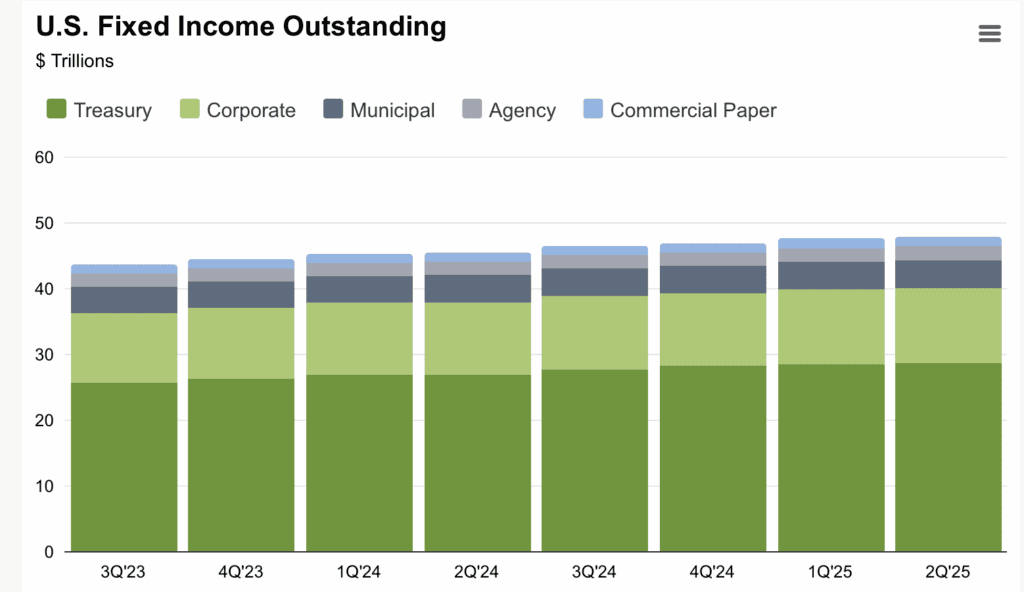
Source: SIFMA
Foreign investors hold about $8.2 trillion, or roughly 30–33 % of all Treasuries, while domestic entities account for the remaining 67–70 %.
Breakdown of U.S. Treasury Holdings (Mid-2024)
| Holder Category | Holdings (Approx.) | Share of Total | Key Notes / Sources |
|---|---|---|---|
| Federal Reserve (SOMA Account) | $4.8 T | ~14 % | Federal Reserve holdings through monetary policy operations. |
| Federal Trust Funds & Intragovernmental Holdings | $7.1 T | ~25 % | Includes Social Security, Medicare, and Civil Service Retirement funds. Fiscal.Treasury.gov |
| Mutual Funds & ETFs | $3.8 T | ~13 % | Includes broad-based bond portfolios; data from Treasury Bulletin. |
| State & Local Governments | $2.1 T | ~7 % | Includes municipal treasuries and investment pools. |
| Commercial Banks | $1.7 T | ~6 % | Used primarily for liquidity and capital compliance. |
| Insurance Companies | $0.55 T | ~2 % | Stable, long-term investment for liability matching. |
| Private Pension Funds | $0.46 T | ~2 % | Includes both defined-benefit and defined-contribution plans. |
| Individuals & Private Entities | $6.0 T | ~21 % | Includes corporate and household direct holdings; retail share ≈ $160 B (Savings Bonds via TreasuryDirect.gov). |
| Foreign Investors (Total) | $8.2 T | ~30–33 % | TIC Data; largest holders: Japan ($1.1 T), China ($0.8 T), U.K. ($0.7 T). |
Why Bonds Might Not Be Right for You
Despite their reputation for safety, individual government bonds aren’t always ideal for retail investors. Their biggest limitation is restricted upside potential, your return is capped at the stated coupon rate. A 4% bond will yield exactly that, regardless of how the economy performs or how well stocks do.
They also carry interest rate risk. If you’re forced to sell your bond before maturity during a period of rising rates, its market value may fall below your purchase price. Longer-term bonds are especially sensitive; a modest 1% increase in rates can translate to a 7–10% decline in price for a 10-year Treasury.
Inflation risk is another concern. If inflation runs at 3% while your bond yields 4%, your real return is just 1%. If inflation climbs higher, your purchasing power erodes further.
Lastly, access and complexity pose challenges. The bond market is less transparent than the stock market—trading typically occurs over-the-counter rather than through centralized exchanges, often with wider bid-ask spreads. Building a diversified bond portfolio with individual securities requires significant capital, time, and expertise.
Historically, the opportunity cost of holding too many bonds has also been substantial. From 1928 to 2024, the S&P 500 delivered an average annual return of 11.79%, while 10-year U.S. Treasuries averaged 4.79%, according to NYU Stern’s historical return data. Over the last 30 years, stocks have typically returned between 9–10% annually, compared to 2.9–6.8% for most bond indices. For younger investors with decades until retirement, leaning too heavily into bonds can significantly reduce long-term wealth accumulation.
So What Should Retail Investors Do?
Fortunately, investors don’t have to buy individual bonds to benefit from fixed-income exposure. Bond funds and ETFs offer diversification across thousands of securities, professional management, and daily liquidity, all with lower costs and smaller investment minimums. Widely used options include the Vanguard Total Bond Market ETF (BND) and the iShares Core U.S. Aggregate Bond ETF (AGG).
For those seeking direct access to government bonds, the U.S. Treasury’s TreasuryDirect.gov platform allows investors to buy Treasury Bills, Notes, Bonds, and I-Bonds directly from the source with no fees and a minimum purchase of just $100. This can be particularly useful for building an emergency fund or hedging against inflation through Series I Savings Bonds, which adjust with the Consumer Price Index (CPI).
Another hands-off option is target-date retirement funds, which automatically rebalance portfolios over time, gradually increasing bond exposure and reducing stock exposure as investors approach retirement age. This approach ensures a smoother transition from growth to income-focused investing.
The Bottom Line
Government bonds are essential to the financial system and serve a critical role in diversified portfolios, especially for retirees and those nearing retirement who need stability. But for most retail investors, especially younger ones, individual bonds are unnecessary complexity. You get better results with lower hassle by using bond funds as part of a balanced portfolio.
Think of bonds like insurance: you need some protection, but you don’t want to be over-insured at the expense of building wealth. For most people starting out, a simple allocation of 80-90% stocks and 10-20% bond funds through low-cost index products will serve you far better than trying to navigate the institutional bond market directly.
The professionals obsess over every basis point move in Treasury yields because they’re managing billions and using sophisticated strategies. For you? Keep it simple, focus on long-term stock growth while you’re young, and let bond funds provide the stability portion of your portfolio without the headaches.