Stock Splits Explained: What Beginner Investors Need to Know

Published: Oct 8, 2025

5.7 min read

Updated: Dec 28, 2025 - 07:12:54

Stock Splits Explained: What Beginner Investors Need to Know
ADVERTISEMENT
Advertise with Us
A stock split doesn’t change a company’s value, it simply increases the number of shares and lowers their price, making them more accessible and liquid. While often seen as a bullish signal, splits are primarily cosmetic. Investors should focus on fundamentals, not share counts.

  • Purpose: Stock splits improve accessibility and liquidity by reducing per-share prices, attracting smaller investors who may not trade fractional shares.
  • Process: The board approves a split, sets a record date for eligible shareholders, and implements it on the effective date; holdings automatically adjust without triggering taxable events (IRS).
  • Reverse splits: Used defensively to raise share prices and avoid exchange delisting; they can signal financial distress rather than strength.
  • Market impact: Splits often boost short-term retail activity but have no effect on intrinsic value or long-term performance, sentiment drives the bump, not fundamentals.
  • Examples: Apple’s 4-for-1 (2020), Tesla’s 3-for-1 (2022), and Amazon’s 20-for-1 (2022) splits made shares more affordable but did not alter business strength or growth prospects.
A stock split is a corporate action in which a company increases the number of its outstanding shares by issuing additional shares to existing shareholders, while proportionally reducing the price of each share. Although the number of shares changes, the company’s total market capitalization, the combined value of all outstanding shares, remains the same. This adjustment plays a significant role in how investors perceive and interact with the stock.
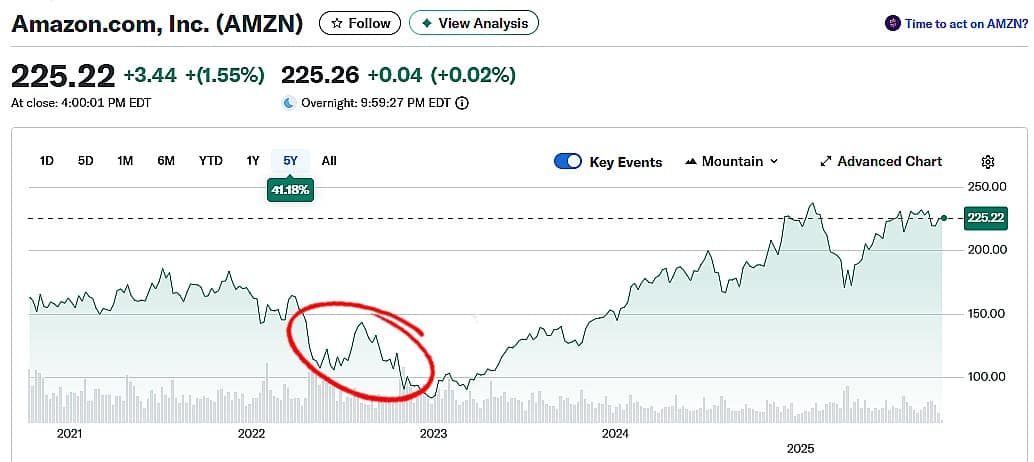
Amazon Stock Split

Amazon’s stock split in 2022 made AMZN more affordable for retail investors. Source: Yahoo Finance

Why Companies Use Stock Splits

The main motivation behind a stock split is accessibility. A company trading at $1,000 per share may intimidate smaller investors who lack access to fractional shares. By splitting shares, for example, in a 10-for-1 split, the per-share price falls to $100, making the stock appear more approachable. Importantly, while the price per share drops, investors’ overall holdings retain the same value.

Liquidity is another reason. A lower share price can draw in more participants, generating higher trading volumes and smoother transactions. From a psychological perspective, many investors view stocks with lower nominal prices as more “affordable,” even though the percentage returns are identical. In fact, behavioral finance research highlights that lower share prices often attract broader investor bases. Splits can also signal confidence. Companies often initiate them after extended periods of price growth, subtly conveying management’s optimism about continued momentum.

How the Process Works

Stock splits must first be approved by the board of directors. Once approved, companies announce two critical dates:

  • Record date: Determines which shareholders are entitled to the additional shares.

  • Effective date: The date when shares officially split, and the adjusted share count and new price appear in brokerage accounts.

This process is entirely automatic for investors. For example, if Apple conducts a 2-for-1 split at $180 per share, a shareholder with 10 shares worth $1,800 would, after the split, own 20 shares priced at $90 each. The total value remains $1,800, but the share count has doubled.

Reverse Stock Splits

Unlike traditional splits, which often follow periods of strength, reverse stock splits typically occur in distressed situations. In a reverse split, a company consolidates shares to raise the price per share. For instance, in a 1-for-10 reverse split, 10 shares at $1 each become one share at $10.

Companies employ reverse splits for two key reasons:

  1. Exchange compliance: Major exchanges like Nasdaq and the NYSE often require a minimum share price (usually around $1). Falling below this threshold can result in delisting, so companies use reverse splits to remain eligible.

  2. Market perception: A stock trading at very low prices can project weakness. By consolidating shares into higher denominations, management aims to restore credibility.

That said, reverse splits rarely inspire optimism. Investors often interpret them as red flags that signal deeper operational or financial issues.

Effects on Investors

From a technical standpoint, a stock split does not change fundamentals. Shareholders retain the same percentage ownership, their investment’s total dollar value remains intact, and dividends are proportionally adjusted. For example, if dividends were $1 per share before a 2-for-1 split, they become $0.50 per share afterward, leaving the total payout unchanged.

Tax considerations are also favorable: stock splits generally do not create taxable events since no gains or losses are realized. Investors simply hold more shares of the same value.

The bigger impact comes from sentiment and market behavior. Lower share prices tend to increase retail participation and trading volumes, at least in the short term. This additional liquidity can fuel temporary rallies. For instance, research has shown that many stocks experience a short-lived price bump following a split as retail demand increases.

Real-World Examples

In recent years, some of the world’s largest companies have turned to stock splits to broaden access:

  • Apple (AAPL): Conducted a 4-for-1 split in August 2020 when shares traded around $500. Afterward, the per-share price fell closer to $125, which encouraged more widespread ownership.

  • Tesla (TSLA): Completed a 5-for-1 split in 2020 after a strong rally and later a 3-for-1 split in 2022, both designed to attract more investors.

  • Amazon (AMZN): Announced a 20-for-1 split in June 2022, its first in more than 20 years, cutting its per-share price from over $2,000 to about $100.

While none of these moves altered company fundamentals, they sparked significant investor interest, particularly among retail traders.

Should Investors Care?

Stock splits themselves do not create or destroy value. They simply repackage shares into different denominations. However, the implications can matter. For long-term investors, lower per-share prices make it easier to buy in smaller increments, especially without fractional share access. They can also improve portfolio flexibility.

At the same time, splits can be viewed as confidence signals, suggesting management sees strong growth potential. But investors should remain disciplined: evaluating fundamentals like earnings growth, revenue stability, debt levels, and competitive advantage matters far more than a split.

Key Takeaways

A stock split increases the number of a company’s outstanding shares while lowering the price of each share proportionally, leaving the overall market value unchanged. In contrast, a reverse split consolidates shares to raise the share price, often as a defensive strategy to prevent delisting or to restore market perception. While splits can enhance accessibility for smaller investors, improve liquidity, and influence sentiment, they do not alter the company’s underlying financial foundation.

High-profile examples such as Apple, Tesla, and Amazon illustrate how stock splits can broaden investor participation and spark enthusiasm, yet long-term performance ultimately depends on the strength of business fundamentals. In essence, a stock split is a cosmetic adjustment rather than a growth catalyst, and for investors, the real focus should remain on a company’s financial health, market position, and long-term strategy to generate sustainable returns.


About this topic
This article forms part of Mooloo’s investing education series, which explains how markets work, how risk and returns are generated, and how investors can make better long-term decisions.

Learn more in our How Investing Works guide.

ADVERTISEMENT
Advertise with Us

Related Posts

Other News

ADVERTISEMENT
Advertise with Us

Tags