PCE Report: An Investor’s Strategic Guide to Market-Moving Economic Data


The Personal Consumption Expenditures (PCE) report is the Federal Reserve’s preferred inflation gauge and a critical measure of consumer spending, which drives about 70% of U.S. economic activity. Each monthly release shapes bond yields, equity sector rotations, currency moves, and Fed policy expectations. Smart investors who track PCE can anticipate rather than just react to market swings. Some Key takeaways:
- PCE combines consumer spending and inflation data, giving early signals on economic momentum.
- High PCE favors banks, energy, and TIPS; low PCE boosts growth stocks and long-duration bonds.
- Market reactions follow predictable patterns, bonds move first, equities adjust later, Fed policy lingers.
- Positioning strategies vary by inflation scenario, with risk management essential against surprises.
The Personal Consumption Expenditures (PCE) report is one of the most influential yet often underappreciated economic releases in the United States. As the Federal Reserve’s preferred inflation gauge, it not only measures how fast prices are rising but also reflects shifts in consumer spending, the engine that drives U.S. economic output. For investors who understand its nuances, the PCE is not just a backward-looking statistic but a forward-looking roadmap for positioning portfolios in an evolving economy.
Understanding the PCE Report’s Core Components
At its core, the PCE report delivers two critical insights: how much consumers are spending and how quickly prices are rising. The spending component reflects household demand for goods and services, offering a window into the strength or weakness of the broader economy.
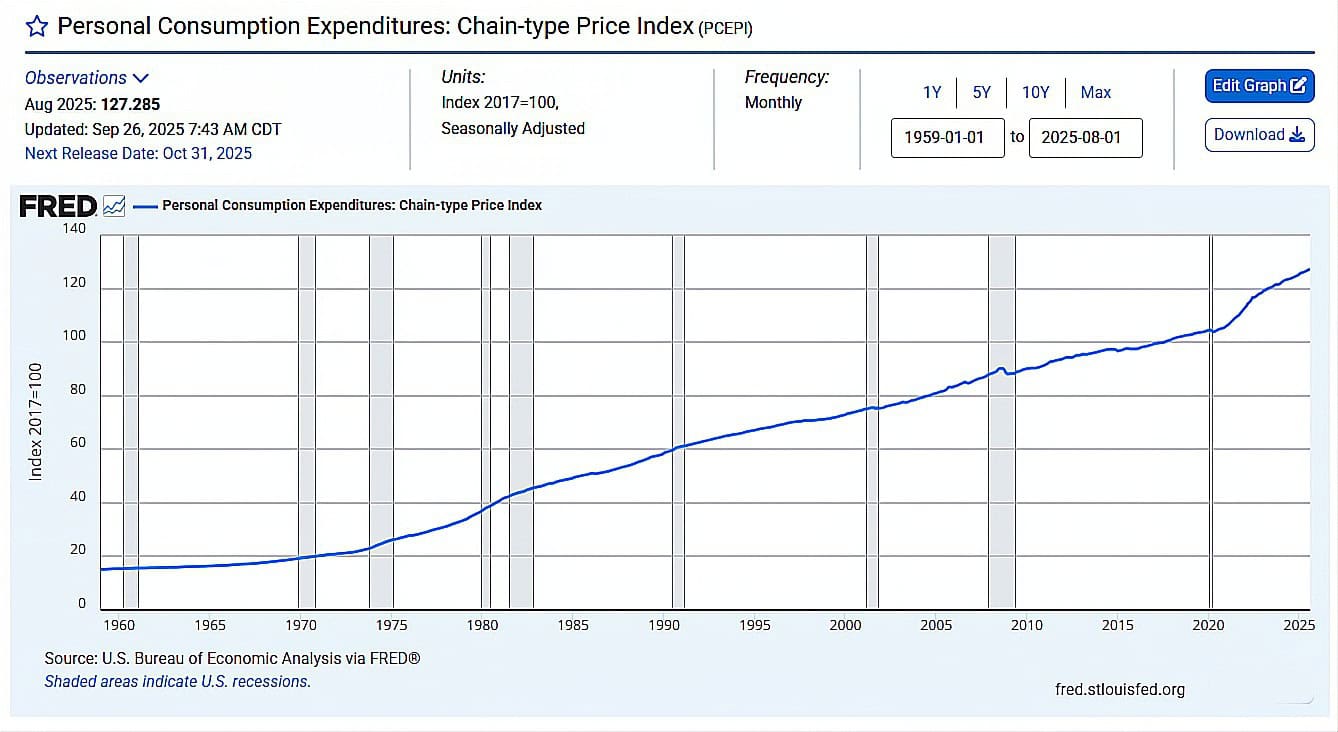
Source: St Louis Fed
The inflation component, measured by the PCE Price Index, directly influences Federal Reserve policy decisions. The above chart shows how U.S. prices have risen over time using the Personal Consumption Expenditures (PCE) Price Index — the Federal Reserve’s preferred inflation measure. The index is set to 100 in 2017, so the August 2025 reading of 127.3 means prices are about 27% higher than in 2017. The steady climb reflects long-term inflation, with a sharp acceleration after 2020 due to pandemic-related disruptions and strong consumer demand. This illustrates how the purchasing power of the dollar has declined over time.
Within these categories, the report highlights headline PCE, which includes volatile food and energy costs; core PCE, which excludes them for a more stable reading; real PCE, which is adjusted for inflation to show actual consumption; and a breakdown of spending across services and goods. This layered view allows investors to move beyond headline noise and capture deeper signals about demand and price trends.
High Inflation Scenarios: When PCE Runs Hot
When PCE inflation readings rise above the Federal Reserve’s 2% target, especially when Core PCE signals persistent upward pressure, investors often respond with targeted strategies across multiple markets. In the bond market, higher inflation expectations tend to push yields upward, prompting investors to short long-term Treasuries or reduce duration exposure in fixed-income portfolios.
Low Inflation Scenarios: When PCE Runs Cool
When PCE readings come in below expectations or show deflationary pressures, the investment landscape shifts dramatically, requiring different strategic approaches.
Duration Extension Strategy: Low inflation often signals potential Federal Reserve accommodation, making long-term bonds attractive. Smart investors typically extend duration in their fixed-income portfolios, capturing higher yields before rates potentially fall. Government bonds become more appealing relative to corporate credit as the flight-to-quality dynamic strengthens.
Growth Stock Emphasis: Low inflation environments often favor high-growth, long-duration assets. Technology stocks and other growth companies benefit from lower discount rates that make their future earnings more valuable in present-value terms. This environment often triggers rotation away from value stocks toward growth-oriented names.
International Diversification: Weak PCE data can weaken the dollar as markets price out aggressive Fed action. This currency dynamic makes international investments more attractive, particularly in developed markets with stronger growth prospects or emerging markets that benefit from dollar weakness.
Defensive Positioning: If low PCE reflects weak consumer demand rather than benign price pressures, defensive sectors like utilities, consumer staples, and healthcare often outperform. These sectors provide steady cash flows and dividends that become more attractive in low-growth, low-inflation environments.
Advanced PCE Analysis: Reading Between the Numbers
Sophisticated investors look well beyond the headline PCE numbers, focusing instead on the underlying trends that often provide earlier signals of market direction. One critical area is the distinction between services and goods inflation. Services inflation is typically stickier and harder to reverse, making it a key concern for the Federal Reserve, whereas goods inflation often fluctuates more quickly.
A sustained rise in services PCE usually points to more entrenched inflationary pressures that could demand policy intervention. Investors also examine regional and demographic spending breakdowns, which shed light on how different income groups contribute to consumer demand. Strong consumption among high-income households, for example, can benefit luxury brands and premium services, while weakness among middle-income groups may flag broader economic vulnerabilities.
Additionally, tracking sequential monthly PCE trends over three- and six-month annualized periods often offers earlier warnings of inflation turning points than year-over-year comparisons, allowing investors to anticipate shifts in both inflation and spending momentum.
Timing Your Moves: Market Reaction Patterns
The PCE report’s market impact often follows predictable patterns that create opportunities for prepared investors.
Immediate Market Response: Bond markets typically react within minutes of the PCE release, with yields moving based on inflation surprises. Equity markets may take longer to digest the implications, often showing sector rotation throughout the trading day rather than immediate broad market moves.
Federal Reserve Policy Implications: Investors increasingly focus on how PCE data affects Federal Reserve policy expectations. Strong PCE readings that increase odds of rate hikes often benefit financial stocks while pressuring interest-sensitive sectors like utilities and REITs.
Economic Cycle Positioning: PCE trends help identify where the economy sits in the business cycle. Early-cycle periods with rising PCE often favor cyclical stocks and commodities, while late-cycle periods with slowing PCE growth might favor defensive assets and longer-duration bonds.
Risk Management and PCE Volatility
Looking Forward: PCE in the Modern Economy
The PCE report’s relevance continues evolving as the economy changes. The growing importance of services, the impact of technology on pricing, and changing consumer behaviors all affect how investors should interpret PCE data.
Understanding these nuances, and positioning portfolios accordingly, separates investors who react to economic data from those who anticipate and profit from the market movements it creates. The PCE report isn’t just economic data; it’s a roadmap for navigating the complex relationship between consumer behavior, Federal Reserve policy, and market performance.
Smart investors don’t just read PCE reports, they use them to stay one step ahead of market consensus, positioning their portfolios for the economic environment these trends suggest is coming next.