AI ETFs: Your Complete Investment Guide to the $1.8 Trillion Revolution


Artificial intelligence is projected to grow into a trillion-dollar industry by 2030, reshaping everything from robotics to healthcare. But instead of betting on individual winners like NVIDIA, many investors are turning to AI ETFs for diversified exposure. The top funds, BOTZ, ARKQ, ROBO, AIQ, and ARKI, offer different mixes of active vs. passive management, global reach, and sector focus. While the growth potential is huge, investors must weigh risks like volatility, concentration in mega-cap tech, and uncertain regulation. Here’s what to know before adding AI ETFs to your portfolio.
- Diversification wins: AI ETFs spread exposure across hardware, software, and global players, reducing the risk of picking the wrong stock.
- Major players: BOTZ (~$3B AUM) and AIQ (~$5B AUM) lead in size, while ARKQ and ROBO offer higher-conviction or broader robotics exposure.
- Risk factors: High volatility, NVIDIA concentration, and policy uncertainty could impact performance across multiple funds at once.
- Portfolio role: Conservative investors might allocate 5–10% to diversified ETFs like BOTZ or ROBO, while aggressive investors could layer multiple funds with dollar-cost averaging and disciplined rebalancing.
- Long-term view: AI is a decades-long megatrend, steady exposure beats chasing short-term rallies.
The artificial intelligence revolution is here, and it’s reshaping everything from how we work to how we invest. While individual AI stocks like NVIDIA grab headlines with explosive gains, many investors are discovering that AI ETFs offer a smarter way to profit from this technological transformation without the risk of betting on single companies.
If you’ve been wondering how to invest in artificial intelligence but don’t know where to start, this guide breaks down everything you need to know about AI ETFs, from the biggest players to the hidden risks most investors miss.
The AI Investment Opportunity: By the Numbers
The scale of the AI opportunity is staggering. The AI industry is expected to surge to $1.8 trillion by 2030, representing a compound annual growth rate of 36.6%. To put that in perspective, that’s faster growth than the internet boom of the late 1990s.
This isn’t just about chatbots and automation. The global robotics technology market was valued at $87.4 billion in 2022 and is projected to reach $349.8 billion by 2032, growing at a CAGR of 15.2%. We’re talking about AI transforming manufacturing, healthcare, transportation, finance, and virtually every industry you can imagine.
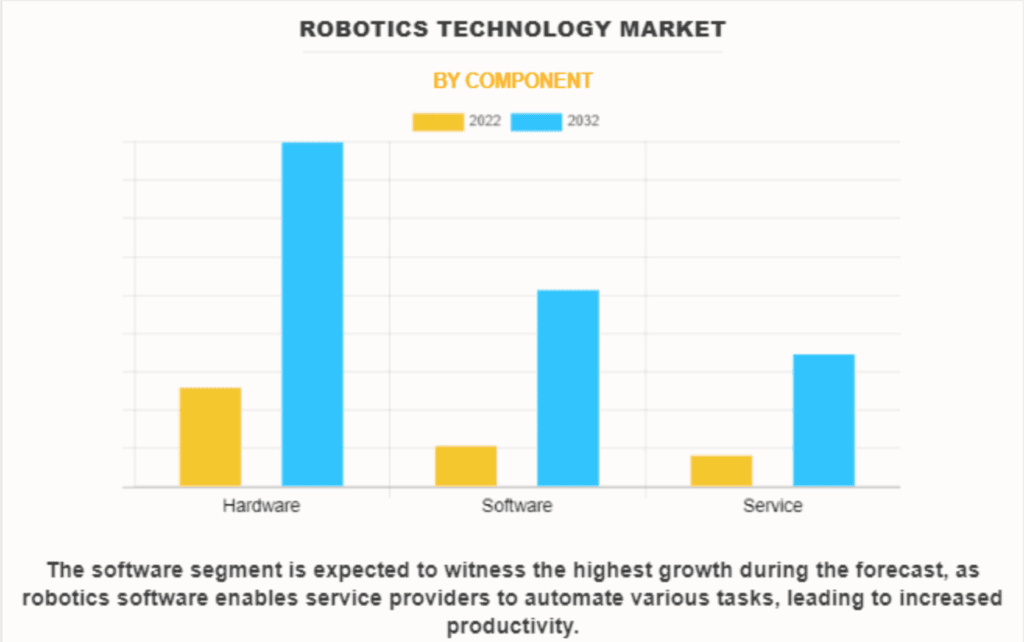
Source: Allied Market Research
But here’s what makes this moment different: AI training costs are plummeting, in some benchmarks dropping by an order of magnitude per year, outpacing Moore’s Law. When technology gets cheaper and more accessible this quickly, adoption accelerates exponentially.
Why AI ETFs Beat Stock Picking
Most investors make the same mistake when they discover a hot trend: they try to pick the winners. With AI, that’s particularly dangerous because:
The Technology is Still Evolving: Today’s leaders might not be tomorrow’s winners. Remember when BlackBerry dominated smartphones? In fast-moving tech sectors, diversification isn’t just smart, it’s essential for survival.
Supply Chain Complexity: AI isn’t just about the companies making the software. It requires semiconductors, cloud infrastructure, data centers, robotics hardware, and specialized components. AI ETFs can help diversify your portfolio, offering exposure to a variety of companies in the AI industry, from tech giants to smaller, innovative firms.
Geographic Diversification: The AI revolution is global. Companies in Japan, Switzerland, South Korea, and other countries are making crucial contributions. Individual stock picking often leads to home-country bias, missing international opportunities.
The Big 5 AI ETFs: Complete Breakdown
| ETF | AUM / Expense | Holdings / Yield | Style | Focus | Top Holdings / Mix | Launch Date | Why Consider | Risks |
|---|---|---|---|---|---|---|---|---|
| Global X Robotics & Artificial Intelligence ETF (BOTZ) | ~$3.02 B / 0.68% | ~53 / ~0.22% | Passive | Robotics, AI hardware & automation | NVIDIA ~11.3%, ABB, Fanuc, Keyence, Intuitive Surgical | Sep 12, 2016 | Broad robotics+AI exposure, highly liquid | Top-stock concentration, tech cyclicality |
| ARK Autonomous Technology & Robotics ETF (ARKQ) | ~$1.49 B / 0.75% | ~37 / low yield | Active | Disruptive tech, automation, AI | Tesla ~12.5%, Kratos, Teradyne, Palantir | Sep 30, 2014 | Alpha potential via high-conviction picks | High volatility, concentrated, manager risk |
| ROBO Global Robotics & Automation Index ETF (ROBO) | ~$1.17 B / 0.95% | ~79 / ~0.46% yield | Passive | Broad robotics & automation | Harmonic Drive, Symbotic, Fanuc, Teradyne, Celestica | Oct 22, 2013 | Very diversified in robotics sector | May lag narrow AI rallies |
| Global X Artificial Intelligence & Technology ETF (AIQ) | ~$5.43 B / 0.68% | ~89 / low yield | Passive | Pure AI & big data (software + hardware) | Microsoft, NVIDIA, Alphabet, Meta | May 11, 2018 | Scaled AI/data exposure | Sector concentration, high correlation |
| ARK UCITS Artificial Intelligence & Robotics ETF (ARKI) | ~€228 M / 0.75% | ~41 / accumulating | Active | AI, robotics, autonomy (UCITS) | Tesla ~9.8%, Palantir, Roblox, AMD | Apr 12, 2024 | Euro-domiciled ARK option | Short track record, ARK-style volatility |
The Hidden Risks Every AI Investor Must Know
Volatility Warning
The AI market is still in its infancy and subject to high levels of volatility. AI ETFs can experience sharp swings in price, which can be risky for investors. We’re talking about 20-30% moves in matter of weeks, not months.
Regulatory Uncertainty
The AI industry is not as heavily regulated as other sectors, such as healthcare or finance. Future policy changes could impact the stability and growth of investments. Government regulation could reshape the entire industry overnight.
Concentration Risk
Many AI ETFs are heavily weighted toward a few large companies. If NVIDIA, which appears in most AI ETFs, faces problems, it impacts multiple funds simultaneously.
Technology Disruption Risk
Today’s AI leaders could become tomorrow’s has-beens. New breakthroughs in quantum computing, neuromorphic chips, or alternative AI architectures could disrupt current market leaders.
Valuation Risk
Many AI stocks trade at extremely high valuations based on future growth expectations. If growth disappoints or investor sentiment shifts, corrections could be severe.
How to Use AI ETFs in Your Portfolio
Core / Conservative Strategy
Allocate ~5–10% of your total equity allocation to a broadly diversified AI/robotics ETF (e.g. BOTZ or ROBO). This gives you meaningful exposure without overcommitting.
Satellite / Moderate Strategy
Use BOTZ as your core, then add smaller positions in ARKQ or AIQ based on conviction. This lets you capture upside from niche trends while anchoring risk.
Thematic / Aggressive Strategy
If you believe AI will dominate the next decade, allocate 15–20% (or more) across multiple ETFs (diversified, concentrated, geographic) plus selective individual stocks.
Dollar-Cost Averaging (DCA)
Given volatility, spreading entries over 6–12 months helps avoid poorly timed entries and reduces average cost.
Rebalancing Discipline
Because AI ETFs can run strongly in one direction, keep your overall allocation in check. If an AI fund balloons above its target, prune it back to maintain portfolio balance.
The Competitive Landscape: Key Comparisons
| ETF | Assets | Exp. | Hold. | Strategy | Best For |
|---|---|---|---|---|---|
| BOTZ | ~$3.0B | 0.68% | ~53 | Broad AI/Robotics | Most investors |
| ARKQ | ~$1.5B | 0.75% | ~37 | Active mgmt | ARK believers |
| ROBO | ~$1.17B | 0.95% | ~79 | Diversified robotics | Diversification seekers |
| AIQ | ~$5.4B | 0.68% | ~89 | AI/Data focus | AI purists |
| ARKI | ~€228M | 0.75% | ~41 | Active UCITS AI/Robotics | EU investors, ARK fans |
What Wall Street Often Gets Wrong About AI Investing
Chasing momentum
Buying after a sharp rally is risky. History shows that AI and tech stocks often face corrections once valuations get overheated.
Ignoring global innovation
Breakthroughs don’t only come from U.S. giants. Key advances in chips, memory, and robotics are emerging from Japan, South Korea, Switzerland, and Israel.
Mistiming the trend
AI is a multi-decade transformation, not a short-term trade. Day-to-day swings are mostly noise compared to the long growth trajectory.
Overlooking infrastructure
While hype focuses on software, the real backbone of AI lies in semiconductors, memory, cooling systems, and interconnects — areas that often hold more durable value.
The Bottom Line: AI ETFs in Your Portfolio
Artificial intelligence is no longer just hype, it’s a transformative megatrend reshaping industries worldwide. But picking individual winners in such a fast-moving space is risky. AI ETFs offer a smarter, diversified entry point, giving investors exposure to both established leaders and emerging innovators across hardware, software, and global markets.
Whether you take a conservative 5–10% allocation with broad funds like BOTZ or ROBO, layer in higher-conviction plays like ARKQ and AIQ, or go aggressive with a thematic basket, discipline and diversification are key. The real opportunity lies not in chasing short-term rallies, but in steadily building exposure to what could be the defining growth story of the next decade.