Startup Guide – AI Employees vs. Human Employees: Which Roles Can Be Automated


By mid-2025, AI-driven automation has already contributed to over 50,000 tech job cuts globally, shifting the conversation from speculation to execution. For startup founders, AI is not eliminating work wholesale, it is redefining how teams are built. Repetitive, rules-based functions like customer support, data entry, and routine reporting can now be fully automated at a fraction of human cost, while roles requiring judgment, creativity, and relationship-building remain human-led but AI-augmented. The competitive edge in 2026 will belong to companies that deliberately automate low-leverage tasks and use AI to multiply the productivity of their first hires, rather than scaling headcount prematurely.
- Automate-first roles: Customer support, data entry, basic content generation, and routine financial reporting can be handled reliably by AI at ~$2,000 per year versus $50,000+ for a human equivalent.
- Augment, don’t replace: Sales, marketing, engineering, and design roles see 30–70% task automation, allowing one AI-enabled hire to produce 3–5× historical output.
- Human-only domains remain: Leadership, complex enterprise sales, creative strategy, and work requiring empathy or ambiguity management show under 20% automation risk.
- New headcount math: AI-first startups reach revenue milestones with smaller teams, driving higher revenue per employee, earlier breakeven, and stronger capital efficiency.
- Strategic takeaway: The goal isn’t maximum automation, it’s deploying the right mix of AI and human judgment to maximize output per dollar while maintaining quality and trust.
The conversation about AI replacing jobs has moved from speculation to measurable reality. In the first half of 2025, more than 50,000 tech job cuts globally were explicitly linked to AI adoption and automation, based on employer disclosures and layoff tracking data. For startup founders, this shift is less a blanket threat than a structural change in how companies are built.
The real challenge is strategic execution: understanding which functions can be automated reliably and which still require human judgment, creativity, and accountability, an imbalance that can determine whether AI becomes a competitive advantage or an operational risk.
The Automation Landscape in 2025-2026
The scale of automation over the next several years is significant. According to World Economic Forum projections, artificial intelligence is expected to handle 34% of all business tasks by the end of 2025. Multiple studies also estimate that 85 million jobs could be replaced by AI by 2026, while research suggests that up to 30% of U.S. jobs may be fully automatable by 2030.
While these figures are striking, they mask a more complex reality. AI is not replacing jobs uniformly across the economy. Instead, automation is targeting specific tasks within roles, with adoption and impact varying widely by industry, occupation, and task composition. In most cases, roles are being reshaped rather than eliminated, as AI takes over routine, repetitive, and data-intensive functions.
For founders building teams in 2025 and 2026, this distinction is critical. The strategic challenge is not whether automation will affect the workforce, but how it will. Understanding which roles can be fully automated, which can be augmented by AI, and which remain firmly human-led is becoming a foundational requirement for effective hiring, workforce planning, and long-term operational strategy.
Roles That Can Be Fully Automated Now
Several categories of work have now crossed the point where AI can fully replace full-time employees, not just assist them.
Customer service and support lead the automation shift. By 2025, up to 80% of customer service interactions are expected to be automated, with AI chatbots handling routine inquiries at a fraction of human cost. Companies such as Klarna have publicly stated that their AI systems now perform the equivalent workload of 700 customer service representatives. For startups, this means first-line customer support can be AI-driven from day one, while human agents focus only on escalations and complex cases.
The economics strongly favor automation. AI customer support operates 24/7, responds instantly, manages unlimited concurrent queries, and typically costs $50–$200 per month for startup-level volumes. By comparison, a single human support representative often costs $40,000–$60,000 annually, excluding benefits and overhead.
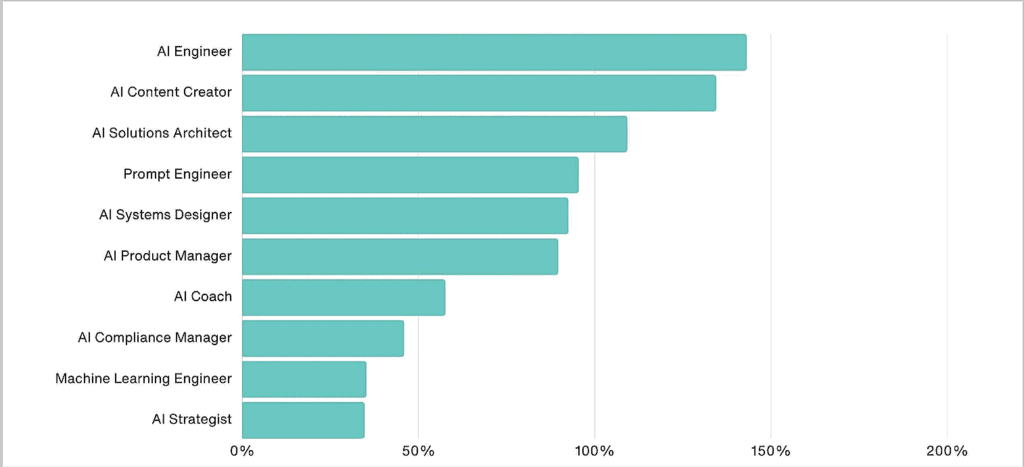
Data entry and administrative processing represent another area where full automation is now practical. AI adoption could eliminate 7.5 million data entry jobs by 2027, with manual data entry roles facing an estimated 95% automation risk. Modern AI systems can process over 1,000 documents per hour with error rates below 0.1%, compared to 2–5% for humans. For startups, tasks such as CRM updates, invoice processing, basic bookkeeping entries, and document management no longer justify full-time hires.
Source: DemandSage
Basic content generation has also become highly automatable. While advanced storytelling, brand strategy, and editorial judgment still require human oversight, AI can reliably generate blog posts, social media updates, product descriptions, and first-draft content. As a result, digital marketing content writer roles are projected to decline by roughly 50% by 2030, not due to reduced demand for content, but because one human editor can now manage AI-generated output at significantly higher scale.
Routine financial analysis and reporting have likewise crossed into automation territory. AI systems can analyze financial statements, generate standardized reports, track KPIs, and flag anomalies faster and more consistently than human analysts. For early-stage companies, this means core financial dashboards and recurring reporting can be automated, allowing human expertise to focus on strategic planning, forecasting, and decision-making.
Roles That Should Be Augmented, Not Replaced
A larger category of roles benefits from AI augmentation rather than replacement. Here, the winning formula is human judgment plus AI capability.
Sales representatives face approximately 67% task automation potential, but the role itself isn’t disappearing. AI handles lead qualification, email sequences, CRM updates, and initial outreach. Humans close deals, build relationships, negotiate complex terms, and understand nuanced customer needs. For founders, this means your first sales hire can be dramatically more productive than historically possible, potentially handling 3-4x the pipeline with AI support.
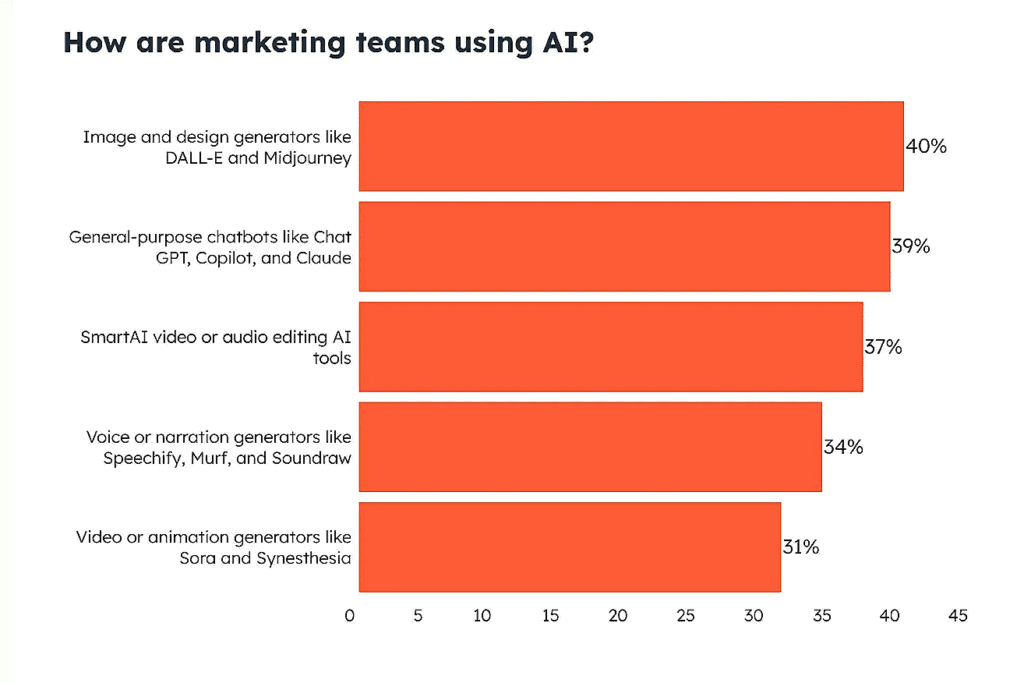
Marketing managers need AI tools but can’t be replaced by them. Less than 20% of marketers surveyed believe AI will take over most marketing duties. Why? Because marketing requires cultural context, creative strategy, and rapid adaptation to changing circumstances. AI generates the content, analyzes the data, and optimizes the campaigns. Humans set strategy, interpret results, and make judgment calls. Your marketing team should be half the traditional size but twice as productive.
Source: HubSpot
Software engineering is experiencing significant augmentation. Anthropic’s CEO has projected AI could write essentially all code by 2026. While this seems alarmist, the reality is that AI coding tools like GitHub Copilot are already allowing engineers to write code 30-50% faster. For startups, this means you need fewer engineers than you would have five years ago, but you still need human engineers to architect systems, make technical decisions, and handle complex problem-solving.
Design roles are being augmented substantially. AI can generate initial designs, create variations, and handle production work, but it can’t yet match human designers for original creative thinking, understanding brand strategy, or making intuitive aesthetic choices that resonate with specific audiences.
Roles That Remain Firmly Human
Despite rapid AI advancement, certain roles remain largely immune to automation because they require capabilities AI fundamentally lacks. Strategic leadership and management roles are highly resistant to automation. Research shows managerial roles face only 9-21% automation risk. Why? Because management requires navigating ambiguity, making decisions with incomplete information, understanding organizational politics, and inspiring teams. These capabilities remain distinctly human.
Complex sales and business development for enterprise deals require relationship building, understanding unspoken needs, navigating organizational complexity, and creative problem-solving that AI can’t replicate. While AI can support these roles, it can’t perform them.
Creative strategy and high-level positioning work requires understanding cultural context, predicting human emotional responses, and making intuitive leaps that aren’t pattern-matching. An AI can generate a thousand variations on a theme; it can’t create a genuinely new theme that resonates.
Skilled trades and physical work requiring dexterity, adaptability to changing environments, and on-the-spot problem-solving remain largely human. While robots can perform repetitive manufacturing tasks, complex physical work like construction, specialized installation, and repair remains human territory.
The Practical Decision Framework
For founders building teams, here’s how to decide what to automate:
- Start with the automation potential framework: If a role is primarily repetitive, rules-based, and doesn’t require complex human judgment, it’s automation-first. If it requires creativity, empathy, strategic thinking, or managing ambiguity, it’s human-first with AI augmentation.
- Calculate the economic crossover: A customer service AI costs perhaps $2,000 annually all-in. A human customer service representative costs $50,000+ annually. If AI can handle 70% of inquiries adequately, you’ve just reduced a three-person support team to one person plus AI at massive cost savings.
- Consider the hybrid model: Rather than thinking “hire or automate,” think in terms of “human + AI” positions. Your first marketing hire shouldn’t be a traditional marketer, it should be an AI-augmented marketer who uses tools to produce 5x the traditional output.
- Watch for the quality threshold: AI customer service that frustrates customers costs more than it saves. AI-generated content that’s obviously robotic damages your brand. The question isn’t just “can AI do this task?” but “can AI do this task at the quality level our business requires?”
Building Your Automation-First Stack
For early-stage founders, automation is no longer optional, it is a strategic advantage. An automation-first approach allows startups to stay lean, reduce operating costs, and scale efficiently from day one. The key is not automating everything, but applying automation deliberately where it delivers the highest return.
Founders should automate core operational tasks immediately, especially work that is repetitive, rules-based, and time-consuming. First-line customer support can be handled by AI chatbots, while basic bookkeeping, data entry, CRM updates, and routine reporting can run automatically in the background. Email marketing sequences and social media scheduling are also well-suited for early automation, enabling consistent execution without ongoing manual oversight.
Rather than expanding headcount too early, successful startups use AI to multiply the effectiveness of their first hires. Engineers can use AI-assisted coding tools to accelerate development and reduce bottlenecks. Marketers benefit from AI-powered content creation and campaign optimization, allowing them to produce more with fewer resources. Sales teams can rely on AI-driven lead qualification and email sequencing, while operations roles should be supported by workflow automation to minimize administrative work.
Despite rapid advances in AI, certain responsibilities should remain firmly human. Strategic decision-making, complex customer relationships, creative direction, and work that relies on empathy or emotional intelligence cannot be fully automated. True innovation, creating something genuinely new rather than iterating on existing patterns, still depends on human judgment and insight.
By adopting a pragmatic automation strategy, early-stage founders can move faster, operate more efficiently, and scale sustainably. Automation becomes a foundation for growth, while human talent is focused where it creates the greatest long-term value.
The Headcount Equation
Automation is fundamentally reshaping startup hiring economics. Compared with even five years ago, many early-stage companies can now reach meaningful revenue milestones with significantly smaller teams. Tasks that once required dedicated hires, customer support, data processing, internal reporting, marketing operations, and basic engineering workflows, are increasingly handled by AI tools and automation platforms.
The result is a clear shift in unit economics. Startups building with AI-first operating models often require materially fewer employees to reach the same revenue levels as earlier cohorts. This isn’t a marginal efficiency gain, it’s a structural change in how companies scale.
Data from venture and productivity studies consistently shows that companies leveraging automation and AI tend to generate higher revenue per employee than their peers. In many cases, revenue per employee is tens of percentage points higher, reflecting lower headcount needs rather than outsized pricing power. This advantage compounds over time. Fewer employees mean lower fixed costs, faster paths to breakeven, reduced capital dependency, and greater strategic flexibility.
For founders, the implication is clear: scaling revenue no longer requires scaling headcount at the same pace. Teams can stay lean for longer, profitability can arrive earlier, and capital efficiency increasingly becomes a core competitive advantage, one that directly influences resilience, optionality, and long-term valuation outcomes.
The Ethical Consideration
There is an uncomfortable reality behind automation’s efficiency gains: real people are affected when work is automated. While this article frames automation as a strategic advantage for founders, responsible implementation matters.
A thoughtful approach prioritizes automating roles that have not yet been filled, rather than immediately displacing existing employees. When workforce transitions are unavoidable, ethical practice includes clear communication, severance where feasible, and support that helps affected workers move forward.
The broader societal challenge, how economies adapt as automation reshapes millions of jobs, extends far beyond the control of any single founder. What is within a founder’s control is how these changes are handled at the individual level. Decisions made with transparency and dignity can mitigate harm, even as technology continues to advance.
Looking Forward to 2026
The automation landscape is set to accelerate through 2026. Nearly 40% of companies expect to replace jobs with AI by the end of 2026, with entry-level roles and high-salary positions facing the highest risk. For founders, this signals a structural shift: your competition will increasingly consist of lean, AI-augmented teams capable of producing more with fewer people.
The winning approach is not maximum automation, but strategic automation. Automate aggressively where AI is faster, cheaper, and more reliable than humans. Augment roles where humans equipped with AI tools outperform either alone. Reserve human hiring for work that requires judgment, creativity, relationship-building, and strategic decision-making.
In 2026, a startup’s competitive advantage will not come from headcount. It will come from deploying the right mix of human talent and AI capability to maximize output per dollar of cost. That balance, not team size, is the new team-building equation.