What the Data Says
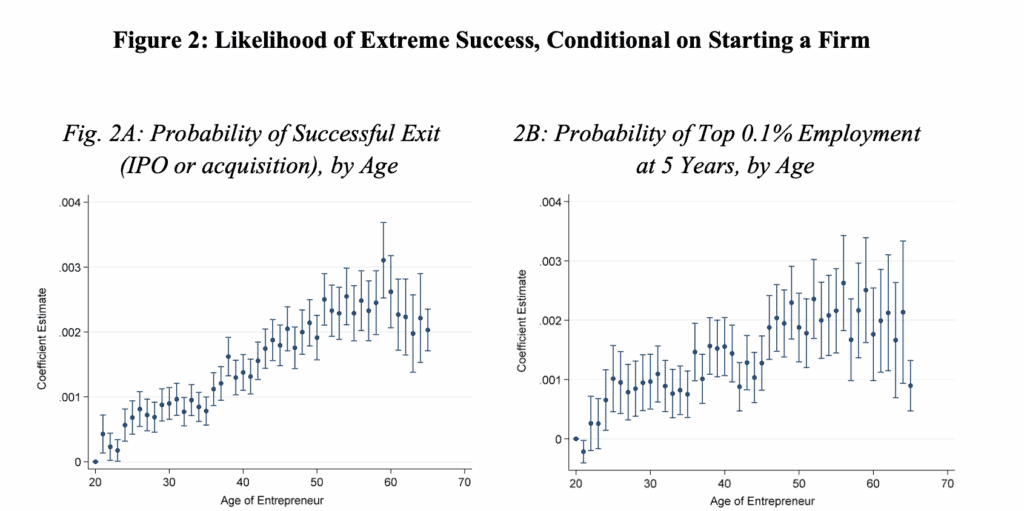
A landmark study by the MIT Sloan School of Management, Northwestern University, and the U.S. Census Bureau, analyzing 2.7 million U.S. founders between 2007 and 2014, found that the mean age of founders of the top 0.1% fastest-growing startups is 45. The study concluded that older entrepreneurs are significantly more likely to build scalable, successful companies than younger ones.
Similarly, research published by MIT Sloan dispels the myth of the 20-year-old tech genius. It shows that age correlates positively with entrepreneurial success, largely because experience compounds over time. The Kellogg School of Management reached a similar conclusion: older entrepreneurs, particularly those with extensive industry knowledge, outperform younger founders in terms of growth, revenue, and sustainability.
According to the Kauffman Foundation, over 25% of new U.S. entrepreneurs in 2019 were aged 55–64, compared to around 15% in 1996. The U.S. Small Business Administration (SBA) also reports that by 2016, people aged 55–64 accounted for one in four new entrepreneurs, while in 1996 that figure was less than one in seven.
Data from the National Bureau of Economic Research (NBER) reinforces this trend: self-employment rates rise sharply after age 60. About 25.2% of Americans aged 55–59 and nearly 30% of those aged 60–64 list self-employment as their primary work. This indicates not just a rise in entrepreneurship but also an enduring appetite for risk and innovation among older adults.
Why “Older” Can Be an Advantage
Older founders possess unique strengths that younger entrepreneurs often lack. Domain expertise is perhaps the most decisive factor. The MIT study found that prior experience in a given sector is among the strongest predictors of startup success. Decades of immersion in a field sharpen an entrepreneur’s intuition for what works and where inefficiencies lie.
Deep professional networks are another major advantage. Years in the workforce translate to valuable relationships with clients, suppliers, investors, and regulators, networks that can open doors, accelerate deals, and attract talent.
Credibility also plays a key role. In industries where trust, compliance, and reliability are paramount, such as finance, healthcare, or infrastructure, older founders are often perceived as more dependable and authoritative.
Many older entrepreneurs also enjoy greater financial flexibility, having accumulated savings, home equity, or investment portfolios that allow them to self-fund early operations and avoid premature dilution of ownership. And beyond financial capital, emotional maturity and measured decision-making enable seasoned founders to handle setbacks with perspective, a key determinant of long-term resilience.
Real Obstacles and How to Tackle Them
Starting a business later in life is not without challenges. Age bias remains an undercurrent in certain venture capital and tech ecosystems, where youth is often equated with innovation. The best counterstrategy is to emphasize measurable traction, such as customer acquisition, revenue growth, or patents, and to showcase the founder’s proven record of leadership and execution.
Technology gaps can also pose hurdles, particularly for founders from traditional industries. However, this can be mitigated by hiring specialized talent, forming cross-generational partnerships, or leveraging accessible no-code and AI tools that reduce technical barriers.
Finally, energy and pacing may differ from earlier decades. But experienced founders often excel in business models that reward strategic thinking over constant hustle, such as consulting, B2B services, acquisitions, or productized knowledge businesses. These models allow founders to capitalize on accumulated expertise while maintaining work-life balance.
Sectors Where Older Founders Excel
Certain industries naturally align with the strengths of older entrepreneurs, emphasizing insight, trust, and specialized knowledge over raw speed.
- In healthcare and biotechnology, years of clinical, managerial, or regulatory experience translate directly into better decision-making. Founders in their 50s and 60s have successfully launched medical device startups, telehealth platforms, and biotech ventures that combine deep domain knowledge with strong professional networks.
- In finance and insurance, credibility is currency. Older founders often have decades of experience managing compliance, risk, and client relationships, making them ideally positioned to innovate in areas like financial planning, fintech advisory, and insurtech platforms.
- Energy and sustainability also attract older entrepreneurs, particularly those transitioning from corporate engineering or manufacturing roles. Their expertise helps them navigate complex regulatory environments and develop commercially viable clean-energy solutions.
- In B2B software and consulting, where client trust and domain fluency are paramount, experienced founders thrive by translating decades of knowledge into scalable systems and digital products. Many turn their intellectual capital into productized IP, books, online courses, SaaS platforms, or data-driven services that monetize expertise efficiently.
- Finally, demographic-focused industries like senior care, wellness, and retirement planning represent fast-growing markets where older founders understand their audience intimately. With the global 60+ population projected to double by 2050, businesses catering to longevity and quality-of-life improvements are positioned for sustained growth, and seasoned founders are leading the charge.
Conclusion: Advantage, Not Disadvantage
The evidence is overwhelming: age is not a handicap in entrepreneurship, it is a strategic asset. Founders in their 40s, 50s, and 60s have consistently shown higher odds of building enduring, high-growth businesses than their younger peers. Their advantage lies not in youth but in preparation, decades of learning, relationships, and resilience that compound into wisdom.
Entrepreneurship does not belong to the young; it belongs to the ready. Experience, when coupled with curiosity and adaptability, remains one of the most powerful forms of capital any founder can possess.