Marketing Your Crowdfunding Campaign: The 90-Day Playbook That Doubles Success Rates


Why Most Campaigns Fail (And It’s Not What You Think)
Only around 38–40% of Kickstarter projects ever reach their funding goals, according to official Kickstarter statistics. While success rates vary by platform, Indiegogo averages roughly 17–30%, based on multiple industry analyses, and Seed&Spark reports about a 75% success rate within its creative and film categories. The overarching truth remains: most crowdfunding campaigns fail.
The reason isn’t bad products or unoriginal ideas, it’s the absence of marketing. As crowdfunding strategist Clay Hebert puts it, “The biggest mistake creators make is launching to crickets.” Without an audience, even great campaigns go unnoticed.
The data supports this. Studies show that about 42% of total funds are typically raised during the first and last three days of a campaign, highlighting the importance of early and late momentum. Projects that secure their first pledge within 24 hours are significantly more likely to succeed, and those that reach at least 30% of their goal within the first weekhave a high probability of full funding, according to Indiegogo’s campaign data.
Moreover, email marketing remains the most effective driver of pledges, with average conversion rates many times higher than social media posts. Campaigns that nurture a pre-launch email list consistently outperform those that rely solely on organic reach.
In short, if you launch without an audience, you’ve already failed, you just don’t realize it yet. Successful crowdfunding isn’t about luck; it’s about preparation, momentum, and marketing that starts long before launch day.
The 90-Day Playbook: Phase by Phase
Phase 2: Audience Building (Days 31–60)
This stage focuses on growing your audience and validating your offer. To hit 30% of your goal in the first week, calculate your list size using: (Goal × 0.30) ÷ Average Pledge ÷ Conversion Rate. For example, a $50,000 goal, $100 pledge, and 2% conversion rate means about 750 subscribers.
Use reservation funnels to boost conversions, collect a $1 refundable deposit instead of free sign-ups. LaunchBoom data from over 1,000 campaigns shows these leads are up to 30× more likely to pledge, with 35–45% conversion rates versus 1–3% from regular lists.
Grow organic reach with content marketing and SEO. Publish 2–3 blog posts weekly about your product’s story, benefits, or niche trends. Target keywords like Kickstarter marketing and crowdfunding strategy, and guest post on niche sites for backlinks.
Stay active on social media, campaigns using three or more platforms raise far more, according to Indiegogo’s Campaign Playbook. Focus where your audience lives: Instagram, Facebook, LinkedIn, YouTube, or Reddit, and post consistent educational, story-driven, and promotional content.
Start PR and influencer outreach 2–3 weeks before launch. Pitch 10–15 outlets or creators, keep emails under 190 words, attach a short press kit, and use 60–90 second video pitches with emotional or story-driven hooks.
Phase 3: Pre-Launch Activation (Days 61–75)
This phase focuses on activation and optimization. Perfect your campaign page with a clear headline, strong visuals, transparent timelines, and detailed rewards. Offer five to seven reward tiers, the $25 tier typically attracts the most backers, while the $100 tier often raises the largest share of funds, accounting for about 16% of total contributions based on Kickstarter’s official data. Create urgency with early-bird discounts of 20–40%, limited to roughly 20–30% of expected backers, a best practice used to build early momentum.
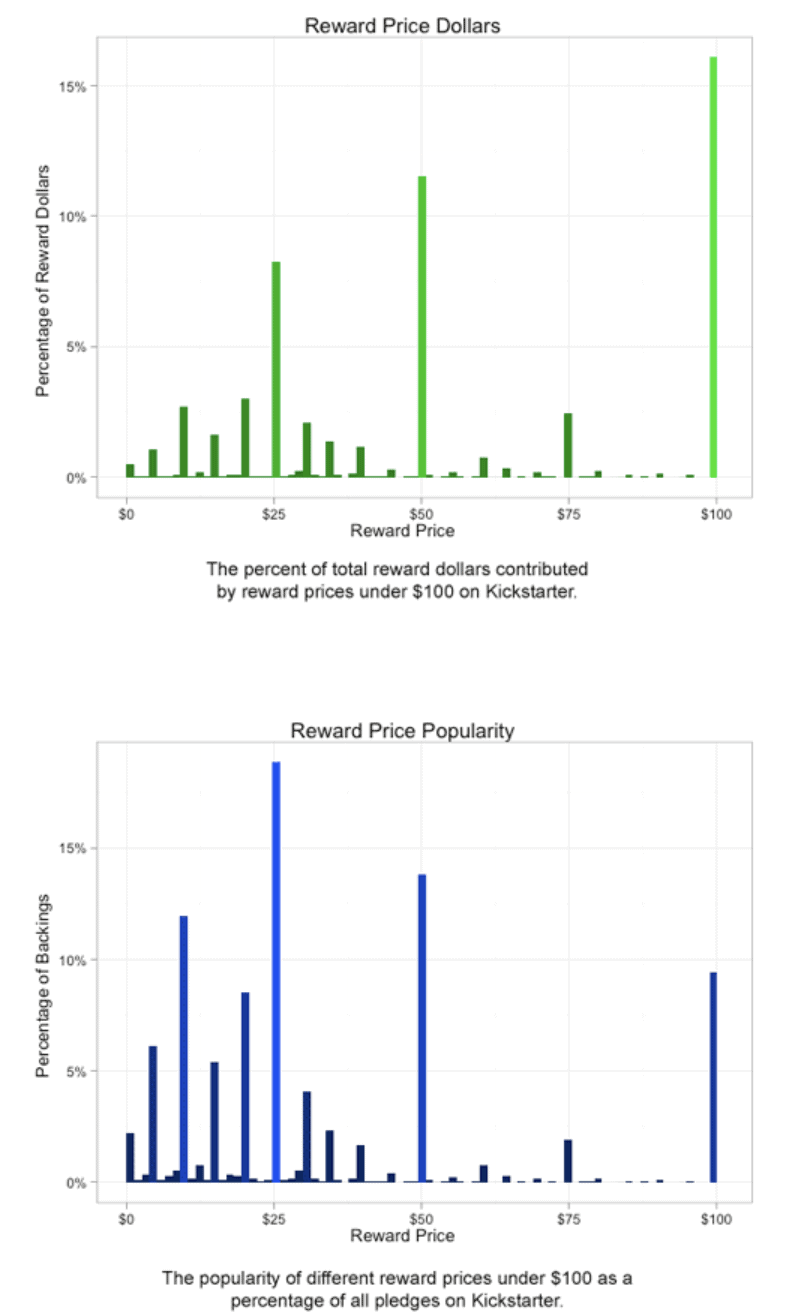
Source: Kickstarter
Secure your Day 1 commitments before launch. Personally message close supporters, friends, and early fans to confirm pledges within the first 24 hours. Campaigns that reach around 30% of their goal early are significantly more likely to succeed, according to Kickstarter’s success metrics. Many creators “soft launch” privately to this inner circle, generating social proof and momentum before going public.
Phase 4: Launch Week Preparation (Days 76–90)
The final phase of your crowdfunding campaign is all about readiness and precision. Schedule your content in advance, five to seven posts on Day 1 and two to three per day for the rest of the week. Celebrate milestones with engaging visuals that highlight funding progress and community support. Regular updates that emphasize transparency and growth help strengthen trust among backers.
Plan your email marketing sequence carefully, send one reminder the day before launch, an announcement when you go live, another that evening showcasing early progress, and follow-up updates with testimonials, stretch goals, and press mentions. A structured schedule maintains engagement and improves conversions.
Even a small crowdfunding team can make a big difference. Aim for at least a project manager, designer, advertiser, and copywriter. Larger campaigns often include social-media managers, influencer coordinators, and PR specialists. Campaigns with defined roles and strong collaboration tend to outperform solo founders, achieving higher average funding rates and stronger retention.
Ultimately, crowdfunding success isn’t luck, it’s structure and discipline. Following a proven 90-day launch plan built on preparation, pre-launch audience building, and consistent promotion turns uncertainty into measurable progress. Campaigns that plan strategically, engage early, and communicate clearly don’t just meet their goals, they often exceed them.
LAUNCH: The First 24 Hours That Make or Break Everything
Launch day isn’t the beginning of your campaign, it’s the culmination of 90 days of preparation and strategic groundwork. Every action within the first 24 hours determines how strong your momentum will be for the rest of the campaign.
The Day 1 Playbook
At 10 a.m., your campaign goes live. Immediately email your reservation funnel list to notify them that it’s launch time. Post across all your social media channels, send texts to your inner circle, and monitor your campaign page closely for any technical issues that could hurt conversions.
During hours 2–4, focus on engagement. Personally thank every single backer through comments or direct messages, share milestone updates such as “50 backers in 3 hours!”, and highlight user-generated content like screenshots from excited supporters. This keeps energy high and builds trust early on.
By hour 6, send another email update, this time to anyone who hasn’t backed yet. Use a subject line such as “We’re at [X]% in just 6 hours, here’s what we learned.” Include social proof, early reviews, and anything that reduces hesitation or friction for undecided visitors.
At hour 12, push for a strong evening close. Send a final email to your reservation list reminding them about early bird pricing or limited-time perks, celebrate the day’s achievements, and emphasize urgency without pressure.
When you hit hour 24, announce your Day 1 results across all platforms. Publicly thank your backers, share the total raised so far, and tease upcoming stretch goals or special updates to maintain excitement for Day 2 and beyond.
The Critical Stats to Track
Monitor your conversion rate (visitors to backers), traffic sources (where your pledges are coming from), average pledge amount, time spent on the page, and bounce rate. If conversion is lower than expected, test new headlines, swap out hero images, or reposition your video. Small changes can produce massive improvements, and early optimization sets the tone for your campaign’s long-term success.
During Campaign: Days 1-30
Post-Campaign: Turning Backers Into Customers
The Marketing Budget Breakdown
For a $50,000 crowdfunding campaign, a realistic marketing budget typically ranges between $8,500 and $23,500, or about 17–45% of the total goal. While the exact percentage depends on the campaign’s scope and niche, allocating a strong marketing budget is essential to drive awareness and conversions.
During the pre-launch phase, expect to spend around $500–2,000 on landing page design, $2,000–8,000 on professional video production, $50–150 per month on email marketing software, and $500–1,000 for ad testing and optimization.
Once the campaign is live, allocate $2,500–5,000 for Facebook and Instagram ads, $500–1,000 for PR tools and media outreach, $1,000–3,000 for influencer partnerships, and $500–1,000 for design and content updates.
According to Crush Crowdfunding and TurboCrowd, campaigns that maintain consistent daily marketing efforts can raise up to three times more than those that don’t. In short, strategic spending isn’t waste, it’s the engine that powers visibility, momentum, and long-term backer trust.
The Ultimate Checklist
90 Days Before Launch: Complete market research, define your target audience, and launch a landing page to capture emails. Script and film your campaign video, set up social channels, and plan a 90-day content calendar.
60 Days Before Launch: Grow your email list, activate your reservation funnel, and create a PR list of 10–15 outlets. Ensure your campaign page is 90% done, reward tiers finalized, and ad creatives tested.
30 Days Before Launch: Reach your email goal, start PR outreach, and secure Day-1 backer commitments (30% target). Finalize your campaign page, schedule email sequences, and brief your team.
Launch Day: Go live at the set time, send all emails, publish social posts, complete personal outreach, and monitor metrics closely.
During Campaign: Post updates every 5 days, respond to all messages, track metrics daily, adjust strategy as needed, and celebrate milestones publicly.
The Uncomfortable Truth
Reading this playbook won’t make your campaign successful, executing it will. Most creators read guides like this, nod along, and then make the same fatal mistakes: they skip the 90-day timeline thinking they can launch in three weeks, neglect audience building and hope for organic traction, cut corners on video quality with casual iPhone footage, or ignore the need for a marketing budget entirely. Then they wonder why they end up among the 60–65% of campaigns that fail to reach their funding goals, according to Kickstarter’s official statistics and industry data.
The truth is, successful campaigns aren’t run by luckier or smarter creators, they’re led by those who prepare relentlessly. They follow the process, stick to the plan, and put in the work long before anyone is watching. In 2024 alone, LaunchBoom campaigns collectively raised $47.6 million across more than 1,000 projects, proving that disciplined execution, not luck, drives consistent crowdfunding success. Their 90-day system works because it’s built on data-driven preparation, audience validation, and structured launch strategy.
Data across platforms supports this. Kickstarter’s success metrics show that 79% of projects raising more than 20% of their goal ultimately succeed, while campaigns that never gain early traction rarely recover. Early momentum, not chance, is what separates success from failure.
The question isn’t whether this playbook works, it does. The real question is whether you’ll follow it. Ninety days of preparation for thirty days of campaign. That’s the trade. Make it count.