From Bets to Business: How Polymarket Became a Forecasting Tool for Entrepreneurs


Polymarket’s strong accuracy in the 2024 election and its ~90% success rate predicting Federal Reserve decisions signal that prediction markets are becoming a reliable, real-time forecasting tool for entrepreneurs. Unlike polls or analyst reports, these markets price actual probabilities based on financial incentives, updating instantly and costing nothing to monitor. Used correctly, Polymarket provides advance warning on rates, regulations, supply chain risks, and competitive shifts, functioning as a free intelligence layer for strategic planning.
- Entrepreneurs can track real-time odds on events like Federal Reserve policy to time debt refinancing, fundraising, or capital purchases more strategically.
- Markets tied to AI regulation, climate policy, and data privacy offer early signals that help founders prepare compliance and gain first-mover advantage.
- Monitoring labor, geopolitical, or logistics markets improves supply chain resilience by signaling when disruptions are becoming likely.
- Corporate and cultural event markets surface sentiment and insider signals that traditional surveys or competitor research often miss.
- Because markets update instantly and cost nothing to observe, they outperform slow, expensive, and sometimes biased traditional forecasts, though thin liquidity and wash-trading risks require caution.
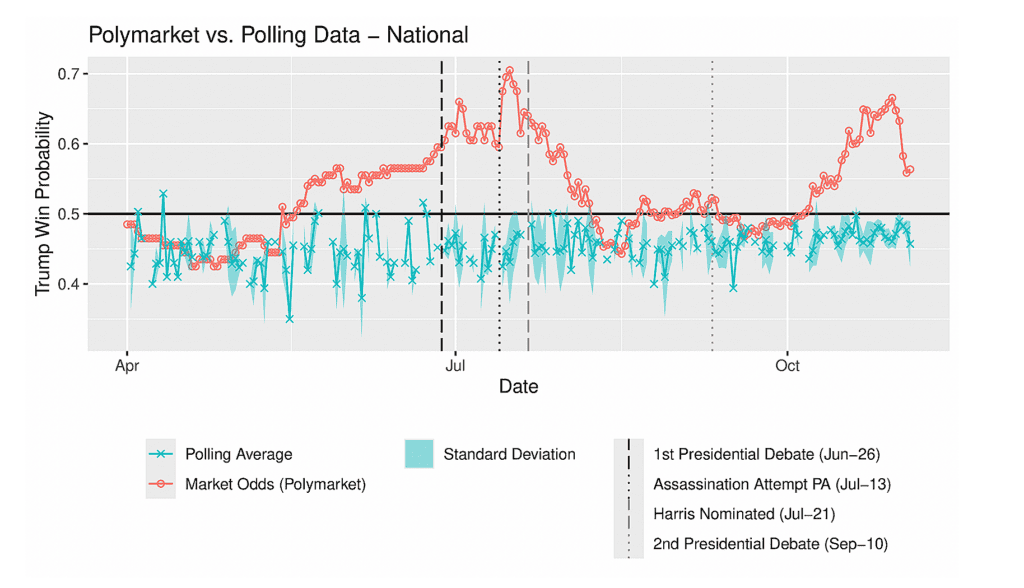
Polymarket’s accuracy in the 2024 presidential election demonstrated a new reality: prediction markets can outperform traditional forecasting methods. While most polls called the race a coin flip, Polymarket showed Trump leading Harris 58% to 42% on the Monday before the election, a forecast that proved far more accurate than conventional polling. For entrepreneurs, this shift represents more than just an electoral curiosity, it signals a fundamental rethinking of how businesses can access reliable forecasting data.
The platform that began as a cryptocurrency-based betting site has quietly evolved into something more valuable: a real-time sentiment barometer that entrepreneurs can monitor without spending a dollar. With Polymarket achieving approximately 90% accuracy in predicting Federal Reserve decisions, forward-thinking business leaders are now incorporating these crowd-sourced odds into financial planning, regulatory strategy, and operational decisions.
The Mechanics Behind the Magic
Prediction markets operate on a simple principle: traders buy shares tied to specific outcomes, and prices reflect real-time probabilities. Unlike traditional polling, which captures sentiment (“Who do you want to win?”), Polymarket asks a different question: “Who will actually win?” That distinction, backed by real money at risk, fundamentally changes the quality of information.
Prediction markets reward accurate analysis through economic incentives, while polls simply measure sentiment without consequences for being wrong. This financial skin-in-the-game creates what economists call an “efficient market” where mispricing gets quickly corrected by traders seeking profit. When someone takes an extreme position that distorts odds, other traders can profitably take the opposite side, creating a self-correcting mechanism.
For entrepreneurs, the beauty lies in passive observation. You don’t need to trade or risk capital, simply monitoring the odds provides free access to aggregated intelligence from thousands of participants with money on the line. Around $3.6 billion was wagered on the 2024 presidential election question alone, representing an enormous pool of distributed analysis that would cost millions to replicate through traditional research.
A Track Record That Beats the Experts
Polymarket’s predictive power extends well beyond elections. Research comparing Polymarket predecessor PredictIt against poll aggregator FiveThirtyEight found that prediction markets were more accurate across presidential, Senate, House and governor races in both 2018 and 2020. Historical data shows that in 15 elections between 1884 and 1940, betting market favorites as of mid-October won 11 times.
Source: Arxiv
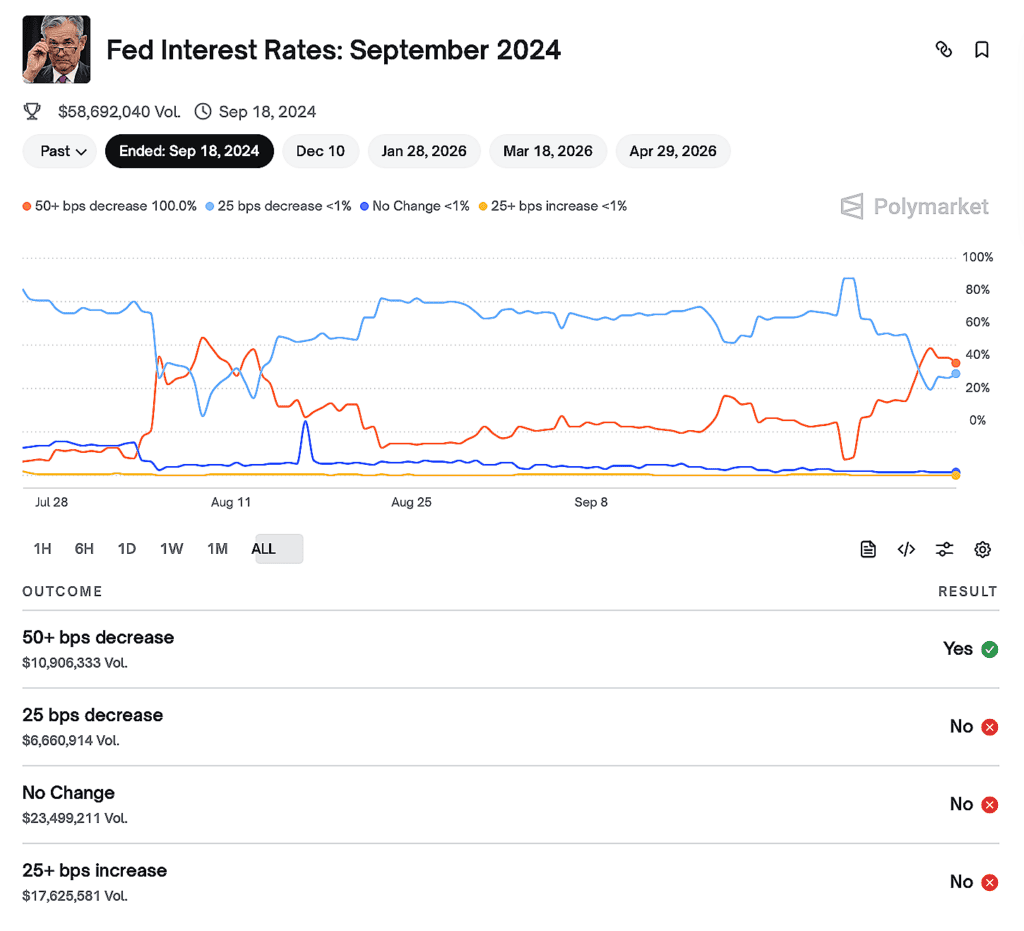
The pattern holds for economic indicators. Polymarket users correctly predicted a 50-basis-point Federal Reserve rate cut in September 2024 with 54% accuracy, while 92% of economists forecasted only a 25-basis-point cut. This edge over professional forecasters reflects the wisdom of crowds: while individual participants may lack expertise, the aggregate captures distributed knowledge that single analysts miss.
Source: Polymarket
Even skeptics acknowledge the platform’s utility. Polling expert Nate Silver joined Polymarket as an advisor in July 2024, lending credibility to prediction markets as a legitimate forecasting tool. Bloomberg Terminal added Polymarket data as a metric for tracking election outcomes, signaling institutional acceptance among financial professionals.
Translating Odds Into Business Strategy
Smart entrepreneurs are already incorporating Polymarket into decision-making across multiple dimensions:
Financial planning represents the most immediate application. When Polymarket shows over 80% probability of a Federal Reserve rate cut, startups can time debt refinancing or equipment purchases to lock in favorable terms before rates decline. Conversely, rising odds of rate increases signal when to accelerate fundraising or negotiate fixed-rate financing ahead of more expensive conditions.
Regulatory strategy benefits enormously from advance warning. Markets tracking AI regulation, climate policy, or industry-specific legislation provide months of lead time compared to waiting for official announcements. A SaaS founder monitoring odds of new data privacy laws can begin compliance work proactively, turning regulatory risk into competitive advantage when less-prepared rivals scramble to adapt.
Supply chain resilience improves when entrepreneurs track odds of labor strikes, port disruptions, or geopolitical tensions. A retailer seeing rising probabilities of West Coast dock worker strikes can reroute inventory through alternative ports or increase safety stock before congestion hits. The cost of monitoring these markets is zero; the value of avoiding operational chaos is substantial.
Marketing and brand positioning require cultural awareness that traditional research struggles to capture in real-time. Polymarket’s odds on cultural and political events reflect genuine public sentiment, helping entrepreneurs time campaigns and messaging. A consumer brand can gauge how audiences truly feel about contested issues rather than relying on filtered focus groups or lagging surveys.
Competitive intelligence emerges from corporate event markets. When Polymarket offers odds on executive departures, product launches, or quarterly performance, entrepreneurs gain signals about rivals that traditional business intelligence misses. These markets aggregate information from employees, suppliers, and industry insiders into actionable probabilities.
Advantages Over Traditional Forecasting
The case for Polymarket rests on three distinct advantages: speed, cost, and objectivity. Traditional analyst reports arrive weeks after events unfold and cost thousands or tens of thousands of dollars. Surveys require time to field, compile, and analyze. Think tank forecasts reflect institutional biases and move slowly.
Polymarket odds update instantly as new information emerges. The platform costs nothing to monitor, no subscriptions, no consulting fees, no research budgets. For bootstrapped startups and resource-constrained SMEs, this free access to crowd-sourced intelligence levels a playing field long dominated by enterprises with deep research capabilities.
The crowd’s objectivity also matters. Markets seek accuracy and truth, not sentiment, because traders lose money when they’re wrong. This financial discipline filters out wishful thinking and motivated reasoning that plague polls and expert analysis. Participants have every incentive to find the truth, regardless of personal preferences.
Practical Integration Into Operations
Entrepreneurs can incorporate Polymarket into existing workflows with minimal friction. The simplest approach involves monitoring key markets weekly during strategic planning sessions. A founder might review odds on Fed decisions, industry regulations, and relevant geopolitical events, then adjust quarterly plans accordingly.
More sophisticated integration involves building dashboards that track multiple markets relevant to specific business contexts. A fintech startup might monitor Fed policy, banking regulations, and crypto legislation simultaneously, creating a composite risk score that informs product roadmaps and fundraising timing.
The critical mindset shift involves treating Polymarket as complementary data, not gospel. Odds should inform decisions alongside traditional metrics, customer feedback, and domain expertise. A 60% probability of a rate cut suggests likelihood but not certainty, smart entrepreneurs prepare for multiple scenarios rather than betting everything on prediction market forecasts.
Understanding the Limitations
Polymarket is not infallible. Research by blockchain firms Chaos Labs and Inca Digital found approximately one-third of trading volume showed signs of wash trading, raising questions about manipulation. While large positions can attract attention but also trigger corrective trading by others, entrepreneurs should remain skeptical of markets with thin liquidity or suspicious volume patterns.
The platform also doesn’t know information that doesn’t exist. Polymarket aggregates available signals but can’t predict genuine surprises. Markets perform best on binary outcomes with clear resolution criteria, election winners, Fed decisions, specific corporate announcements, and struggle with ambiguous questions or distant time horizons.
Regulatory uncertainty adds another layer of complexity. Polymarket settled with the CFTC in 2022 for $1.4 million and officially blocks U.S. users, though many access it via VPNs. This gray area means the platform’s long-term viability remains unclear, particularly if enforcement intensifies.
The Future of Crowd-Sourced Intelligence
The incoming administration’s friendlier stance toward cryptocurrencies could accelerate prediction market adoption, potentially legitimizing these platforms as mainstream business intelligence tools. As more markets emerge covering corporate events, industry trends, and economic indicators, entrepreneurs will have richer datasets to inform decisions.
The transformation from betting platform to business tool reflects a broader shift in how information flows. In an era of information overload, prediction markets cut through noise by forcing participants to put money where their mouth is. For entrepreneurs operating with limited resources and existential stakes, that signal clarity has genuine value.
Polymarket demonstrates that the wisdom of crowds, properly incentivized and aggregated, can outperform credentialed experts with institutional resources. The entrepreneurs who recognize this aren’t gambling, they’re accessing a competitive intelligence advantage hiding in plain sight, available to anyone with internet access and the judgment to use it wisely.
Related: This article is part of Mooloo’s Business & Entrepreneurship Hub, covering how businesses are started, financed, scaled, and protected over time.