
Interest Rate or APY – What’s The Difference And How Do Banks Calculate It?


Understanding how banks calculate savings account interest helps you make sense of your balance growth and compare accounts more accurately.
Most savings accounts advertise an interest rate, but the number you see on a bank’s website does not tell the full story. The way interest is calculated and applied to your account affects how much you actually earn, and two accounts with identical advertised rates can produce different results depending on the calculation method the bank uses.
The Difference Between Interest Rate and APY
When you look at savings account rates, you will usually see two figures: the interest rate and the annual percentage yield, commonly abbreviated as APY. These are related but not the same thing.
The interest rate is the basic percentage the bank applies to your balance before accounting for compounding. The APY reflects the total amount you would earn over a full year once compounding is factored in. Because APY captures the real effect of how often interest is added to your account, it gives you a more accurate picture of what your money will actually earn.
Federal law requires banks to disclose APY on savings accounts, which makes it easier to compare offers across different institutions. When you are evaluating accounts, APY is generally the more useful figure to focus on.
How Daily Interest Calculation Works
Most savings accounts in the United States calculate interest on a daily basis, even if the bank only credits that interest to your account once a month. The daily calculation is straightforward: the bank takes your current balance, multiplies it by the annual interest rate, and then divides that figure by 365 to get the interest earned for that day.
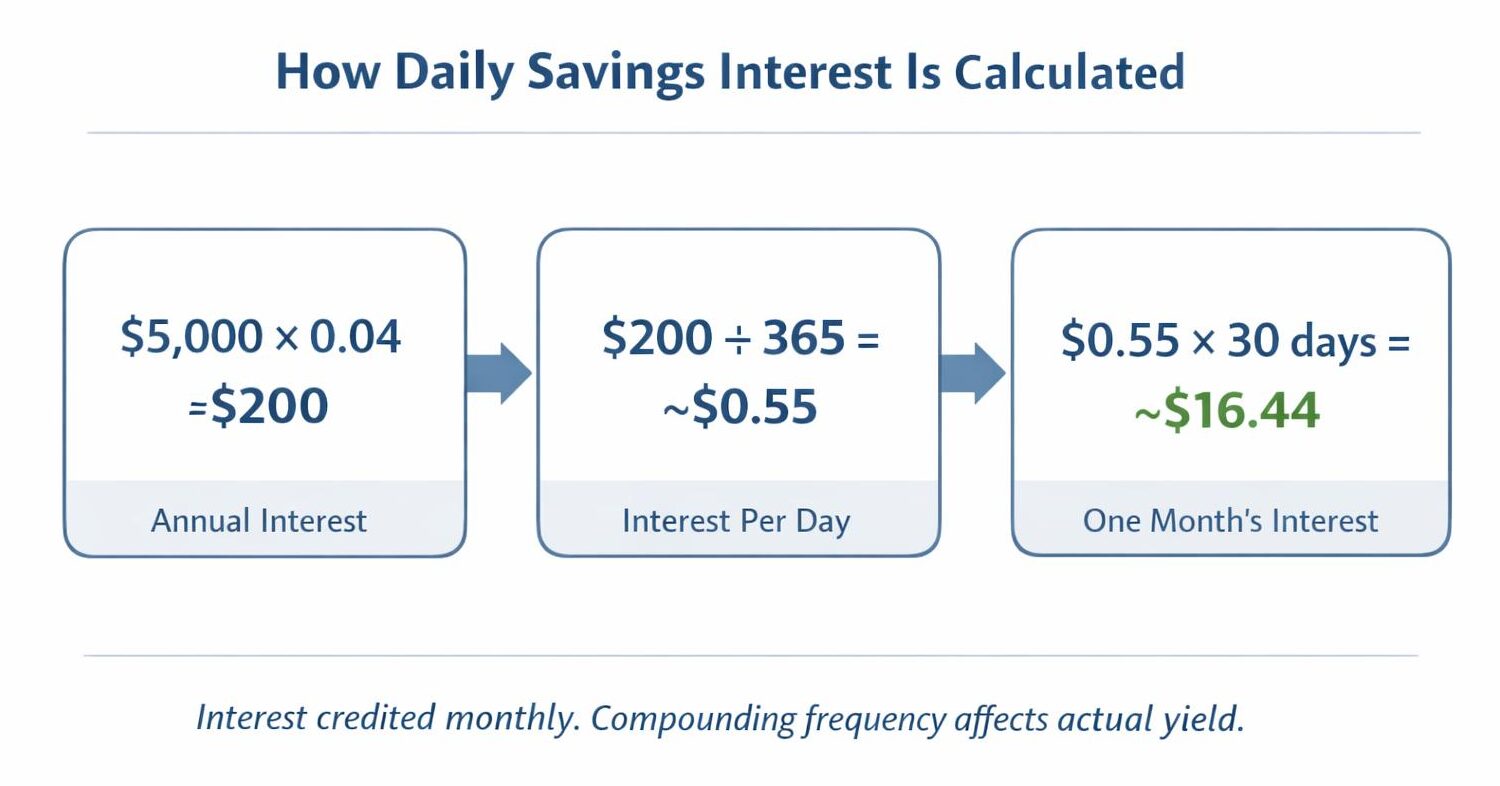
For example, if you have a balance of $5,000 and an annual interest rate of 4%, the daily interest calculation would look like this:
- $5,000 multiplied by 0.04 equals $200 in annual interest
- $200 divided by 365 equals approximately $0.55 in interest per day
Over a 30-day month, that would add up to roughly $16.44 before compounding effects are applied. The actual amount credited to your account each month will vary slightly depending on how many days are in that month and whether your balance changed during the period.
What Compounding Actually Does to Your Balance
Source: Mooloo Graphics
Compounding is the process of earning interest on interest that has already been added to your account. It is one of the more important concepts in personal savings because it means your balance can grow faster over time than a simple interest calculation would suggest.
How often interest compounds depends on the bank. Common compounding frequencies for savings accounts include daily, monthly, and quarterly. Daily compounding means that each day’s interest is added to your balance before the next day’s interest is calculated, so your effective earning base grows slightly each day. Monthly compounding adds the full month’s interest at once, and that larger balance then becomes the basis for the next month’s calculation.
The difference between daily and monthly compounding on a typical savings account balance is small in absolute dollar terms, especially at lower interest rates. However, over longer periods and with larger balances, more frequent compounding does produce a measurably higher return. This is precisely why APY exists as a standardized disclosure as it allows you to compare accounts with different compounding frequencies on equal footing.
How Your Balance Affects the Calculation
Banks generally calculate your daily interest based on your end-of-day balance, meaning the amount in your account at the close of each business day. If you deposit money partway through the month, you begin earning interest on that larger amount from the day the deposit is processed and reflected in your balance.
The reverse is also true. If you withdraw funds, your earning base shrinks from that point forward. This is worth keeping in mind if you move money in and out of a savings account regularly, since your interest earnings for any given month will reflect your actual balance history across all those days, not just the balance at the start or end of the period.
Some accounts have tiered interest structures, where different portions of your balance earn at different rates. A bank might pay one rate on balances up to a certain threshold and a different rate on amounts above that threshold. Reading the rate disclosure carefully helps you understand which structure applies to your account.
Minimum Balance Requirements and Their Effect
Some savings accounts require you to maintain a minimum balance to earn the advertised rate or to avoid fees. If your balance falls below the required threshold, the bank may apply a lower interest rate, charge a monthly fee, or both. Either outcome reduces the net return on your savings.
This is a practical consideration that is easy to overlook when comparing accounts purely by APY. An account with a higher advertised rate but a strict minimum balance requirement may produce a lower net return than an account with a slightly lower rate and no minimum, depending on your typical account balance.
Taxes on Savings Account Interest
Interest earned in a regular savings account is generally considered taxable income by the Internal Revenue Service. Banks are required to report interest payments to the IRS and typically issue a Form 1099-INT to account holders who earn interest above the reporting threshold in a given tax year. Even if you do not receive a 1099-INT, any interest income you earn is generally still reportable on your federal tax return.
The tax treatment of savings account interest is worth factoring in when you evaluate returns. For example, if you earn $200 in interest during a year, the portion you keep after taxes will depend on your marginal federal income tax rate and whether your state also taxes interest income. State tax treatment varies, so it is worth checking the rules where you live.
A standard savings account, including high-yield savings accounts at online banks, does not offer tax deferral on interest. Certain tax-advantaged account structures treat interest differently, but those are separate products with their own rules and restrictions.
High-Yield Savings Accounts and Rate Variability
High-yield savings accounts work the same way as standard savings accounts in terms of how interest is calculated. The distinction is in the rate offered, which is often meaningfully higher at online banks and credit unions than at traditional brick-and-mortar institutions, largely because online banks carry lower overhead costs.
One aspect of savings account rates that is easy to overlook is that they are variable. Banks can change the interest rate on a savings account at any time, and they frequently do in response to shifts in the federal funds rate set by the Federal Reserve. A rate that looks attractive when you open an account may be adjusted up or down over time. This is fundamentally different from a certificate of deposit, which locks in a rate for a fixed term.
Checking the current rate on your account periodically is a reasonable habit, particularly when broader interest rate conditions are changing. What institutions offer competitively today may shift, and comparing your current account against alternatives from time to time is a straightforward way to make sure your savings are working as effectively as they can.
Practical Ways to Maximize Interest Earnings
A few practical habits can help you get more from a savings account once you understand how interest is calculated:
- Keep your balance as consistent and high as your financial situation allows, since interest accumulates on whatever balance the bank records each day
- Compare accounts using APY rather than the stated interest rate, since APY accounts for compounding frequency
- Check whether an account has minimum balance requirements that could reduce your effective rate or result in fees
- Be aware that rates can change, so reviewing your account’s current rate occasionally makes sense
- Account for taxes when estimating net returns, since after-tax yield is what you actually keep
- Understand how quickly deposits are reflected in your available balance for interest purposes, since processing times can vary between institutions
None of these steps require significant effort, but taken together they reflect a more complete understanding of how savings account interest works in practice rather than just in theory.