
Are Trust Accounts Covered by FDIC Insurance?


Trust accounts can receive FDIC insurance coverage, but the rules are more nuanced than those for standard deposit accounts, and understanding how coverage is calculated could make a significant difference if you hold substantial Trust assets at a bank.
Most people are familiar with the basic idea that the FDIC insures bank deposits up to a certain limit per depositor, per institution. What fewer people realize is that trust accounts are treated as a separate ownership category, with their own rules for calculating how much coverage applies. In fact, depending on how a trust is structured and how many beneficiaries it names, the total coverage available can be considerably higher than what a standard individual account would receive.
What FDIC Insurance Actually Does
The Federal Deposit Insurance Corporation is an independent US government agency that protects depositors if an insured bank fails. When a bank collapses, the FDIC steps in to reimburse depositors up to the applicable limits, which means account holders do not lose their money up to the insured amount even if the bank cannot pay its debts.
FDIC insurance applies to deposits at member banks, which includes the vast majority of US commercial banks and savings institutions. Credit unions are covered by a separate agency called the National Credit Union Administration, which operates on similar principles but has its own rules. Coverage applies to deposit accounts such as checking accounts, savings accounts, money market deposit accounts, and certificates of deposit. It does not apply to investment products like mutual funds, stocks, or annuities, even when those products are sold through a bank.
The standard coverage limit is set by federal law. Readers should verify the current amount directly with the FDIC, as limits can change. The https://www.fdic.gov/resources/deposit-insurance/faqFDIC website at fdic.gov publishes up-to-date figures and an online calculator called EDIE that lets you model your specific deposit situation.
How Trust Accounts Fit Into the Coverage Framework
The FDIC recognizes several ownership categories for the purpose of calculating insurance. Each category is insured separately, which means a depositor can hold multiple accounts at the same bank and receive separate coverage if those accounts fall into different ownership categories. Trust accounts form one such category – entirely distinct from individual accounts, joint accounts, retirement accounts, and business accounts.
For FDIC purposes, a trust account is a deposit account where one person or entity holds funds for the benefit of one or more other people. The person who controls the account and makes decisions is called the owner or grantor. The people entitled to receive the funds under the terms of the trust are called beneficiaries. The FDIC calculates coverage based on the number of qualifying beneficiaries named in the trust, not simply on the total balance in the account.
Revocable Trusts and How Coverage Is Calculated
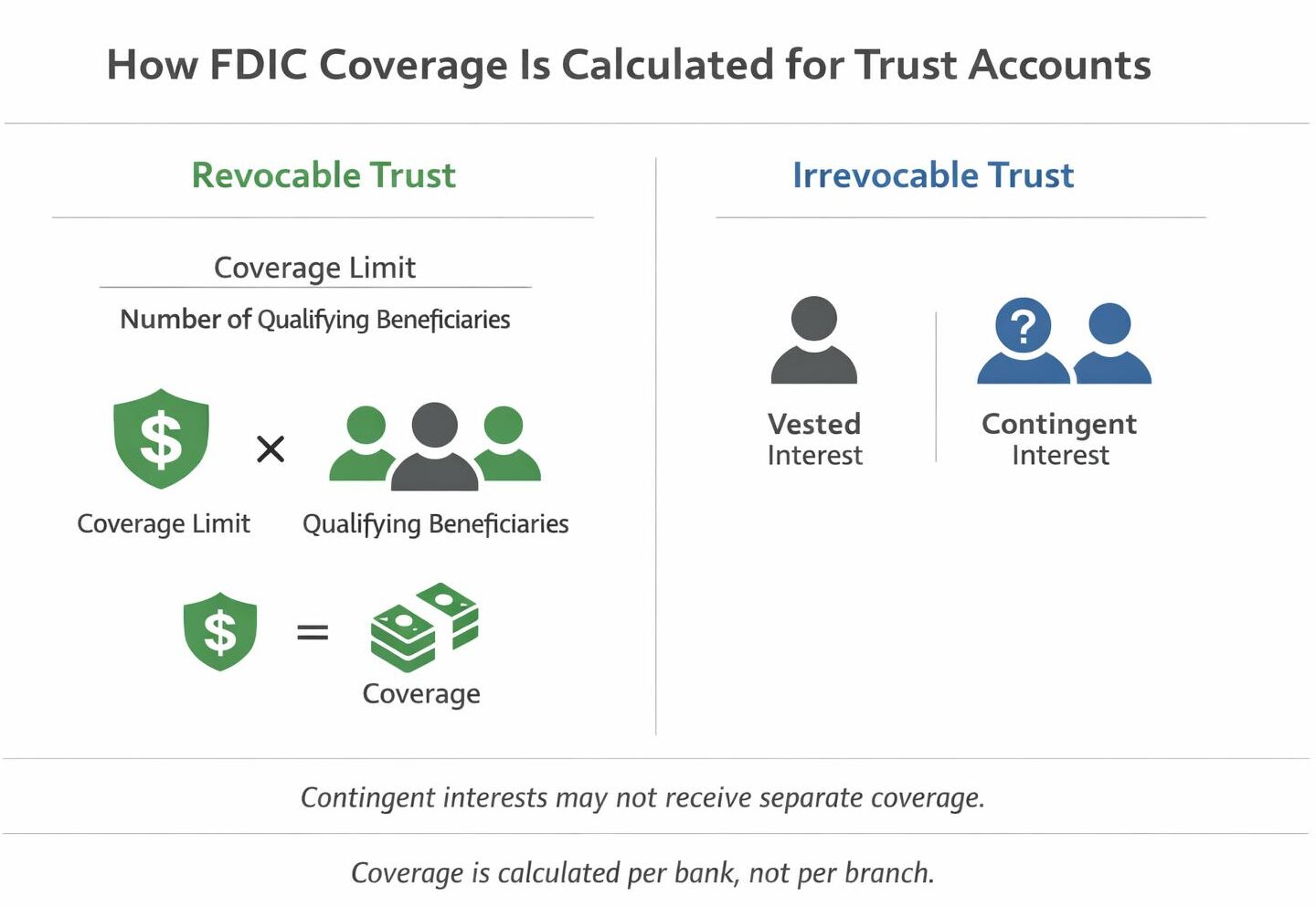
The most common type of trust account people encounter in personal banking is a revocable trust, sometimes called a living trust. Payable-on-death accounts, sometimes referred to as POD accounts, work on a similar principle and are treated the same way by the FDIC. In a revocable trust, the owner retains control over the funds during their lifetime and can change the terms or close the account at any time.
Under FDIC rules for revocable trusts, coverage is calculated by multiplying the standard per-depositor limit by the number of qualifying beneficiaries, up to a certain threshold. For example, if a trust names five beneficiaries and the standard coverage limit is $250,000, the account could potentially be insured for up to $1,250,000 at a single bank. This formula can make revocable trust accounts a practical consideration for people who want to keep large deposits at one institution without exceeding insured limits.
A qualifying beneficiary under FDIC rules is generally a living person, a charity, or a non-profit organization. Not every named beneficiary automatically qualifies. Contingent beneficiaries, meaning people who would only receive funds if the primary beneficiary has already died, may not count toward the coverage calculation depending on how the trust is structured. These rules are detailed, and getting them right matters if you are relying on elevated coverage.
Irrevocable Trusts and Different Rules
Irrevocable trusts follow a different set of FDIC rules. An irrevocable trust is one whose terms generally cannot be changed once established, and the grantor typically gives up direct control over the assets. These trusts are commonly used in estate planning, asset protection strategies, and charitable giving arrangements.
For irrevocable trusts, the FDIC looks at each beneficiary’s interest in the trust rather than simply counting beneficiaries. Each beneficiary’s interest is insured separately up to the standard limit, provided that interest is non-contingent, meaning it does not depend on a future event or condition. If a beneficiary’s interest is contingent, the FDIC may aggregate all contingent interests and treat them as a single insured amount rather than insuring them separately.
This distinction between vested and contingent interests can significantly affect how much coverage is actually available. A trust with four beneficiaries where two have clearly defined interests and two only receive funds under uncertain future conditions will not be calculated the same way as a trust where all four interests are unconditional.
Practical Considerations for Account Holders
If you have a trust account at a bank, there are a few things worth understanding from a practical standpoint.
- The FDIC calculates coverage at the time of a bank failure, not at the time you open the account. If a trust is amended after an account is opened, the coverage calculation will reflect the trust’s terms as they exist at the time of the bank’s failure.
- Documentation matters. The FDIC may require proof of the trust’s terms and the identity of beneficiaries when processing a claim. Keeping clear records of the trust document and any amendments can simplify the process if a claim ever needs to be made.
- Coverage is calculated per institution, not per branch or per account. If you hold multiple trust accounts at the same bank, the FDIC combines them when calculating whether you have exceeded the insured limit for that ownership category at that institution.
- Holding trust accounts at multiple FDIC-insured institutions provides separate coverage at each, since the limits apply per institution rather than across all accounts nationwide.
- Some banks may require trust accounts to be titled in a specific way to qualify for trust coverage. Confirming the requirements with the bank before opening an account can help ensure it is set up correctly.
Where Things Can Get Complicated
The rules around FDIC coverage for trust accounts have evolved over the years, and the FDIC has updated its regulations to simplify some calculations. However, edge cases still arise. Complex trusts with layered beneficiary arrangements, special needs trusts, trusts for minors, and trusts that hold funds for entities rather than individuals can all raise questions about how coverage applies.
One area that sometimes catches people off guard is the interaction between trust coverage and individual coverage at the same bank. Because these are treated as separate ownership categories, funds in individual accounts and funds in trust accounts can each receive separate coverage. A married couple who each hold individual accounts and also share a revocable trust could potentially have access to substantially more total coverage than a single depositor with only individual accounts, depending on how everything is structured.
The FDIC’s rules, while detailed, are not always straightforward to apply without reviewing the specific trust document. If there is any uncertainty about how your trust account is structured or how much coverage it currently carries, the FDIC’s EDIE calculator and its published deposit insurance guides are good starting points. For trusts involving significant assets, speaking with a trust attorney or a financial professional familiar with deposit insurance rules can also help clarify the picture.
Verifying Your Coverage
The FDIC makes its coverage rules publicly available and provides tools to help depositors understand their situation. The EDIE calculator at fdic.gov allows you to enter details about your accounts and receive an estimate of your current coverage. The FDIC also publishes detailed guidance on trust account coverage that explains how different trust structures are treated.
Because insurance limits, regulations, and FDIC policies can change, relying on current official sources rather than outdated summaries is the most reliable approach. If you have questions specific to a trust arrangement, contacting the FDIC directly by phone is an option, as the agency provides assistance to depositors who want to understand how their accounts would be treated.