What Is an Earned Income Tax Credit?


The Earned Income Tax Credit is one of the largest federal tax benefits available to working Americans with low to moderate incomes, yet millions of eligible people miss out on it every year simply because they are not aware they qualify.
The Earned Income Tax Credit (EITC) is a refundable federal tax credit for qualifying U.S. workers with low to moderate earned income. Unlike a deduction, it reduces federal income tax dollar for dollar and can generate a refund even when the credit exceeds the tax you owe.
What the Earned Income Tax Credit Actually Does
Understanding how the EITC works, who qualifies, and how it affects your tax return can make a meaningful difference to your finances. Unlike a tax deduction, which reduces the amount of income subject to tax, a tax credit directly reduces the amount of tax you owe. The Earned Income Tax Credit is also refundable, which means that if the credit exceeds your tax bill, you may actually receive the difference as a refund.
A tax credit reduces your tax liability dollar for dollar. For example, if you owe $1,000 in federal income tax and you qualify for a $1,500 credit, your liability drops to zero. With a refundable credit, the remaining $500 would come back to you as a refund rather than simply disappearing.
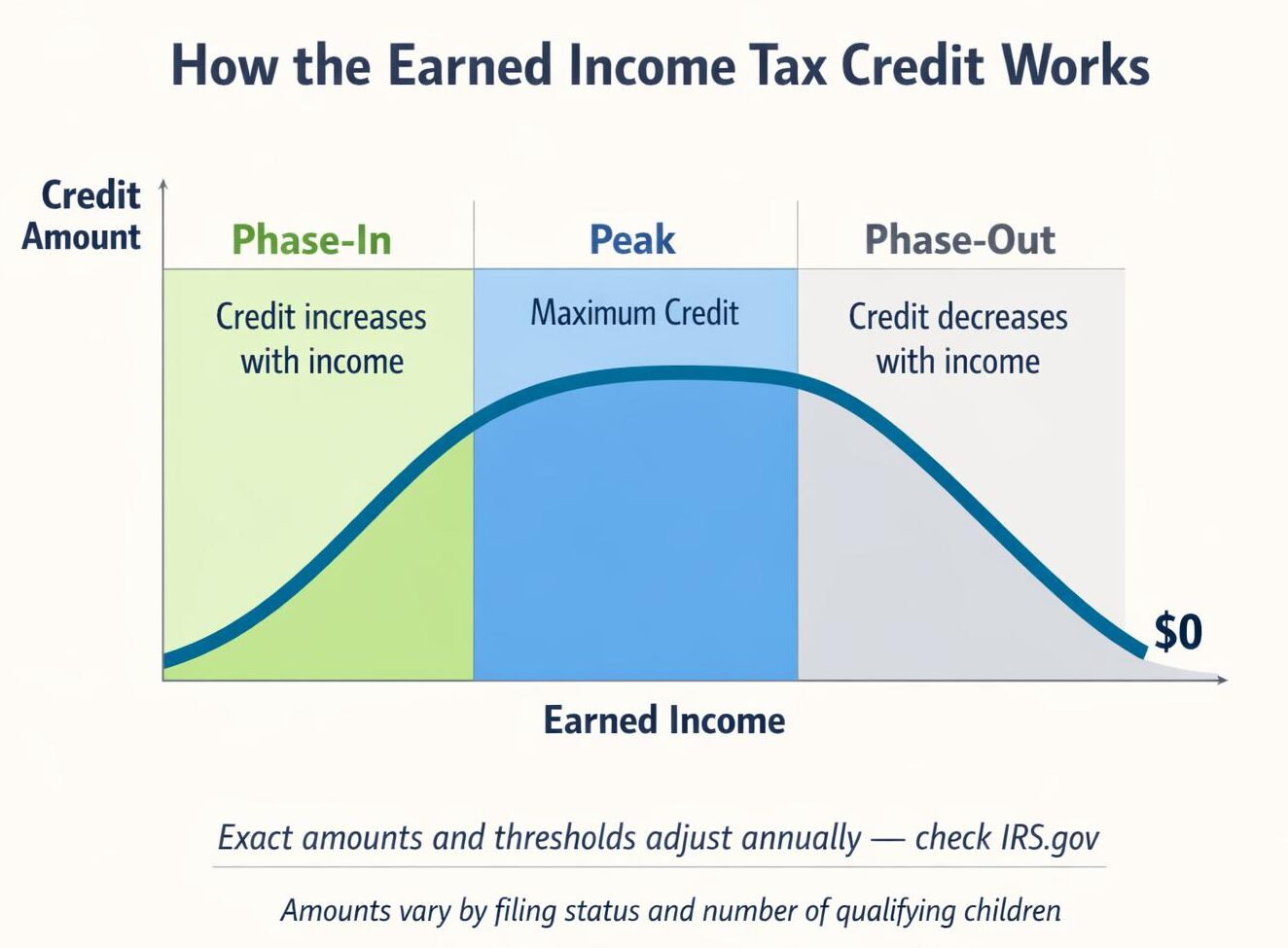
The credit was designed to encourage and reward work. It phases in as your earned income rises, reaches a maximum amount, and then gradually phases out as income increases beyond a certain threshold. This structure means the benefit is targeted at people who are working but earning below certain limits, rather than at those with no income.
What Counts as Earned Income
The word “earned” in the name is significant. The credit is based on income you receive from working, not from passive sources. Earned income generally includes wages, salaries, tips, and net self-employment income. If you run a small business or do freelance work, your net profit from that activity can count as earned income for this purpose.
While investment income does not count as earned income, but if your investment income exceeds a certain threshold in a given year, you may become ineligible for the credit even if your wages are otherwise within the qualifying range. The investment income limit is adjusted periodically, so verifying the current figure with the IRS or a tax professional is recommended.
Earned Income Tax Credit Eligibility Requirements
Source: Mooloo graphics
Qualifying for the Earned Income Tax Credit depends on several factors related to your income level, family situation, filing status, and other personal circumstances.
- You must have earned income from employment or self-employment during the tax year.
- Your income must fall below the applicable limit for your filing status and number of qualifying children.
- You must have a valid Social Security number, as must any qualifying child you claim.
- You must be a U.S. citizen or resident alien for the full year.
- If you do not have a qualifying child, you must meet age requirements. The age rules for this category have changed over time, so checking current IRS guidance is recommended.
- You generally cannot file as married filing separately, though tax law changes have affected this rule and it is worth confirming the current requirements each year.
- You cannot be claimed as a dependent on someone else’s return.
Income thresholds and maximum credit amounts are adjusted each year for inflation. Because these figures change annually, the IRS publishes updated numbers each tax season, and tax preparation software typically applies the correct limits automatically. You can check your eligibility here.
How Qualifying Children Affect the Credit
The presence of qualifying children in your household significantly affects both the income thresholds and the size of the credit you may receive. A taxpayer with three or more qualifying children may be eligible for a substantially larger credit than someone without children, and the income level at which the credit phases out completely is also higher.
A qualifying child must meet several tests. The child must be related to you in an eligible way, such as a son, daughter, stepchild, or sibling. The child must be under a certain age at the end of the tax year, or any age if permanently and totally disabled. The child must have lived with you in the United States for more than half the year and must have a valid Social Security number.
The same child cannot be claimed by two different taxpayers for this credit in the same year. If parents are separated or divorced, only the parent with whom the child lived for the greater portion of the year is generally eligible to claim the child for the Earned Income Tax Credit. This rule differs from the one that governs claiming a child as a dependent, which can sometimes cause confusion. You will need to complete Schedule EIC if you are claiming the credit with qualifying children.
The Credit for Workers Without Children
People without qualifying children can still claim the Earned Income Tax Credit if their income falls below the applicable limit. The credit amount in this situation is considerably smaller than what families with children may receive, and the income range over which the credit is available is narrower. It still provides a real benefit for eligible workers, however, and is worth claiming if you qualify.
Tax legislation has expanded eligibility for this group at various points, including changes to age eligibility and the credit amount available to childless workers. Because these rules have shifted over time, checking current IRS guidance for the tax year you are filing is the most reliable approach.
How the Credit Is Calculated
The credit is not a flat percentage of your income. It increases as earned income rises until it reaches a maximum amount, remains at that level across a range of income, and then gradually decreases as income rises further. Once income passes the applicable phase-out threshold for your filing status and number of children, the credit reaches zero.
For self-employed individuals, the calculation uses net self-employment earnings after deducting the deductible portion of self-employment tax. This can make the calculation slightly more involved, though tax software handles it automatically.
Claiming the Credit
You claim the Earned Income Tax Credit by filing a federal income tax return, even if your income is low enough that you would not otherwise be required to file. If you are eligible and do not file, you will not receive the credit. For many people at lower income levels, filing a return specifically to claim this credit is worthwhile.
By law, the IRS cannot issue refunds that include the Earned Income Tax Credit before mid-February. This delay allows time for fraud screening. If you are counting on a refund that includes this credit, it is useful to account for this timing when planning your finances.
Common Errors and Audit Considerations
The Earned Income Tax Credit has historically had a higher error rate than many other parts of the tax return, partly because the eligibility rules are detailed and partly because some filers claim the credit incorrectly. The IRS pays particular attention to EITC claims as a result.
Common mistakes include claiming a child who does not meet the residency or relationship tests, misreporting self-employment income, and filing with an incorrect Social Security number. If the IRS reviews your EITC claim and denies it due to reckless or intentional disregard of the rules, you may be barred from claiming the credit for a number of years. For more information on the intent and requirements of IRS notices, check IRS Notices Explained.com.
Careful record-keeping can help if questions arise. If you claim a qualifying child, documentation showing that the child lived with you for more than half the year supports your claim. School records, medical records, and housing documentation are examples of records that may be useful.
When to Seek Further Guidance
The rules surrounding the Earned Income Tax Credit are detailed enough that many people benefit from working with a tax professional, particularly if they have self-employment income, complex household situations, or questions about whether a child qualifies. Free tax preparation assistance is available through programs such as IRS Free File and the Volunteer Income Tax Assistance program for eligible taxpayers.
Because credit amounts, income thresholds, and eligibility rules are reviewed and updated annually, any specific figures you encounter may be outdated by the time you file. The IRS website at irs.gov publishes current information each tax season and is the most reliable source for confirming the numbers that apply to your situation.