
Why Did My Credit Score Drop?


A sudden drop in your credit score can occur without any obvious warning, even when you haven’t done anything that seems like a financial mistake. The reality is credit scores are calculated using a range of factors, and even routine financial activity can cause your score to move up or down.
Understanding what drives those changes makes it easier to interpret what you’re seeing and, where necessary, take steps to address it.
How Credit Scores Are Calculated
Before getting into specific causes, it helps to understand what goes into a credit score. The most widely used scoring model in the US is the FICO score, though VantageScore is also commonly used by lenders and credit card issuers. Both models weigh similar factors, though they do so slightly differently.
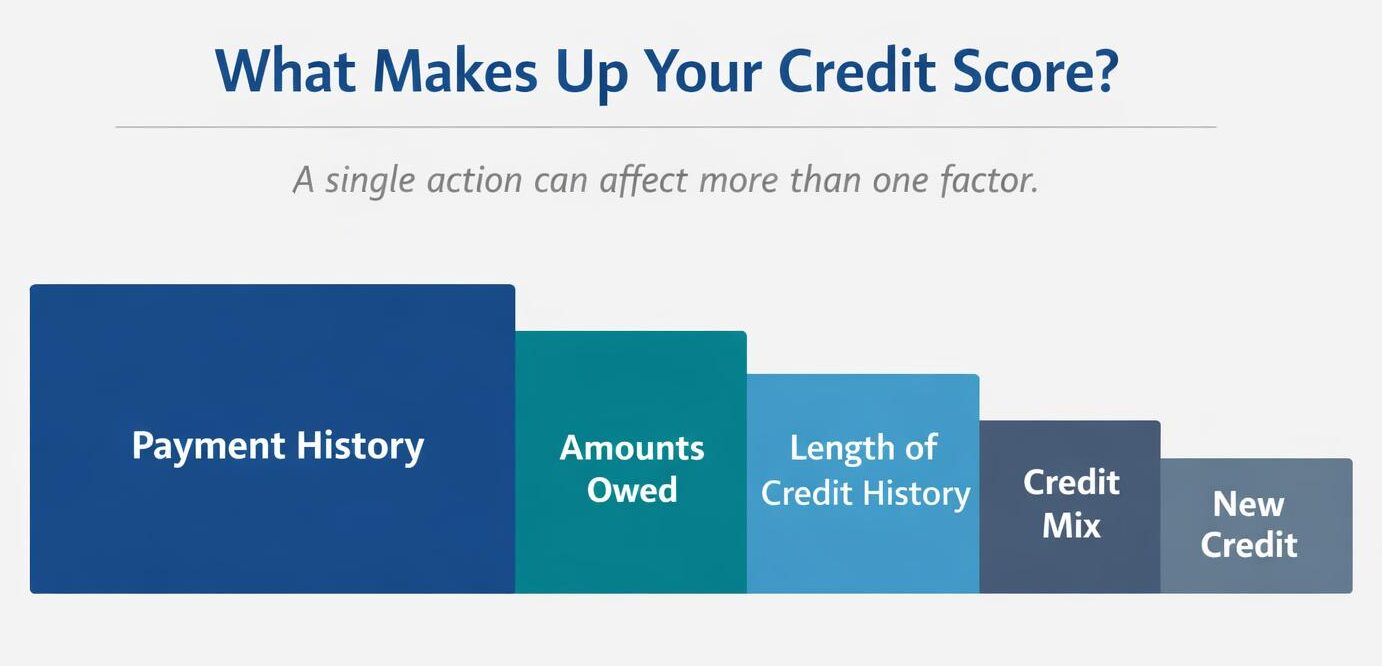
The main components of a FICO score are:
- Payment history – whether you pay bills on time (typically the largest factor)
- Amounts owed – how much of your available credit you are currently using
- Length of credit history – how long your accounts have been open
- Credit mix – the variety of credit types you have, such as cards, loans, and mortgages
- New credit – recent applications and new accounts
Because these factors interact, a single financial action can affect more than one category at once. That is why some changes to your credit profile have a larger impact than others.
You Missed a Payment or Paid Late
Payment history carries the most weight in most scoring models, so a missed or late payment is one of the most significant reasons a score can drop. Lenders typically report a payment as late once it is 30 days past due. At that point, the late payment is added to your credit report and your score can fall noticeably, with the size of the drop depending in part on where your score stood beforehand.
Counterintuitively, people with higher scores often see a larger point drop from a single late payment than people who already have lower scores. This is because a late payment is more unexpected for someone with a strong credit history.
Late payments stay on your credit report for seven years, though their impact on your score generally lessens over time as the event recedes and you build a more recent pattern of on-time payments.
Your Credit Utilization Went Up
Source: Mooloo graphics
Credit utilization refers to the percentage of your available revolving credit that you are currently using. For example, If you have a credit card with a $5,000 limit and carry a $2,500 balance, your utilization on that card is 50 percent. Scoring guidance generally suggests keeping utilization well below 30 percent, and lower utilization tends to be better for your score.
If you made a large purchase, had higher spending than usual in a given month, or your credit limit was reduced by your card issuer, your utilization ratio would rise and your score could drop as a result. This type of score change is often temporary. If you pay down the balance and utilization falls again, the score typically recovers relatively quickly, because utilization is based on your current balance rather than a running history of past balances.
You Applied for New Credit
When you apply for a new credit card, loan, or line of credit, the lender performs what is called a ‘hard inquiry’ on your credit report. Each hard inquiry can cause a small, short-term drop in your score. A single inquiry typically has a minor effect, but multiple applications in a short period can add up.
There is an exception worth knowing about. When you are shopping for a mortgage, auto loan, or student loan, most scoring models treat multiple inquiries within a certain window of time as a single inquiry, recognizing that consumers naturally compare rates before choosing a lender. The exact timeframe varies by scoring model, so it is worth checking how the model being used handles this if you are actively rate shopping.
A New Account Was Opened
Opening a new credit account can affect your score in more than one way. It introduces a hard inquiry, as mentioned above. It also lowers the average age of your credit accounts, because a brand new account brings down the overall average. This is one reason why people sometimes notice a small score drop shortly after being approved for a new card or loan, even though the new account itself adds to your available credit.
Over time, as the account ages and you maintain a positive payment history, this effect typically reverses. The impact of a new account on average age is generally more noticeable for people who have a shorter overall credit history.
An Old Account Was Closed
Closing a credit card, whether you close it yourself or the issuer closes it due to inactivity, can affect your score in two ways. First, it removes available credit, which can increase your overall utilization ratio if you carry balances on other cards. Second, if it was one of your older accounts, its eventual removal from your report may reduce the average age of your credit history.
Closed accounts in good standing typically remain on your credit report for around ten years, so the impact on average age is not immediate. The utilization effect, however, happens right away.
A Negative Item Appeared on Your Report
Sometimes a score drop happens because new negative information has been added to your credit report that you were not aware of. This could include:
- A collection account from an unpaid debt, which may have been sold to a collection agency
- A charge-off, where a lender has written off a debt as unlikely to be repaid
- A public record such as a bankruptcy
- A tax lien, depending on the scoring model and report being used
- A judgment from a civil court case
If a negative item appears that you do not recognize or believe to be inaccurate, you have the right to dispute it with the credit bureaus. Under the Fair Credit Reporting Act, bureaus are required to investigate disputes and correct or remove information that cannot be verified. You can access your credit reports from all three major bureaus at annualcreditreport.com, which is the federally authorized source for free credit report access.
Your Score May Have Changed for Technical Reasons
Occasionally, a score drop has less to do with your financial behavior and more to do with how the score is being calculated or reported. Credit scores can vary across bureaus because not all lenders report to all three. If a positive account is not being reported to a particular bureau, your score at that bureau may look different from the others.
It is also worth checking whether the score you are seeing comes from the same bureau and uses the same scoring model each time you view it. Free scores offered through apps, banks, or credit card portals sometimes use different models or different bureaus than what a lender might pull when you apply for credit. A change in score could reflect a change in which model or bureau is being used, rather than a genuine change in your credit profile.
What to Do After a Score Drop
If you notice a drop in your score, the first practical step is to check your credit reports to identify what changed. Look for new accounts you did not open, balances that seem higher than expected, or any negative items that are unfamiliar. Once you understand the cause, you can assess whether it is something that will resolve on its own over time or whether it requires action.
For utilization-related drops, paying down balances is usually the most direct path to recovery. For late payments, the best course of action is returning to consistent on-time payments and allowing time to work in your favor. For errors, filing a dispute with the relevant credit bureau is the appropriate step.
Credit scores are not static, and a single drop does not define your long-term financial profile. Most negative impacts fade over time when offset by positive ongoing behavior, and understanding the mechanics behind your score gives you a clearer picture of how to maintain and improve it over the months and years ahead.