What Is an ETF and How Does It Work?


An ETF, or exchange-traded fund, is one of the most widely used investment vehicles in the United States today. Knowing how they work will help you make more informed decisions about how you invest.
ETFs have grown significantly in popularity over the past 20 years, attracting both beginner investors and experienced portfolio managers. They offer a way to invest in a broad range of assets through a single purchase, which appeals to people who want built-in diversification without the complexity of building a portfolio from scratch. Before deciding whether ETFs belong in your investment strategy, you need to know what they are, how they trade, and what trade-offs come with using them.
The Basic Structure of an ETF
An ETF is a fund that holds a collection of assets, which might include stocks, bonds, commodities, or a mix of different securities. That fund is divided into shares, which investors can buy and sell on a stock exchange, just like shares of an individual company. When you buy one share of an ETF, you are effectively buying a small piece of everything the fund holds.
For example, an ETF that tracks the S&P 500 index holds shares in the companies that make up that index. Buying one share of that ETF gives you exposure to all of those companies at once. If the overall index rises, the value of your ETF share tends to rise alongside it. If it falls, your share value falls as well.
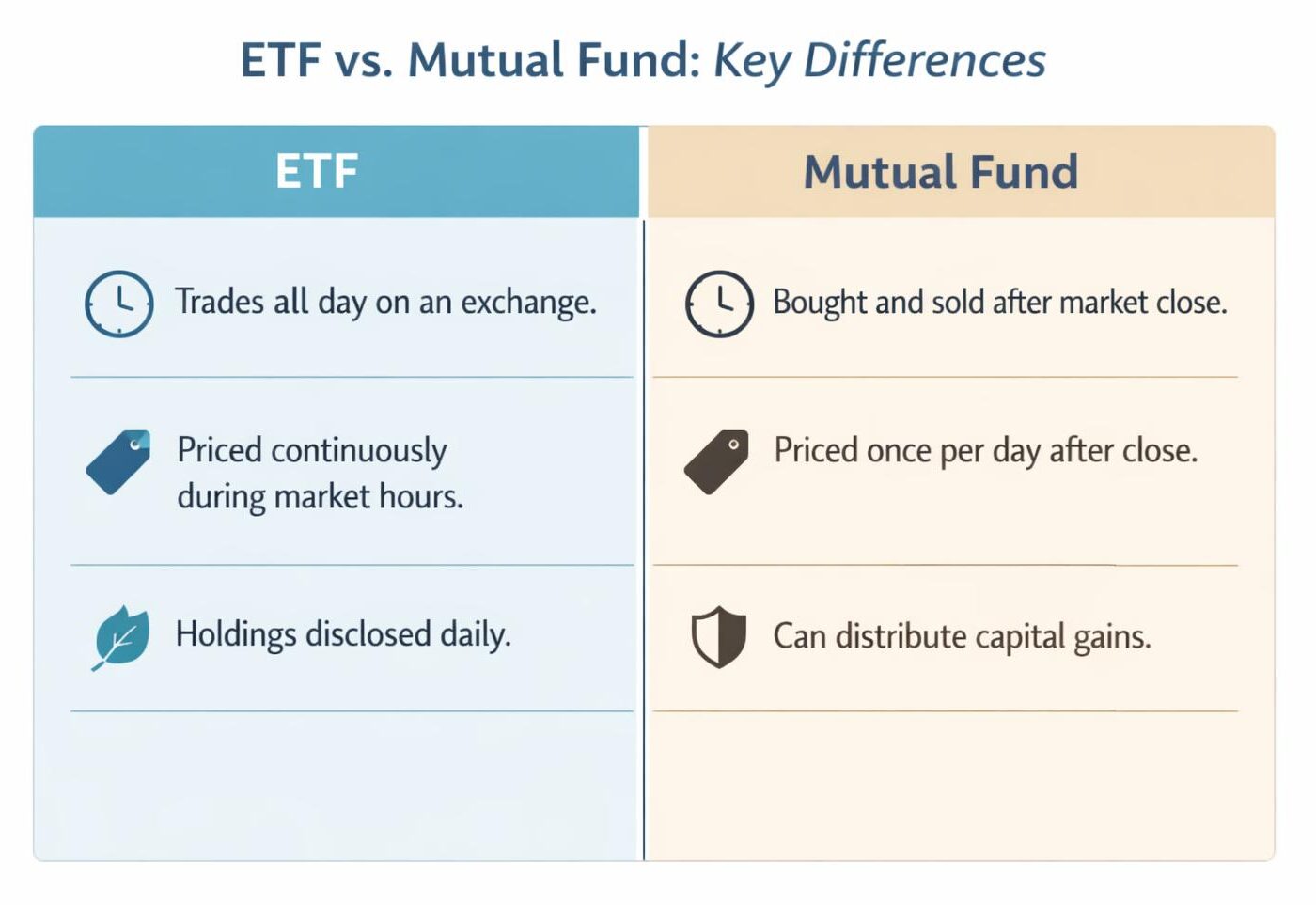
This structure is similar to a mutual fund, but there is a key difference in how the two are traded. Mutual funds are priced once per day after the market closes. ETFs, on the other hand, are priced continuously throughout the trading day and can be bought or sold at any point while the market is open.
How ETFs Are Created and Priced
The process behind ETF creation involves large financial institutions called authorized participants. These institutions work with the ETF provider to create or redeem large blocks of ETF shares, known as creation units. This mechanism helps keep the market price of an ETF close to the value of the underlying assets it holds, which is called the net asset value, or NAV.
Because ETFs trade on an exchange throughout the day, there can be small differences between the ETF’s market price and its NAV at any given moment. These differences are usually minor for large, liquid ETFs, but they can be more noticeable with smaller or less actively traded funds. Investors buying or selling during fast-moving market conditions may see slightly wider gaps between price and value. Frequently ETFs from different providers will investment in very similar portfolios – check this article for information on how to compare them. This comparison of Bitcoin ETF pricing is a great example of how much of a difference the annual fee can make to the return on ETFs all tracking the same asset.
Types of ETFs
Source: Mooloo graphics
Not all ETFs work the same way, and the variety available today covers a wide range of investment strategies and asset classes.
- Index ETFs: These track a specific market index, such as the S&P 500, the Nasdaq-100, or a bond index. They aim to replicate the performance of the index rather than beat it.
- Sector ETFs: These focus on a specific industry or sector, such as technology, healthcare, energy, or financial services. They allow investors to concentrate exposure in a particular area of the economy.
- Bond ETFs: Instead of holding stocks, these funds hold fixed-income securities such as government bonds, corporate bonds, or municipal bonds.
- International ETFs: These provide exposure to markets outside the United States, including developed markets in Europe and Asia, as well as emerging markets.
- Commodity ETFs: Some ETFs track the price of physical commodities like gold or oil, either by holding the physical asset or through futures contracts.
- Thematic ETFs: These focus on broader investment themes or trends, such as clean energy, artificial intelligence, or dividend-paying companies.
- Actively managed ETFs: Unlike index ETFs, these are managed by a portfolio manager who makes decisions about what to buy and sell, rather than simply following an index.
Costs Associated With ETFs
One of the reasons ETFs have become popular is their generally low cost structure, particularly for index-based funds. The main ongoing cost to be aware of is the expense ratio, which is the annual fee charged by the fund expressed as a percentage of your investment. This fee is deducted from the fund’s assets automatically and does not appear as a separate line item on your account statement, but it does reduce your overall return over time.
Expense ratios vary depending on the type of ETF. Broad index ETFs from major providers tend to have lower expense ratios, while actively managed funds or more specialized thematic ETFs typically charge more. It is worth comparing expense ratios when evaluating similar funds, as even small differences can compound meaningfully over many years.
There are also transaction costs to consider. When you buy or sell ETF shares through a brokerage, you may or may not pay a trading commission depending on your broker. Many major brokers in the United States now offer commission-free trading on a range of ETFs, though the specifics vary by platform and fund. There is also a bid-ask spread, which is the small difference between the price at which buyers are willing to purchase and sellers are willing to sell. This is a less visible cost but still worth factoring in, particularly if you trade frequently.
Tax Considerations
ETFs are generally considered to be tax-efficient investment vehicles compared to mutual funds, largely because of how they handle capital gains. When investors in a mutual fund redeem shares, the fund may need to sell underlying assets to meet those redemptions, which can trigger taxable capital gains that all shareholders in the fund must pay. The ETF creation and redemption process works differently, which typically allows ETF managers to avoid passing capital gains to investors as frequently.
That said, ETFs are not tax-free. When you sell your ETF shares for a profit, you will generally owe capital gains tax. The rate depends on how long you held the shares and your overall taxable income, with different rates applying to short-term gains, which are taxed as ordinary income, and long-term gains, which apply to assets held for more than one year. Dividends paid by ETFs may also be subject to tax depending on whether they are classified as qualified or ordinary dividends. Tax rules can change, so it is worth consulting current IRS guidance or a qualified tax professional before making decisions based on tax treatment alone.
Advantages and Disadvantages of ETFs
ETFs offer a number of practical benefits that have made them a common choice among investors of different experience levels.
- Diversification: A single ETF can give you exposure to a large number of securities at once, which spreads risk across many holdings rather than concentrating it in a few.
- Flexibility: Because they trade like stocks, ETFs can be bought and sold throughout the trading day, giving investors more control over when and at what price they transact.
- Transparency: Most ETFs disclose their holdings on a daily basis, so investors can see what assets they own.
- Lower cost: Index-based ETFs in particular tend to have lower expense ratios than actively managed mutual funds.
There are also some limitations and risks to keep in mind.
- Market risk: ETFs still carry the risk of the underlying assets. A stock ETF will fall in value when markets decline, and there is no guarantee of recovery within any particular time frame.
- Trading behavior: The ability to buy and sell throughout the day can encourage more frequent trading, which may work against long-term investment goals and increase transaction costs.
- Complexity in specialized funds: Some ETFs, particularly those using leverage, inverse strategies, or derivatives, are significantly more complex and carry risks that differ from straightforward index funds. These products are designed for specific purposes and have a different risk profile than standard ETFs.
- Tracking error: An ETF that aims to replicate an index may not perfectly match the index’s returns due to fees, timing differences, and other operational factors.
How ETFs Fit Into a Broader Investment Approach
ETFs can serve many different roles within a portfolio. Some investors use a small number of broad index ETFs to build a diversified, low-cost portfolio that mirrors the overall market. Others use sector or thematic ETFs to adjust their exposure to specific areas they have a view on. Bond ETFs can be used to add fixed-income exposure without purchasing individual bonds.
The right way to use ETFs depends on your own financial situation, goals, and time horizon. What works well for a long-term retirement investor may not be appropriate for someone with a shorter-term need for the funds. Understanding how ETFs are structured, what they cost, and how they behave in different market conditions puts you in a better position to evaluate whether and how they might fit into your own financial picture.