
How Much Money Do You Need to Retire?


Figuring out how much money you need to retire is one of the most common and consequential financial questions Americans face, yet there is no single correct answer that works for everyone.
Retirement savings targets depend on a wide range of factors including your expected lifestyle, where you plan to live, when you want to stop working, what other income sources you will have, and how long you might live. That complexity can make the question feel overwhelming, but there are well-established frameworks and rules of thumb that can help you think through a realistic target for your own situation.
The 4% Rule and What It Actually Means
One of the most widely referenced guidelines in retirement planning is the 4% rule. The basic idea is that if you withdraw 4% of your retirement portfolio in your first year of retirement, then adjust that amount for inflation each subsequent year, your savings have a strong historical probability of lasting at least 30 years.
Working backward from that logic gives you a useful starting estimate. If you need $50,000 per year from your portfolio to cover expenses, dividing $50,000 by 0.04 gives you a target of $1.25 million. If you need $80,000, the target becomes $2 million. The formula is straightforward: divide your expected annual spending from savings by 0.04.
It is worth understanding where this rule came from. It originated from research by financial planner William Bengen in the 1990s, based on historical stock and bond market returns. Since then, many financial researchers have since questioned whether 4% remains a safe withdrawal rate given current market conditions and longer lifespans. Some suggest a more conservative rate such as 3% or 3.5% for people retiring early or during periods of lower expected returns. Thus, the 4% rule is a useful starting point, but not a guarantee.
The 10x Salary Benchmark
Another commonly cited target comes from major retirement services companies, which suggest aiming to have saved roughly 10 times your final annual salary by the time you retire at around age 67. This benchmark is built on assumptions about Social Security income, average spending in retirement, and a roughly 30-year retirement horizon.
The 10x figure is a simplified target, and it may not reflect your situation accurately. Someone who plans to retire abroad with modest expenses might need considerably less. Someone who wants to maintain an expensive lifestyle, travel extensively, or cover significant healthcare costs might need more. These benchmarks exist to give people a rough milestone to aim for, not to replace careful planning.
How Social Security Fits Into the Picture
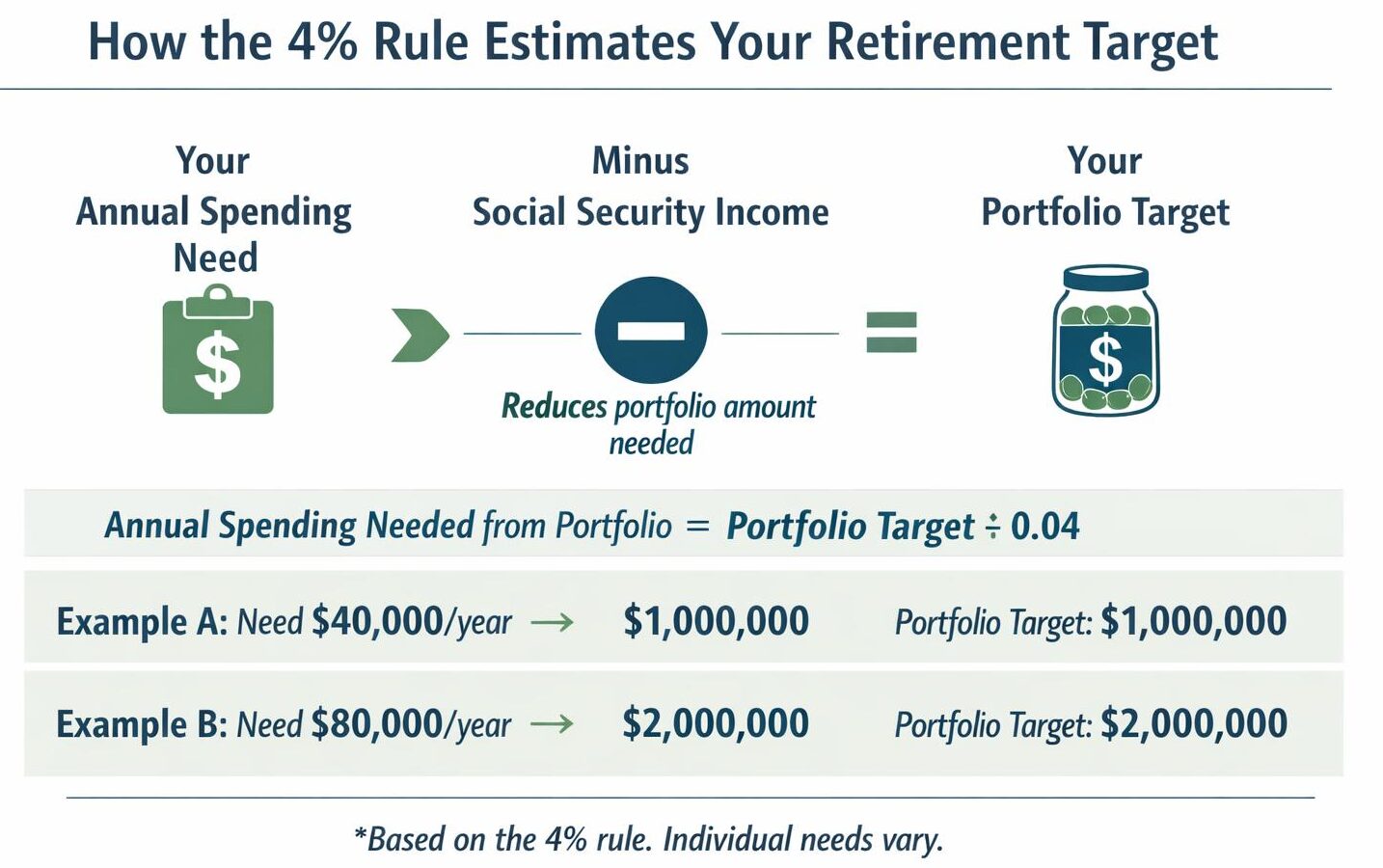
Social Security benefits play a meaningful role in most Americans’ retirement income plans, and they directly affect how much you need to save on your own. If Social Security will cover a portion of your expected expenses, you need to draw less from your personal savings each year, which reduces your required portfolio size.
For example, if you expect to need $60,000 per year in retirement and Social Security will provide $20,000 of that, you only need your portfolio to generate $40,000 annually. Using the 4% rule, that translates to a target of $1 million rather than $1.5 million.
Your estimated Social Security benefit depends on your earnings history and the age at which you claim. You can access your personal earnings record and benefit estimates through the Social Security Administration’s website at ssa.gov. Claiming before your full retirement age reduces your monthly benefit permanently, while delaying past full retirement age increases it up until age 70. These trade-offs are worth understanding carefully because the difference in lifetime income can be substantial.
Healthcare Costs Are a Major Variable
Healthcare is consistently one of the largest and most unpredictable expenses in retirement. Medicare becomes available at age 65, but it does not cover everything. Premiums, deductibles, copayments, dental care, vision, hearing, and potential long-term care costs can add up significantly over time.
Total healthcare spending in retirement varies widely depending on health status and longevity, and the amounts involved can be considerable. Planning conservatively for healthcare costs is generally considered wise, since medical costs have historically risen faster than general inflation. If you retire before age 65, you will also need to account for health insurance coverage during the years before Medicare eligibility, whether through a former employer, the ACA marketplace, or another source.
Long-term care, which includes nursing home stays or in-home assistance, represents a particularly large potential cost that many retirees underestimate. Long-term care insurance or other strategies to address this risk are worth exploring well before retirement.
The Role of Inflation in Long-Term Planning
A dollar today will not buy the same amount in 20 years. Inflation gradually erodes purchasing power, which means your retirement savings need to support not just today’s cost of living but a rising cost of living over time. Even modest inflation rates compound meaningfully across a 25- or 30-year retirement.
This is one reason why investment allocations in retirement matter. Keeping all of your savings in cash or very low-yielding accounts may feel safe, but it exposes you to the real risk of your purchasing power declining steadily over time. Most financial planning approaches assume some ongoing exposure to growth assets even during retirement to help keep pace with inflation, though the appropriate allocation depends on individual risk tolerance and time horizon.
When You Retire Matters Enormously
Retiring at 55 is a very different financial proposition than retiring at 67. An earlier retirement means a longer period your savings need to last, fewer years of contributions, more years before Social Security eligibility, and more years before Medicare coverage begins. All of these factors push your required savings target higher.
Someone retiring at 55 might need to plan for a 35- or 40-year retirement, which some financial planners suggest warrants a more conservative withdrawal rate. Someone retiring at 70 with significant Social Security income and a shorter expected drawdown period may find their required savings considerably lower by comparison.
Sequence of returns risk is another important consideration related to timing. This refers to the risk that poor investment returns in the early years of retirement can permanently impair a portfolio’s long-term sustainability, even if average returns over the full retirement period appear reasonable. Retiring into a significant market downturn can be considerably more damaging than retiring during a period of strong returns, even when both retirees experience similar average annual returns over 20 years.
Building Toward Your Target
Understanding where you stand relative to a retirement savings goal is more useful than simply knowing the goal in isolation. Common savings vehicles in the US include 401(k) and 403(b) plans offered through employers, traditional and Roth IRAs, and for self-employed individuals, plans such as SEP-IRAs or Solo 401(k)s. Each has different contribution limits, tax treatment, and withdrawal rules that affect how you should think about building and eventually drawing down your savings.
Contribution limits and income thresholds for these accounts are adjusted periodically, so checking current limits through the IRS website or a reliable financial resource is worthwhile each year. Taking full advantage of employer matching contributions in a workplace plan is widely considered one of the most straightforward ways to accelerate savings growth, since matched contributions represent an immediate addition to your balance before any investment return is earned.
Practical Ways to Estimate Your Own Number
Rather than relying solely on generic rules of thumb, working through a more personalized estimate tends to produce a more useful target. A few steps that can help include:
- Estimating your expected annual spending in retirement, either by projecting your current spending forward or by building a detailed budget based on your planned lifestyle
- Subtracting any reliable income sources such as Social Security, pension income, or rental income to find the amount your portfolio needs to cover each year
- Applying a withdrawal rate assumption such as 3.5% or 4% to that annual shortfall to arrive at a portfolio target
- Factoring in healthcare costs separately, including potential long-term care needs
- Adjusting for your planned retirement age and expected retirement length
- Revisiting the estimate every few years as your circumstances, savings balance, and life plans evolve
Online retirement calculators from major financial institutions can also help you model different scenarios. These tools tend to be more useful when you input your own specific figures rather than rely on default assumptions, since those defaults may not reflect your actual plans or situation.
There Is a Range, Not a Single Number
Retirement savings targets are best understood as a range rather than a precise figure. Someone with modest spending, a paid-off home, meaningful Social Security benefits, and good health might retire comfortably on considerably less than headline benchmarks suggest. Someone with high fixed expenses, significant healthcare needs, or ambitious lifestyle goals may need substantially more.
What the various benchmarks and rules of thumb offer is a structured way to think through the problem. Starting with a reasonable estimate, tracking progress over time, and adjusting as circumstances change is a more practical approach than either avoiding the question entirely or expecting a single formula to deliver a definitive answer.