What Is the Difference Between Checking and Savings Accounts?


Checking and savings accounts are both offered by banks and credit unions, but they serve genuinely different purposes and work in quite different ways. Understanding those differences matters more than it might seem.
Choosing the right account for the right purpose can affect how easily you access your money, how much interest you earn, and whether you run into fees or restrictions you were not expecting. This guide explains how each account type works, what sets them apart, and how most people use them together.
What a Checking Account Is Designed For
A checking account is built around frequent, everyday transactions. It is the type of account you use to pay bills, receive direct deposits from an employer, make purchases with a debit card, withdraw cash from an ATM, and write checks. The defining feature is that money flows in and out regularly, sometimes many times each month.
Banks and credit unions generally do not place limits on how many withdrawals or transfers you can make from a checking account each month. You can spend from it as often as you need without triggering fees or penalties related to transaction volume. That flexibility is the whole point.
In exchange for that accessibility, checking accounts typically pay little to no interest on the balance you hold. Some accounts pay a small amount, and certain high-yield checking accounts offer more competitive rates, but the average standard checking account earns very little. The account is optimized for access, not for growing your money.
Common features of checking accounts include:
- A debit card linked directly to the account balance
- Online bill pay tools
- Direct deposit compatibility
- Access to ATM networks
- Paper or electronic check-writing ability
- Overdraft options, which allow transactions to go through even when the balance is low, though fees may apply
What a Savings Account Is Designed For
A savings account is meant to hold money you are not spending right away. The structure of the account encourages you to leave funds in place rather than draw on them constantly. In return for keeping a balance, the bank pays you interest over time.
Interest rates on savings accounts vary considerably between institutions and change with broader economic conditions. Traditional savings accounts at large banks have historically offered modest rates, while online banks and high-yield savings accounts have offered more competitive rates during certain periods. Because rates shift over time, it is worth comparing current offers rather than assuming any particular rate will remain stable.
Savings accounts are commonly used for:
- Emergency funds, meaning money set aside to cover unexpected expenses like car repairs or medical bills
- Short-term savings goals such as a vacation, a home purchase down payment, or a major purchase
- Holding money you do not need immediately but want to keep accessible
One practical detail is that savings accounts have historically come with federal limits on certain types of outgoing transfers or withdrawals per month. A Federal Reserve rule known as Regulation D previously set a cap of six such transactions per statement cycle. The Federal Reserve suspended that limit in 2020, but many banks still apply their own restrictions or charge fees above a certain number of withdrawals. If you plan to transfer from a savings account frequently, it is worth checking your bank’s current policy.
The Core Differences Side by Side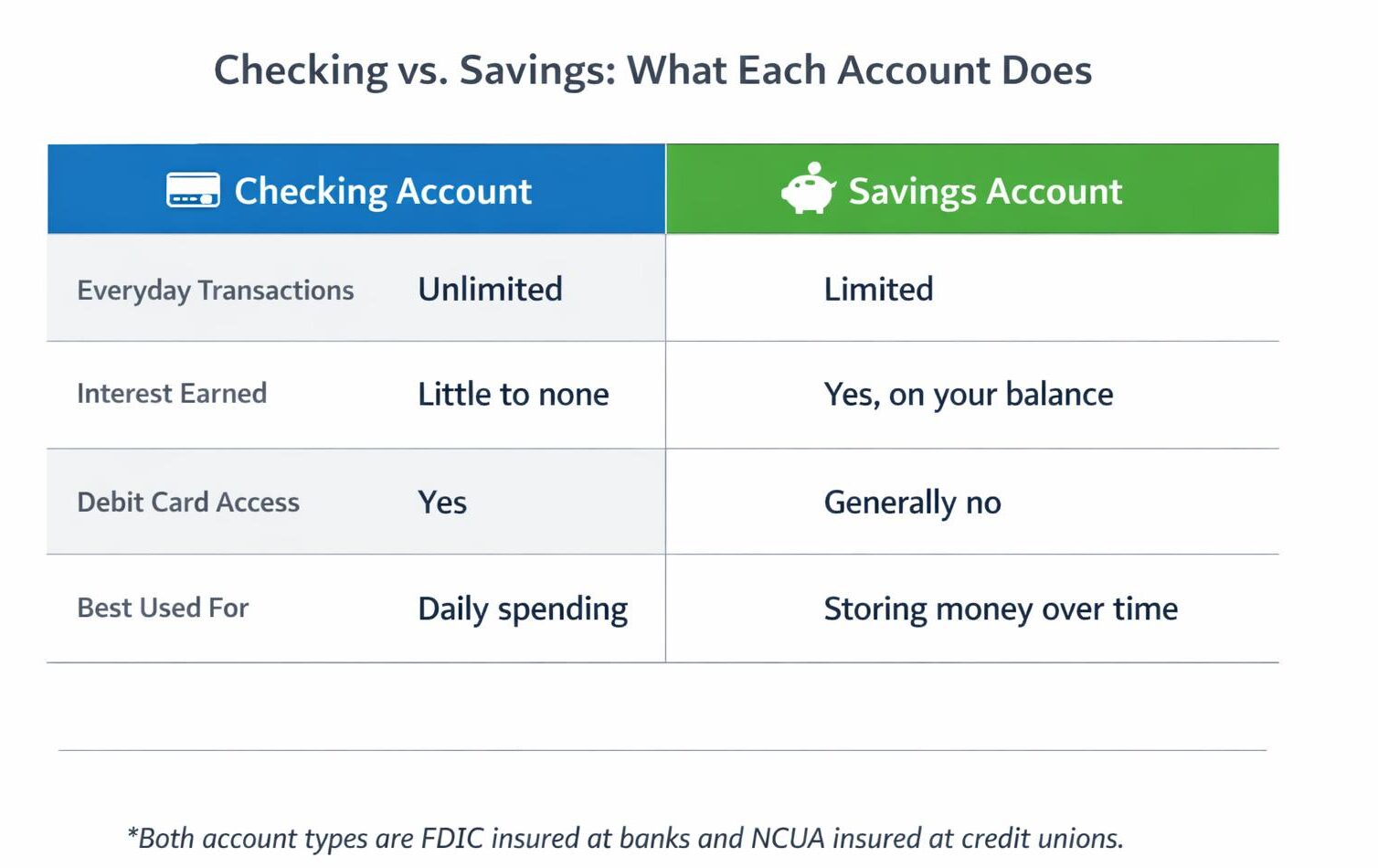
Both account types are insured by the FDIC at banks or the NCUA at credit unions up to standard coverage limits, but their day-to-day mechanics differ in important ways. Here is a straightforward comparison of the key distinctions:
- Transaction frequency: Checking accounts allow unlimited everyday transactions. Savings accounts are intended for occasional deposits and limited withdrawals.
- Interest earnings: Savings accounts pay interest on your balance. Standard checking accounts typically pay very little or none at all.
- Debit card access: Checking accounts are linked to debit cards for everyday purchases. Savings accounts generally are not used this way.
- Purpose: Checking is for spending. Savings is for storing money over time.
- Withdrawal limits: Checking accounts have no standard transaction limits. Savings accounts may have restrictions depending on the institution.
How the Two Accounts Work Together
Most people benefit from having both types of accounts and using them for their intended purposes. A common approach is to receive income into a checking account, pay regular expenses from it, and transfer a portion to a savings account on a regular schedule.
For example, someone might set up an automatic transfer from their checking account to their savings account each time they get paid. This makes saving a built-in habit rather than something that happens only when money is left over at the end of the month. The checking account handles daily spending, while the savings account steadily accumulates a balance in the background.
This separation also provides a practical buffer. When spending money and saved money sit in the same account, it can be easy to spend what you intended to save. Keeping them in separate accounts creates a mild but useful psychological barrier.
Fees and Minimums to Be Aware Of
Both account types can come with fees, though fee structures vary widely. Some common ones to look out for include:
- Monthly maintenance fees: Some banks charge a flat fee each month unless you maintain a minimum balance or meet other requirements such as having a qualifying direct deposit.
- Minimum balance fees: Falling below a required minimum balance can trigger fees on either type of account.
- Overdraft fees: On checking accounts, spending more than your available balance can result in fees, though many banks now offer overdraft protection programs or have reduced these charges in recent years.
- Excessive transaction fees: On savings accounts, making more than the allowed number of withdrawals per month may result in fees at some institutions.
Many banks, particularly online banks, offer checking and savings accounts with no monthly fees and no minimum balance requirements. Comparing options before opening an account is worthwhile, especially if you are working with a limited balance.
Alternatives Worth Knowing About
Beyond standard checking and savings accounts, there are a few related products that sometimes come up in this context.
A money market account sits somewhere between a savings and checking account. It typically earns interest like a savings account but may also come with a debit card or check-writing ability. These accounts often require higher minimum balances and may still have transaction limits. They can be a reasonable option for someone who wants to earn interest but also wants occasional direct access to funds.
Certificates of deposit, or CDs, are another savings option. With a CD, you agree to leave a sum of money deposited for a fixed period, such as six months or two years, in exchange for a fixed interest rate. The trade-off is reduced flexibility. Withdrawing money before the term ends typically results in an early withdrawal penalty. CDs are generally not suitable as a place for emergency funds or money you might need on short notice.
High-yield savings accounts, offered mainly by online banks, function like standard savings accounts but often pay noticeably higher interest rates. They are FDIC insured in the same way as traditional savings accounts and generally have no special restrictions beyond standard savings account rules. For money you are setting aside and do not need to access frequently, a high-yield savings account is worth considering.
Choosing Based on Your Situation
There is no universal answer for which account is better because they are not interchangeable tools. A checking account without a savings account means your money is always exposed to everyday spending decisions. A savings account without a checking account creates friction every time you need to pay a bill or make a purchase.
When evaluating any account, useful questions to ask include whether there are monthly fees and how to avoid them, what interest rate the account currently pays, how easy it is to transfer money between accounts, and whether the bank’s ATM network and digital tools meet your needs. Account terms and interest rates can change, so it is always worth reviewing the current details directly with the institution before opening an account.